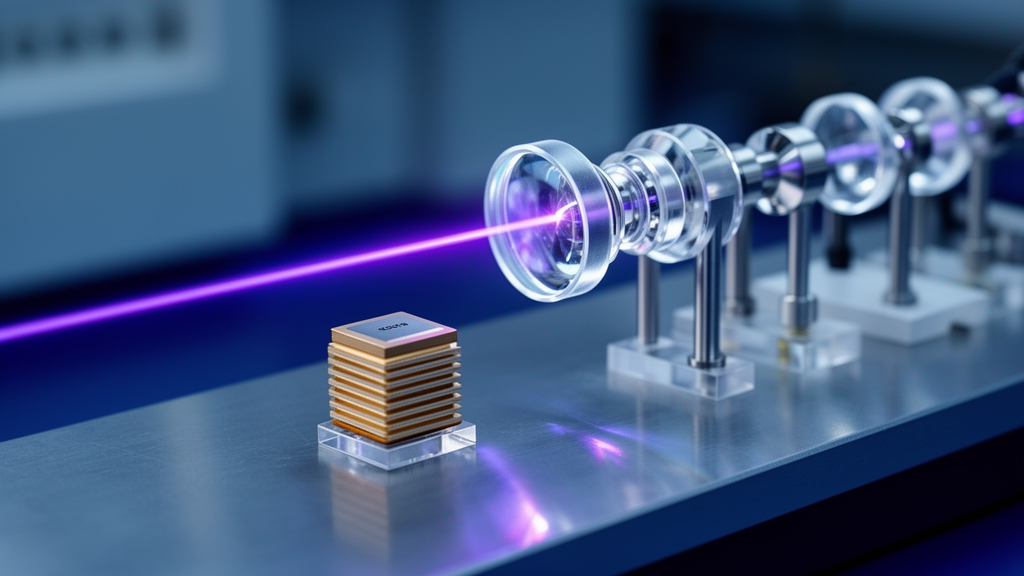
A photonic integrated blue laser operating at 461 nanometres has combined a linewidth below 30 kilohertz with electrically controlled frequency tuning, according to a study published in Nature Photonics. The device delivered more than 1 milliwatt of optical output and supported mode-hop-free linear frequency chirps of up to 900 megahertz at repetition rates as high as 1 megahertz, with tuning nonlinearity below 2%. Monolithic aluminium nitride piezoelectric actuators changed the refractive index of the photonic circuit to tune the laser frequency.
The researchers also used the laser for proof-of-principle underwater communication and a qualitative demonstration of coherent aerosol sensing. Frequency-agile lasers in the ultraviolet-to-blue spectral range of 360–480 nanometres are needed for technologies including free-space and underwater optical communications, optical atomic clocks and quantum computing based on Rydberg atoms. Integrated lasers can offer compact and robust sources at these wavelengths, but remain difficult to realize in the blue range.
The research team used hybrid integration to combine a gallium-nitride Fabry–Perot laser diode with a low-loss silicon-nitride photonic circuit. The gain chip was self-injection locked to a high-quality-factor microresonator, while the silicon-nitride waveguides had a propagation loss of approximately 0.4 decibels per centimetre. The laser architecture had to meet several specifications at once: operation in the blue, low phase noise, useful output power, rapid tuning and highly linear frequency trajectories.
The reported laser operated at 461 nanometres and maintained a linewidth below 30 kilohertz. Its frequency could be modulated through the integrated piezoelectric actuators, which acted on the refractive index of the circuit. With this configuration, the device produced mode-hop-free linear chirps spanning as much as 900 megahertz, including at repetition rates up to 1 megahertz.
The measured tuning nonlinearity remained below 2%, indicating that the actuator-controlled trajectories closely followed the intended linear ramps. The passive silicon-nitride platform was fabricated from 25-nanometre-thick films deposited by low-pressure chemical vapour deposition. Following deposition, the films were annealed at 1,200 degrees Celsius for 11 hours to remove excess hydrogen and break N–H and Si–H bonds.
Deep-ultraviolet lithography using a 248-nanometre wavelength defined the waveguide patterns, and anisotropic dry etching with CHF3 and SF6 produced clean, smooth sidewalls while minimizing polymer redeposition. A 3-micrometre-thick hydrogen-free silicon-oxide cladding was then added, and aluminium nitride actuators were fabricated directly on the photonic circuit. Light transfer between the separate gain and passive components required careful interface design.
The Fabry–Perot laser was butt-coupled to the chip through a horn-shaped taper that expanded to 3 micrometres on the laser side to improve mode matching and alignment tolerance. At the output facet, an inverse taper with a 250-nanometre tip coupled the signal into a lensed single-mode fibre. Finite-element simulations optimized both taper geometries by maximizing the mode-overlap integral while considering fabrication and alignment tolerances.
The measured coupling loss was approximately 2 decibels per facet for the laser-to-chip and chip-to-fibre interfaces. Stable long-term operation required active thermal management. Commercially procured gallium-nitride gain chips were mounted on aluminium-nitride carriers with high thermal conductivity and reduced thermal-expansion mismatch relative to the laser devices.
A thermistor die-bonded directly to the carrier monitored the assembly. The carrier was mounted on a customized copper heat sink equipped with a thermoelectric cooler, and closed-loop feedback based on the thermistor and Peltier element held the device at 20 degrees Celsius during measurements. Silicon-free thermal paste was applied at the interfaces to improve heat transfer.
A continuous nitrogen sheath was also used to mitigate facet oxidation and degradation during blue-wavelength operation; the researchers noted that sealed inert-gas packaging could provide similar environmental protection. For the communication demonstration, the team encoded information with six-level frequency-shift keying, assigning a different chirp rate to each frequency level. The complete pattern contained six vertical bits and 50 horizontal bits, which were flattened by columns into an array of 300 bins.
Each bin occupied a 3.3-microsecond time slot in a waveform repeated at 1 kilohertz. Varying the maximum voltage-ramp excursion within a slot changed the instantaneous chirp rate and therefore the corresponding frequency level. The waveform was uploaded to an arbitrary-function generator, amplified 50 times by a high-voltage amplifier and applied to the piezoelectric actuators through radio-frequency probes.
The communication test used coherent homodyne detection. The modulated optical signal was collected in fibre and divided by a 90/10 splitter. The larger share was coupled into free space, passed through a 30-centimetre water column and collected into fibre by a second collimator, while the smaller share served as a local oscillator.
The two signals were combined with a 50/50 splitter and directed to a balanced photodetector, with an oscilloscope recording the resulting beatnote. A short-time Fourier transform reconstructed the encoded pattern bin by bin. This experiment demonstrated that the integrated laser could carry a multilevel frequency-encoded signal through water, but it did not constitute a field test of a complete underwater communication system or characterize extended distances, changing water conditions or diverse link geometries.
The aerosol experiment tested coherent backscatter rather than calibrated particle measurement. Candle smoke was introduced into an approximately one-metre free-space path between the transmitter and the target. Ambient laboratory air already contained an uncontrolled background of aerosol particles that scattered blue light, while the candle smoke did not provide a uniform or well-defined concentration along the propagation path.
Under those conditions, the experiment was intended as a qualitative demonstration of scattering-induced attenuation. The beatnote amplitude associated with reflection from the target decreased by a factor of 3.2 when candle smoke was present. In the coherent heterodyne detection arrangement, that result corresponded to approximately tenfold attenuation of the returned optical field relative to the ambient-air background.
The results show a compact hybrid laser-and-photonic-circuit architecture operating with narrow linewidth, more than 1 milliwatt of output power and piezoelectrically controlled tuning. The same source produced 900-megahertz mode-hop-free chirps with tuning nonlinearity below 2%, carried a six-level encoded signal through a 30-centimetre water column and registered a measurable reduction in coherent return when candle smoke entered a roughly one-metre optical path. The scope of the reported work includes a device demonstration, a laboratory communication experiment and a qualitative aerosol-scattering demonstration rather than a calibrated aerosol sensor or an extended underwater link.
During the 12-month experimental campaign, which included active temperature stabilization and a nitrogen environment, the researchers reported no failure episodes for the gallium-nitride Fabry–Perot laser diodes or the photonic integrated circuits.
Subject of Research: Piezoelectrically tunable photonic integrated blue laser with narrow linewidth and rapid frequency tuning
Article Title: Narrow-linewidth, piezoelectrically tunable photonic integrated blue laser
Article References: Siddharth, A., Gardner, A. B., Ji, X., Hulyal, S. U., Reichler, M. S., Attanasio, A., Riemensberger, J., Bhave, S. A., Volet, N., Bianconi, S., & Kippenberg, T. J. (2026). Narrow-linewidth, piezoelectrically tunable photonic integrated blue laser. Nature Photonics. https://doi.org/10.1038/s41566-026-02040-9
Image Credits: AI Generated
DOI: 10.1038/s41566-026-02040-9
Keywords: blue laser, photonic integration, piezoelectric tuning, narrow linewidth, frequency chirp, silicon nitride, gallium nitride, underwater communication, coherent detection, aerosol sensing, Narrow-linewidth, piezoelectrically
News Source: Denise Maddox. (October 22, 2026). Piezoelectrically tunable blue laser supports 900-megahertz chirps. Scienmag.