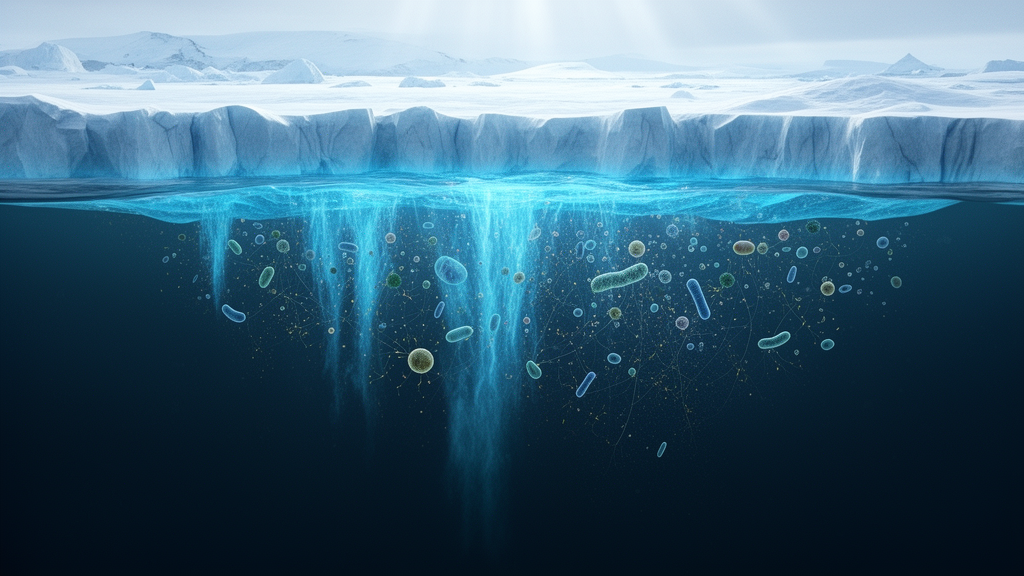
Sea-ice meltwater reduced the diversity of Antarctic prokaryotic communities and weakened their potential ecological association networks in a controlled microcosm experiment using seawater collected from the Amundsen Sea. Researchers amended communities from surface and mesopelagic layers with melted sea ice across a 0–50% dilution gradient, then assessed their responses with 16S rRNA gene sequencing and co-occurrence network analysis. The experiment found an acute laboratory response to meltwater addition, rather than a direct measurement of microbial change in the natural environment.
The study addressed the difficulty of resolving microbial responses to meltwater in situ. Meltwater signals from retreating glaciers, ice shelves and seasonal sea ice can be rapidly diluted, transported and mixed with surrounding seawater, making their biological effects difficult to distinguish directly. To examine these responses under controlled conditions, the investigators used intact microbial communities collected from two depths in the Amundsen Sea and exposed them to different proportions of melted sea ice.
Comparisons with theoretical passive-mixing expectations helped determine whether the observed changes could be explained simply by adding organisms from the sea ice. As the proportion of meltwater increased, prokaryotic diversity declined and overall community composition shifted. Opportunistic taxa, particularly Shewanella , were strongly enriched.
The increase in Shewanella was greater than passive mixing and sea-ice inoculation alone could explain, indicating that the change was not attributable solely to the transfer of sea-ice microbes into the experimental communities. In contrast, ammonia-oxidizing prokaryotes, including members of the Nitrosopumilales and Nitrosococcales, declined along the dilution gradient. Although the melted sea ice supplied ammonium, these organisms decreased as the meltwater proportion rose, suggesting that meltwater-associated environmental changes may have offset a potential stimulatory effect of ammonium availability.
Co-occurrence analysis showed a parallel contraction in the structure of the microbial association networks. With increasing meltwater addition, the networks became smaller and less connected, with reduced cohesion and fewer keystone taxa. These co-occurrence patterns represent statistical relationships that may indicate potential ecological associations; they do not by themselves demonstrate direct biological interactions or their functions.
The results nevertheless show that acute meltwater input can rapidly reorganize the diversity, composition and inferred association structure of Amundsen Sea prokaryotic communities assembled in laboratory microcosms. Particle-associated communities retained greater structural stability than free-living communities as meltwater was added, indicating that the two microbial lifestyles differed in their response. The findings are limited to the seawater communities, sampling layers, experimental design and meltwater dilution range tested, so they do not establish that the same pattern occurs throughout the Amundsen Sea or under natural mixing and transport processes.
Even so, the study offers a controlled view of how sea-ice meltwater can alter Antarctic microbial communities and weaken their potential association networks, while demonstrating the need for direct field measurements to establish responses in the ocean.
Subject of Research: Laboratory responses of Amundsen Sea prokaryotic communities to sea-ice meltwater
Article Title: Sea Ice Meltwater Alters Prokaryotic Community Structure and Interaction Networks in the Amundsen Sea, Antarctica
Article References: Choi, J., Kang, J. K., Kang, S., Kim, M. K., Lee, S. Y., Rho, A., Yun, S., Lee, W. S., & Hwang, C. Y. (2026). Sea Ice Meltwater Alters Prokaryotic Community Structure and Interaction Networks in the Amundsen Sea, Antarctica. Microbial Ecology. https://doi.org/10.1007/s00248-026-02913-0
Image Credits: AI Generated
DOI: 10.1007/s00248-026-02913-0
Keywords: Amundsen Sea, Antarctica, sea-ice meltwater, prokaryotic communities, microbial diversity, Shewanella, co-occurrence networks, 16S rRNA sequencing, microcosm experiment, ammonia oxidation, Meltwater, Alters
News Source: Drew Townsend. (October 22, 2026). Research report: Sea Ice Meltwater Alters Prokaryotic Community Structure and Interaction Networks in the Amundsen Sea, Antarctica. Scienmag.