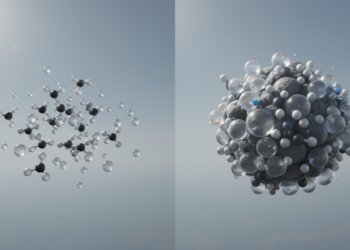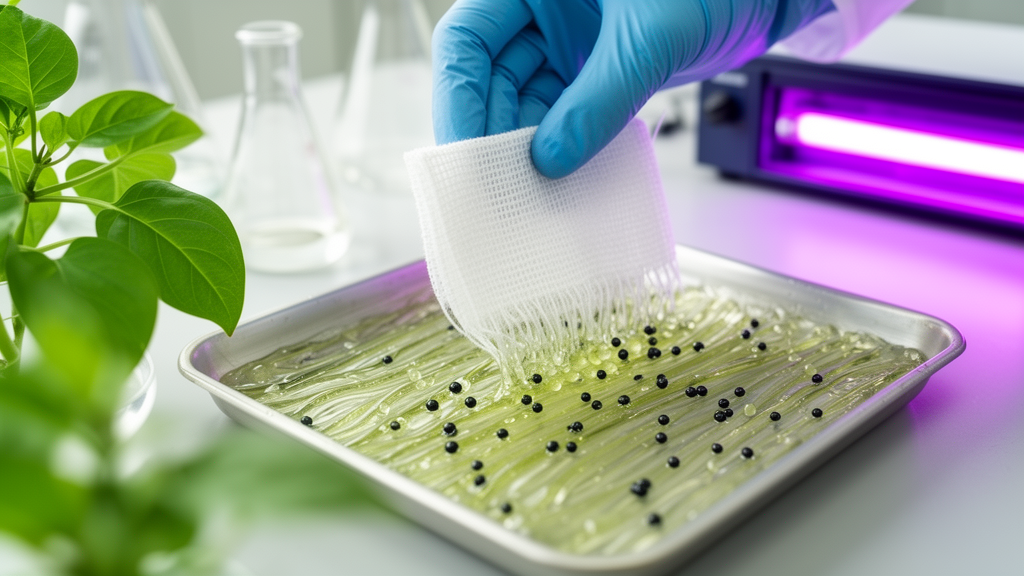
Plant-derived carbon dots incorporated into a chitosan-and-polydopamine coating gave cotton fabric antibacterial, antifungal, antioxidant and ultraviolet-protective properties in a laboratory materials study. Researchers synthesized the particles, designated MS-CDs, from Moringa oleifera and Syzygium aromaticum through a hydrothermal process, then integrated them into the biopolymer matrix and deposited the nanocomposite on cotton using repeated dip–dry cycles. The resulting coated textiles blocked more than 95% of ultraviolet A radiation and showed measurable activity against two bacterial species and the fungus Aspergillus niger.
The carbon dots exhibited excitation-dependent blue–green photoluminescence when excited across wavelengths from 300 to 550 nm. As excitation increased across that range, the emission peak shifted from 386 to 543 nm, representing a 157 nm red shift. This characteristic response was measured as part of characterizing the plant-derived nanoparticles, which were described as a biocompatible carbon nanomaterial and a potentially sustainable component for functional textile finishes.
The coating process combined MS-CDs with chitosan and polydopamine to create what the researchers called a complete natural nanocomposite on cotton. Repeated application through dip–dry cycles provided the method for loading the fluorescent particles into the polymer coating. The work was designed to place several functions in one textile treatment: suppression of microbial growth, radical scavenging and protection against ultraviolet A exposure. The reported results concern coated samples tested in the laboratory rather than human clinical outcomes or the performance of commercially manufactured textiles.
Antibacterial assays found strong activity against Gram-negative Escherichia coli and Gram-positive Bacillus subtilis. For the MS-CD/biopolymer nanocomposite, the minimum inhibitory concentration was 0.25 mg/mL against E. coli and 2 mg/mL against B. subtilis. The corresponding minimum bactericidal concentrations were 0.5 and 4 mg/mL, respectively. Thus, the thresholds associated with inhibiting and killing B. subtilis occurred at higher nanocomposite concentrations than those for E. coli, showing that antimicrobial performance depended on the tested organism.
Scanning electron microscopy supported a possible explanation for the antibacterial effect. The researchers proposed that MS-CDs and chitosan may act together through contact-mediated disruption of the bacterial envelope. This mechanism was described as likely, rather than as a direct demonstration of the sequence of events for every cell under every assay condition. The microscopy observations provided structural support for the interpretation that interaction at the bacterial surface contributed to the reduced viability observed in the assays.
The coated textile also displayed antioxidant activity in two chemical radical-scavenging assays. Maximum activity reached 72.54% in the 1,1-diphenyl-2-picrylhydrazyl, or DPPH, assay and 93.75% in the 2,2′-azinobis-3-ethylbenzothiazoline-6-sulfonic acid, or ABTS, assay. These percentages describe the reported maximum performance of the coated material under the respective assay conditions. Ultraviolet–visible analysis separately found that the CDC-coated textile provided UVA blocking above 95%, demonstrating that the same coating combined chemical antioxidant activity with substantial ultraviolet filtration.
Antifungal testing found activity against A. niger. The minimum inhibitory concentration was 10 mg/mL for MS-CDs alone, compared with 1.46 mg/mL for the complete CDC coating formulation. The lower value for the complete formulation showed that, in this assay, the assembled coating inhibited fungal growth at a lower concentration than the carbon dots by themselves. The findings therefore support activity for both the plant-derived particles and the nanocomposite formulation, with the strongest concentration-based result reported for the coating against A. niger.
Washability testing indicated that substantial antibacterial efficacy remained after the coated cotton was washed. The samples completely inhibited E. coli and significantly reduced B. subtilis colony formation following washing. The supplied study abstract does not state the number of wash cycles or the precise laundering conditions, so the result establishes retained activity for the procedure used without defining performance across every possible washing regime. Overall, the study demonstrates a multifunctional plant-derived coating on a tested cotton substrate, combining organism-specific antibacterial and antifungal activity, assay-dependent radical scavenging, high UVA blocking and antibacterial activity after washing. These are material-level results and do not constitute evidence of human health benefits, long-term environmental performance or readiness for commercial textile production.
Subject of Research: Plant-derived carbon-dot nanocomposite coatings for multifunctional cotton textiles
Article Title: Plant-derived carbon dots-loaded nanocomposite coatings for antimicrobial, antioxidant, and UV-protective textiles
Article References: Muthalali, M., Das, P., Hassan, S., Marvi, P. K., & Srinivasan, S. (2026). Plant-derived carbon dots-loaded nanocomposite coatings for antimicrobial, antioxidant, and UV-protective textiles. Journal of Materials Science. https://doi.org/10.1007/s10853-026-13903-5
Image Credits: AI Generated
DOI: 10.1007/s10853-026-13903-5
Keywords: carbon dots, cotton textiles, chitosan, polydopamine, antibacterial coatings, antifungal activity, antioxidant assays, UVA blocking, Moringa oleifera, nanocomposites, Plant-derived, carbon
News Source: Denise Maddox. (October 22, 2026). Plant-derived carbon dots-loaded nanocomposite coatings for antimicrobial, antioxidant, and UV-protective textiles. Scienmag.