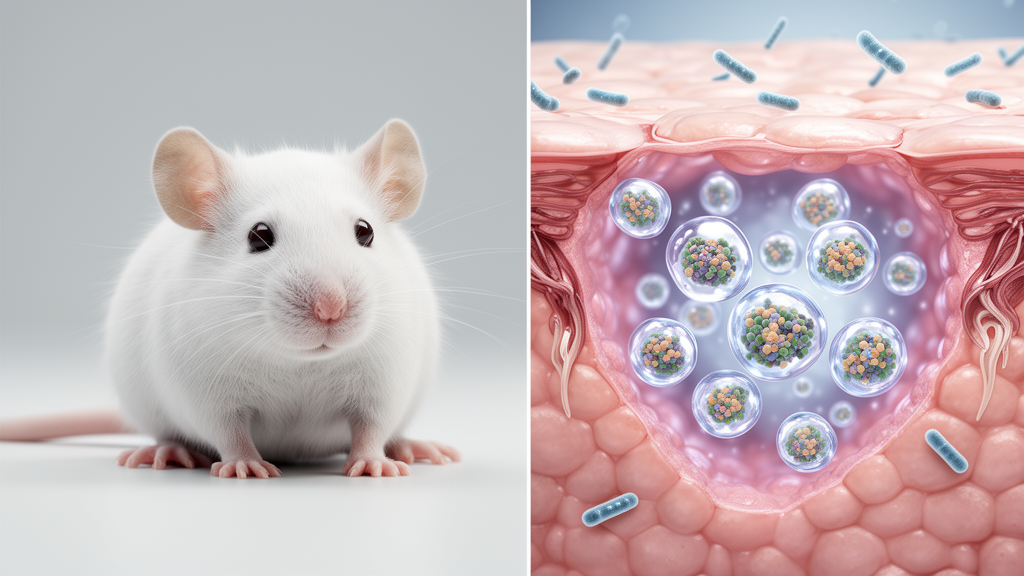
Outer membrane vesicles released by the anaerobic bacterium Bacteroides fragilis can reduce the colonization of several Pseudomonadota species by triggering autophagy, according to a study combining 16S rRNA sequencing of human skin microbiota, mouse skin-colonization experiments and cultured-cell assays. Intact vesicles reproduced this effect, while sonication-disrupted vesicles and extracellular vesicles from Staphylococcus epidermidis did not. The experiments provide a mechanistic model for bacterial interactions on skin, but they do not establish that the same process explains the compositional differences observed in the human cohorts.
The study also examined whether the microbial community associated with human skin changes between childhood and early adulthood. The team analyzed skin samples from 304 healthy volunteers: 150 children with a mean age of 5.45 ± 0.50 years and 154 young adults with a mean age of 19.48 ± 0.88 years. The overall microbial structure and alpha diversity differed significantly between the groups, and principal-coordinate analysis separated the cohorts.
Bacillota and Actinomycetota abundance did not differ significantly, whereas Bacteroidota was more abundant and Pseudomonadota less abundant in young adults. The study was cross-sectional, so it measured differences between age groups at one point rather than following individual microbiomes over time. At the genus level, Bacteroides was the predominant genus in both cohorts, accounting for an average relative abundance of 15.36% in children and 26.67% in young adults, as determined by 16S rRNA sequencing.
The abundances of Bacteroides and Alistipes increased significantly in young adults, whereas Prevotella 9 was more abundant in children. Several Pseudomonadota genera, including Klebsiella , Moraxella and Pseudomonas , were significantly less abundant in the adult group. In children, Bacteroidota and Pseudomonadota abundance were inversely correlated; the same association was not detected among young adults.
The authors proposed that the age-associated increase in Bacteroides might contribute to the exclusion of potentially pathogenic Gram-negative bacteria, although the human data establish an association rather than causation. To test that possibility, the researchers established a mouse skin co-colonization model using B. fragilis ATCC 25285 and bacterial isolates from skin or clinical specimens. Concurrent topical application of live B. fragilis and K. pneumoniae at a 1:1 ratio significantly reduced K. pneumoniae colonization.
The same bacterium also reduced the loads of Moraxella catarrhalis and Pseudomonas fulva . By contrast, colonization by the Gram-positive organisms Staphylococcus aureus and S. epidermidis was not significantly affected, indicating selectivity for the tested Pseudomonadota in this model. Timing also mattered: pre-inoculating mice with B. fragilis two hours before K. pneumoniae was effective, whereas introducing B. fragilis after K. pneumoniae was not.
Experiments with cultured cells indicated that the effect could not be explained simply by soluble antimicrobial products or impaired bacterial adhesion. Concentrated B. fragilis culture supernatant inhibited several organisms in vitro, but the pattern did not match the mouse results, and S. aureus was inhibited in culture without a corresponding reduction in vivo. In an immortalized human epidermal cell model, B. fragilis did not alter K. pneumoniae , M. catarrhalis or P. fulva adhesion to keratinocytes.
Exposure to K. pneumoniae , but not to B. fragilis alone, increased transcription of TNFα , IL36α and IL10 , while the antimicrobial peptide LL37 was inhibited by either bacterium. These observations pointed away from direct competition or inflammatory signalling in keratinocytes as the main explanation for the reduced colonization seen in mice. The central mechanistic evidence came from macrophages expressing LC3-GFP.
Cells exposed to B. fragilis alone or co-exposed to B. fragilis and K. pneumoniae accumulated more LC3-positive puncta than cells infected with K. pneumoniae alone. Western blotting showed increased LC3-II and reduced p62, a protein that is selectively degraded during autophagic flux, following co-infection. Transmission electron microscopy revealed double-membrane autophagosomes and vacuoles containing cellular debris.
Treatment with 3-methyladenine, an inhibitor of autophagy initiation, abolished the reduction in intracellular K. pneumoniae , M. catarrhalis and P. fulva , linking the antibacterial effect to the autophagic response under the tested conditions. Purified B. fragilis outer membrane vesicles reproduced several of these findings. The vesicles were spherical, had a bilayer membrane and averaged 162.1 ± 18.9 nanometres in size, with a mean zeta potential of −17.768 ± 2.238 millivolts.
Particle-to-protein ratios remained consistent across different protein concentrations, and the vesicle preparation displayed a different protein profile from whole-cell lysates. At 5 micrograms per millilitre, the vesicles increased LC3 puncta, LC3-II accumulation and autophagic structures in macrophages and reduced the intracellular loads of all three tested Pseudomonadota species. The effect disappeared when autophagy was inhibited with 3-methyladenine.
The vesicles did not significantly inhibit bacterial growth when tested directly in vitro, arguing against a simple direct-antibiotic explanation. Evidence from genetically modified mice extended the mechanism to skin colonization. Live B. fragilis lowered K. pneumoniae loads in wild-type C57BL/6J mice but not in homozygous lc3a -deficient mice, with six animals per group.
Heat-killed bacteria were ineffective. Skin immunohistochemistry showed increased LC3A immunoreactivity and reduced p62/SQSTM1 immunoreactivity after treatment with live B. fragilis , consistent with enhanced autophagic activity and substrate turnover. Purified intact outer membrane vesicles also reduced K. pneumoniae colonization in wild-type but not lc3a -deficient mice, with four animals per group.
Neither disrupted B. fragilis vesicles nor S. epidermidis extracellular vesicles had the same effect, suggesting that vesicle integrity and bacterial source were important under the tested conditions. Live B. fragilis and intact vesicles also reduced skin expression of the inflammatory cytokines TNFα and Il36α induced by K. pneumoniae . The authors described the mechanism as a possible explanation for the inverse relationship between Bacteroidota and Pseudomonadota observed in children.
The experiments also show that the response depends on the integrity of the outer membrane vesicles and on host LC3A-associated autophagy. Whether this mechanism operates at the same scale or strength in healthy human skin remains unresolved. Several limitations constrain how broadly the results can be applied.
The human study was cross-sectional, so differences in hygiene, lifestyle, hormonal development and other environmental or developmental factors may have contributed to the observed age-related pattern. Because 16S rRNA sequencing cannot establish bacterial viability, species identity, stable residence or the precise anatomical source of a sequence signal, transient deposition and gut-to-skin transfer could not be excluded. The animal work also relied on the laboratory-adapted B. fragilis ATCC 25285 strain because the researchers did not recover Bacteroides from healthy human skin samples under their culture conditions.
The occlusive dressings used in the mouse model may have increased local hydration and reduced oxygen exposure, potentially favoring the anaerobe. The specific vesicle-associated molecules that initiate autophagy remain unresolved, and their activity may differ among species or strains. Proteomic and lipidomic analysis of vesicles from skin-adapted isolates will be needed to identify the relevant components and determine whether this laboratory mechanism operates in healthy human skin.
Subject of Research: Bacteroides fragilis outer membrane vesicles, autophagy and skin colonization resistance
Article Title: Bacteroides fragilis outer membrane vesicle mediates Pseudomonadota colonization by inducing autophagy on the skin
Article References: Guo, Y., Nurxat, N., Wang, Q., Shen, Z., Zhao, N., Liu, Y., Jian, Y., Ye, B., Li, M., & Liu, Q. (2026). Bacteroides fragilis outer membrane vesicle mediates Pseudomonadota colonization by inducing autophagy on the skin. iScience, 29(11), Article 117969. https://doi.org/10.1016/j.isci.2026.117969
Image Credits: AI Generated
DOI: 10.1016/j.isci.2026.117969
Keywords: Bacteroides fragilis, outer membrane vesicles, autophagy, skin microbiome, Pseudomonadota, colonization resistance, Klebsiella pneumoniae, host–microbe interactions, murine skin model, 16S rRNA sequencing, Bacteroides, fragilis
News Source: Morgan Morrow. (October 22, 2026). Bacteroides vesicles trigger autophagy and reduce skin colonization in mice. Scienmag.