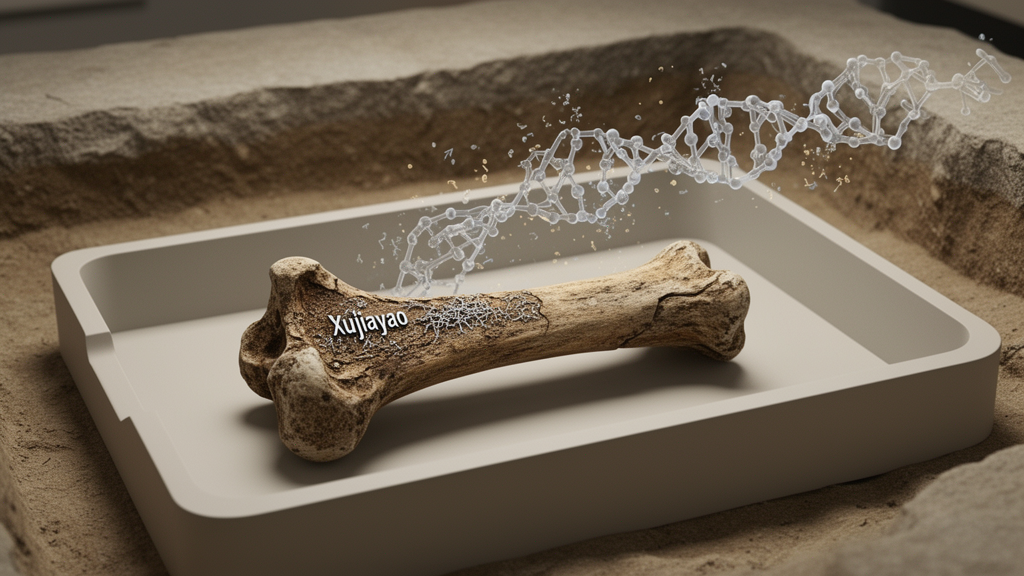
Protein sequences recovered from two Middle Pleistocene fossils at Xujiayao in China identify the specimens as members of the Denisovan lineage, according to a combined palaeoproteomic and comparative-morphology study. The researchers identified 18 endogenous proteins in the bones and found that a Denisovan-specific variant in the collagen gene COL1A2, designated COL1A2-996 R>K, strongly supported the taxonomic assignment. The analysis also found shared cranial features among the Xujiayao and Harbin fossils and East Asian archaic Homo assemblages from Jinniushan, Dali and Hualongdong, supporting the conclusion that these fossils belong to the same broader Denisovan lineage.
The Xujiayao assemblage is important because it contains numerous fossils within a clear stratigraphic sequence dating to approximately 199,000–138,000 years ago. Its evolutionary position had remained uncertain despite extensive study. The authors describe their results as a comprehensive view of Denisovan features, including traits resembling Homo erectus, features associated with modern humans and similarities shared with late Neanderthals.
To obtain ancient proteins, the investigators drilled small holes in two Xujiayao hominin specimens, PA1497 and PA1490, while protecting surrounding surfaces with aluminium foil. A three-dimensional scan was completed before sampling so that the complete external morphology could be preserved for anatomical analysis. Bone powder was demineralized with 0.6 M hydrochloric acid and separated into an acid-soluble fraction and acid-insoluble fractions.
Proteins in the retained material were extracted with 50 mM ammonium bicarbonate, digested overnight with porcine trypsin at 37 °C, desalted and purified. Extraction blanks were processed through the same procedure to estimate contamination, while a modern camel bone was included as a positive control. Initial collagen assessment was performed with matrix-assisted laser desorption and ionization time-of-flight mass spectrometry, with every sample analysed in triplicate.
More detailed liquid chromatography coupled to tandem mass spectrometry was then conducted independently at Capital Medical University and Fudan University. The Capital Medical University analyses used data-dependent acquisition on an Orbitrap Fusion Lumos, while the Fudan University analyses used an Orbitrap Exploris 480 with a FAIMS Pro device and a different chromatographic setup. Because the two acid-insoluble fractions from PA1490 showed no obvious collagen signal, they were combined for liquid chromatography–tandem mass spectrometry analysis.
Processing archaeological samples alongside blanks and using two analytical platforms provided independent checks on the identifications. The mass-spectrometry files were searched against a custom database of mammalian type I collagens and a previously published database containing the modern human proteome and bone and dentine proteins translated from archaic hominin genomes. Common contaminant databases were included in the searches.
The principal PEAKS workflow used a 1% false-discovery rate at the peptide level and required protein identifications to meet a threshold of −10log10[P] ≥ 20. A separate MaxQuant analysis used the same digestion and modification settings, with a 1% peptide-spectrum-match false-discovery rate and a 10% protein threshold to identify potential low-abundance proteins. The researchers also searched the blank controls and published Xiahe 1 and Xiahe 2 data to monitor contaminants and compare results with other individual specimens.
Endogeneity was assessed through deamidation at asparagine and glutamine residues, using peptide intensities and peptide-spectrum-match counts to calculate rates for each protein. Proteins with one or fewer relevant peptides were excluded from this assessment, while proteins with relatively high deamidation in both analytical workflows were classified as endogenous ancient proteins. The investigators also removed peptides that could be matched to bacteria, fungi, plants or other animals.
They did not apply several additional classification proxies because the available data did not provide sufficiently extensive evidence for them. For phylogenetically informative sites, at least two remaining peptides had to be supported in both PEAKS and MaxQuant searches, and the associated spectra had to meet criteria for diagnostic y and b ions. Of the 18 endogenous proteins identified, nine produced consensus sequences suitable for phylogenetic analysis.
Candidate alleles were retained only when they met thresholds of at least two peptide-spectrum matches, a peptide-spectrum-match ratio of at least 25% and an intensity ratio of at least 10%. Amino acids potentially altered by common taphonomic post-translational modifications were resolved to their unmodified forms, and leucine and isoleucine were treated as equivalent because they have the same mass. Consensus sequences were retained only where amino-acid positions had overlapping coverage in both software workflows.
COL4A4 was excluded from the phylogenetic analysis because it appeared only in PA1490 and covered 13 amino acids, or 0.77% of the protein sequence. The comparative protein dataset contained the two Xujiayao specimens, Denisova 3, the Altai and Vindija Neanderthals, 50 randomly selected present-day human sequences from the Human Genome Diversity Project and translated sequences from chimpanzee. PartitionFinder2 was used to select partitioning schemes and amino-acid substitution models.
Consensus Bayesian trees were then inferred with MrBayes in two independent runs of 10 million iterations, with samples taken every 500 generations and the first two million iterations discarded as burn-in. Additional trees based on alternative datasets were also constructed. In a separate test, the analysis did not find reliable evidence supporting either amino acid of the Penghu-specific COL5A2-E1211V variant.
Cranial evidence was evaluated through high-resolution computed tomography of the Xujiayao material at a reported resolution of 37.56 micrometres. Three-dimensional reconstruction in VGSTUDIO MAX produced 26 linear distances, three cranial angles and two indices. Comparative fossils and models were digitised with a point accuracy of 50 micrometres and compared with East and Southeast Asian Homo erectus, African, European and South Asian Homo heidelbergensis or early Neanderthals, other East Asian late Middle and Late Pleistocene archaic Homo, Neanderthals and modern humans.
Principal component analysis incorporated cranial breadth, height, parietal and occipital chord and subtense measurements, cranial angles, the porion-bregmatic-height-to-cranial-breadth index and the parietal curvature index. A correlation-coefficient matrix standardised variables on different scales. The shared morphology was not uniform in its resemblance to other human groups.
The Denisovan-associated fossils displayed a thick cranial vault reminiscent of Homo erectus, but the Xujiayao and Harbin material also had a strongly arched temporal squama, which the study associates with modern humans. The temporal labyrinth structure and the presence of a suprainiac fossa resembled features found in late Neanderthals. More distinctive traits identified across the Denisovan-associated material included a low cranial profile with nearly parallel lateral walls, a massive supraorbital torus, a flat zygomaxillary region and weak prognathism.
These observations show that the proposed Denisovan morphology combines features that would otherwise place the fossils in different comparative groupings, contributing to the difficulty of classifying East Asian archaic Homo from anatomy alone. The wider taxonomic conclusion is bounded by the different evidence available for each assemblage. The two Xujiayao specimens have direct palaeoproteomic support, including the Denisova-specific COL1A2-996 R>K mutation, while Xujiayao and Harbin serve as the Denisovan reference material for the morphological comparison.
The assignment of Jinniushan, Dali and Hualongdong to the Denisovan lineage is an inference from their shared cranial features rather than from recovered genomes or proteomes from those specimens. Proteomic sampling was limited to two individuals, and only nine of the 18 endogenous proteins contributed consensus sequences to the phylogenetic analysis. Nevertheless, the study links a diagnostic collagen variant in Xujiayao with a quantitative trait pattern shared across several East Asian archaic Homo assemblages, resolving part of the long-standing uncertainty over the evolutionary position of the Xujiayao fossils.
Subject of Research: Palaeoproteomic and cranial analysis of Middle Pleistocene East Asian archaic Homo fossils
Article Title: The proteome of Middle Pleistocene Xujiayao and common Denisovan morphology
Article References: Xing, S., Wu, Z., Shao, Q., Ge, J., Bennett, E. A., Rao, H., Lin, S., Zhao, Y., Liu, F., Liu, Y., Zhou, K., Feng, X., Jiangzuo, Q., & Fu, Q. (2026). The proteome of Middle Pleistocene Xujiayao and common Denisovan morphology. Nature. https://doi.org/10.1038/s41586-026-11132-z
Image Credits: AI Generated
DOI: 10.1038/s41586-026-11132-z
Keywords: Xujiayao, Denisovans, palaeoproteomics, ancient proteins, East Asian human evolution, Middle Pleistocene, cranial morphology, COL1A2, archaic Homo, protein sequencing, proteome, Middle
News Source: Gavin Prescott. (October 22, 2026). Xujiayao proteome links East Asian archaic Homo fossils to Denisovans. Scienmag.