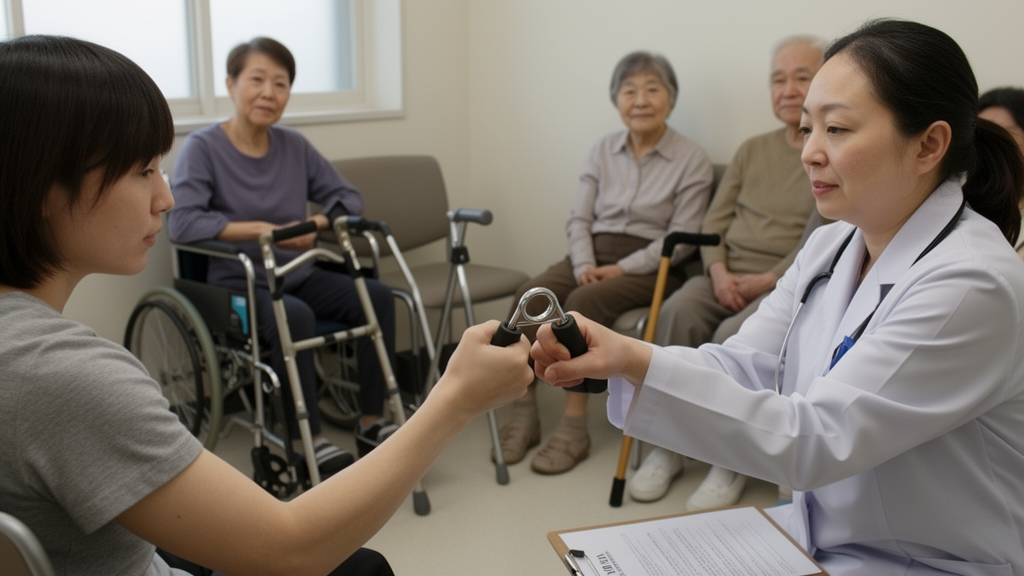
Handgrip strength, a common marker of functional health, did not consistently improve predictions of incident disability in basic activities of daily living among older adults with arthritis who were free of such difficulties at baseline. In a multi-cohort external validation study, researchers developed a prediction model using data from the Survey of Health, Ageing and Retirement in Europe (SHARE) and tested it without refitting in three other national cohorts. Although handgrip strength was associated with subsequent disability within the development cohort, its added predictive value was small and did not transfer reliably across populations.
The development analysis included 3,658 SHARE participants, of whom 585 developed an incident activity-of-daily-living disability during follow-up. The model was then applied directly to the Health and Retirement Study (HRS), the English Longitudinal Study of Ageing (ELSA), and the China Health and Retirement Longitudinal Study (CHARLS). These external samples contained 696, 639, and 328 participants, respectively, with 93, 132, and 121 disability events. Participants in every cohort were at least 65 years old, reported physician-diagnosed arthritis or rheumatism and current pain, and had no baseline difficulty in five basic activities of daily living.
The investigators compared a benchmark model that did not use handgrip strength with four approaches: raw handgrip strength, handgrip strength divided by height squared, locally age- and sex-standardized handgrip strength, and weakness defined using European Working Group on Sarcopenia in Older People 2 criteria. Performance was evaluated through discrimination, calibration, the Brier score, and net benefit, with optimism correction applied to the development results. Sensitivity analyses examined prediction horizons, handgrip measurement protocols, Asian Working Group for Sarcopenia thresholds, and mortality. In SHARE, adding raw handgrip strength raised the area under the receiver operating characteristic curve from 0.681 to 0.692; after optimism correction, the corresponding values were 0.675 and 0.685.
That modest gain disappeared in the external cohorts. In HRS, the area under the curve was 0.706 with handgrip strength and 0.711 without it. In ELSA, the values were 0.661 and 0.665, and in CHARLS they were 0.620 and 0.628. Thus, in each external dataset, the model without handgrip strength had a slightly higher point estimate for discrimination. Calibration also differed substantially among cohorts. For the raw-handgrip model, observed-to-expected ratios were 0.70 in HRS, 1.19 in ELSA, and 1.67 in CHARLS, indicating different degrees of mismatch between predicted and observed event risks. Accounting for CHARLS’s three-year follow-up reduced its ratio to 1.22, but the adjustment did not correct the calibration slope. No alternative handgrip representation, including the Asian Working Group for Sarcopenia weakness definition, consistently improved external performance.
The findings show that a prognostic association does not necessarily translate into useful incremental prediction in a new population. Here, handgrip strength carried prognostic information within the SHARE development cohort, but adding it to the benchmark model produced little reproducible improvement when the model was transported without adjustment. Differences in calibration partly reflected varying follow-up intervals, yet the results also support the need to validate and recalibrate risk estimates locally before using handgrip-based absolute predictions outside the population in which they were developed. The study was observational and included only older adults reporting arthritis or rheumatism and current pain, so its results do not establish that handgrip strength causes disability. The practical implication is narrower: measuring handgrip strength may remain valuable for assessing general function, but the study provides no evidence that adding it to a demographic-and-clinical risk model universally improves prediction of incident disability across countries.
Subject of Research: External validation of handgrip-based prediction of incident disability in older adults with arthritis
Article Title: Handgrip strength for predicting incident ADL disability in older adults with arthritis: a multi-cohort external validation study
Article References: Yu, C., Wang, Z., & Gao, G. (2026). Handgrip strength for predicting incident ADL disability in older adults with arthritis: a multi-cohort external validation study. BMC Geriatrics. https://doi.org/10.1186/s12877-026-08477-5
Image Credits: AI Generated
DOI: 10.1186/s12877-026-08477-5
Keywords: Handgrip strength, Activities of daily living, Disability prediction, Arthritis, Older adults, External validation, Model calibration, Sarcopenia, Cohort transportability, Handgrip, strength, predicting
News Source: Beatrice Stafford. (October 22, 2026). Handgrip Strength Adds Little Cross-Cohort Predictive Value for Disability. Scienmag.