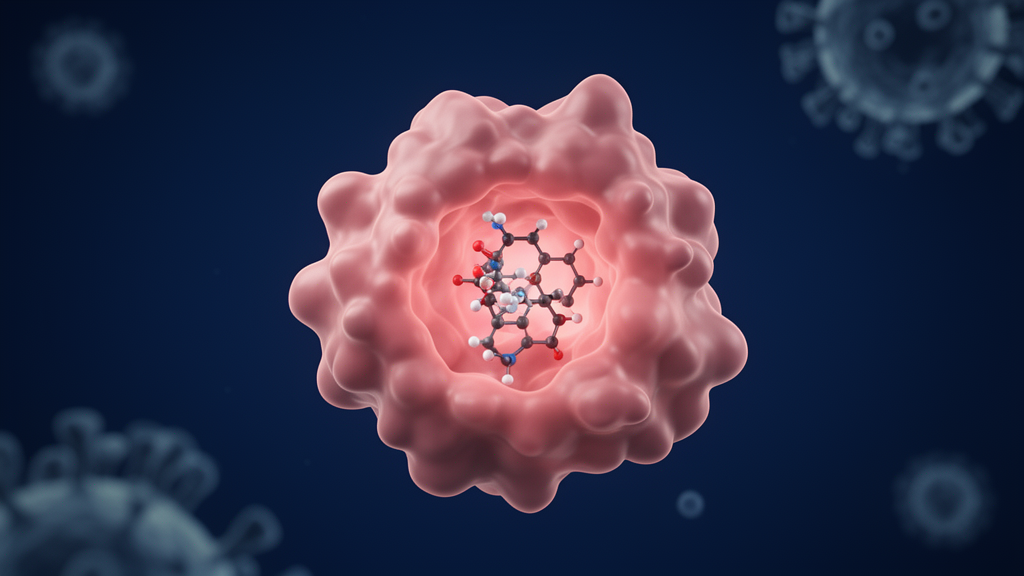
Cyclosporine A bound directly to the chemokine CCL5 in laboratory experiments, with an apparent dissociation constant of 2.7 micromolar, according to a network-pharmacology study of Stevens–Johnson syndrome and toxic epidermal necrolysis. Researchers combined database predictions, protein-interaction analysis and molecular docking with microscale thermophoresis to identify and test the interaction. The finding provides a possible mechanism through which cyclosporine A could influence immune-cell recruitment independently of its established inhibition of calcineurin, but the study did not show that binding changes CCL5 activity or improves outcomes in patients.
Stevens–Johnson syndrome and toxic epidermal necrolysis, collectively abbreviated SJS/TEN, are acute, life-threatening mucocutaneous reactions most often triggered by medication. They are characterized by widespread keratinocyte death and detachment of the epidermis. Reported annual incidence ranges from 0.4 to 13 cases per million, while mortality is below 10% in SJS and can exceed 40% in TEN, with an overall rate of approximately 20%. Although the immune mechanisms of these conditions are not fully resolved, cytotoxic CD8+ T cells and inflammatory mediators including perforin, granzyme B and tumor necrosis factor-alpha contribute to tissue injury.
Cyclosporine A is an 11-amino-acid cyclic peptide produced through fungal fermentation and is used as an immunosuppressive drug. Its established action involves inhibition of calcineurin, a pathway that reduces nuclear factor of activated T-cell signaling, cytokine production and the activation and proliferation of immune cells. Although cyclosporine A has been reported to be clinically effective in SJS/TEN, the study’s authors noted that its detailed mechanisms in this setting remain incompletely understood. They asked whether the drug might also interact directly with extracellular inflammatory mediators, providing a route to rapid anti-inflammatory effects that does not depend solely on intracellular calcineurin inhibition.
CCL5, also known as RANTES, is a chemokine secreted by several cell types, including T cells, macrophages, epithelial cells and endothelial cells. It recruits T cells, monocytes and macrophages to sites of inflammation through the receptors CCR1, CCR3 and CCR5, with downstream signaling involving nuclear factor kappa-B and mitogen-activated protein kinase pathways. CCL5 has been investigated in viral infection, cancer, autoimmune disease and drug injury. The supplied article also notes earlier reports of elevated CCL5 in the serum and blister fluid of SJS/TEN patients, making it a plausible candidate for the investigation, although the present work did not directly measure those levels in a patient cohort.
To identify candidate targets, the researchers entered cyclosporine A’s chemical structure into PharmMapper and SuperPred. The two databases returned 205 and 141 human proteins, respectively, producing 334 potential cyclosporine A targets. They separately assembled 1,211 genes associated with SJS and 1,333 associated with TEN from GeneCards and OMIM. Intersection of these datasets produced 22 shared targets. A STRING protein–protein interaction network, assessed at a minimum interaction score above 0.7, connected 18 of the proteins. Cytoscape’s CytoNCA plugin then ranked candidates using degree, betweenness and closeness centrality, highlighting five core proteins: MMP9, CASP3, CCL5, CXCR4 and CYP3A4.
The functional analysis associated the shared proteins with protein metabolism, signal transduction, regulation of catalytic activity, extracellular-region components and oxidoreductase activity. Enriched pathway categories included linoleic-acid metabolism, drug metabolism, tumor necrosis factor signaling, nuclear factor kappa-B signaling and apoptosis. The five central proteins also covered processes relevant to the tissue injury under study: MMP9 participates in matrix degradation, CASP3 is an effector protease involved in apoptosis, and CCL5 and CXCR4 belong to the chemokine-recruitment system. CYP3A4 was distinguished as a phase I drug-metabolizing enzyme and was excluded from subsequent therapeutic-target experiments despite producing the strongest docking score, because the authors considered its metabolic role distinct from direct anti-inflammatory action.
Molecular docking was then used to model cyclosporine A interactions with MMP9, CCL5, CASP3, CXCR4 and CYP3A4. Using AutoDock Vina with a semi-rigid ligand-protein setup, the study obtained docking scores of −5.4, −5.8, −5.3, −4.7 and −7.3 kilocalories per mole, respectively. Among the four nonmetabolic candidates, CCL5 was prioritized because its score indicated the most favorable modeled interaction. The docking analysis placed cyclosporine A in a structurally accessible hydrophobic pocket on the CCL5 surface. Such a model can identify a physically plausible binding configuration, but its score is a computational estimate rather than direct evidence of binding, so the researchers tested the interaction experimentally.
For the binding assay, the team used fluorescently labeled recombinant human CCL5, stated by the manufacturer to be at least 95% pure, and exposed it to graded concentrations of cyclosporine A. Microscale thermophoresis was performed at 25 °C with labeled CCL5 at 20 nanomolar and cyclosporine A concentrations ranging from 0.0305 to 1,000 micromolar. Three independently pipetted measurements at each concentration were pooled and fitted to a 1:1 binding model. The resulting signal-to-noise ratio was 27.3, which the authors classified as high-quality binding data. The apparent dissociation constant was 2.70 micromolar, with a 95% confidence interval of plus or minus 0.58 micromolar.
The experiments therefore support direct physical binding between cyclosporine A and recombinant CCL5 under the tested in vitro conditions. Their proposed mechanism is that cyclosporine A may bind extracellular CCL5 and thereby reduce CCL5-mediated migration of immune cells into affected skin, potentially helping explain rapid anti-inflammatory effects in SJS/TEN. That functional interpretation remains a hypothesis. The assay did not determine whether cyclosporine A neutralizes CCL5, alters its receptor binding, changes its clearance, or affects its dimerization or oligomerization. Cell-based chemotaxis experiments would be needed to show whether the interaction changes the ability of CCL5 to recruit T cells or monocytes.
Physiological relevance is also uncertain. The authors report that total plasma cyclosporine A after oral administration is commonly about 100–400 nanograms per milliliter and that more than 90% is protein-bound, leaving free concentrations in the nanomolar range, below the measured micromolar dissociation constant. They note, however, that cyclosporine A is highly lipophilic and can accumulate in skin, citing epidermal concentrations in orally treated psoriasis patients that were approximately tenfold higher than concurrent blood trough levels. Such tissue accumulation could potentially create higher local exposure, but the proposed micromolar concentration window in SJS/TEN lesions was not directly established. The study also did not test patient samples, cellular responses, animal models, skin injury or clinical outcomes, so its contribution is a defined biochemical interaction supported by computational and laboratory methods rather than demonstrated therapeutic efficacy.
Subject of Research: In vitro evidence that cyclosporine A directly binds the inflammatory chemokine CCL5, with implications for a possible mechanism in SJS/TEN
Article Title: Cyclosporin a directly binds CCL5: a novel mechanism in SJS/TEN revealed by network pharmacology
Article References: Peng, F., Hao, W., Peng, Y., & Liu, O. (2026). Cyclosporin a directly binds CCL5: a novel mechanism in SJS/TEN revealed by network pharmacology. Frontiers in Pharmacology, 17, Article 1853184. https://doi.org/10.3389/fphar.2026.1853184
Image Credits: AI Generated
DOI: 10.3389/fphar.2026.1853184
Keywords: cyclosporine A, CCL5, RANTES, SJS/TEN, microscale thermophoresis, molecular docking, network pharmacology, chemokine, keratinocyte apoptosis, drug reaction, Cyclosporin, directly
News Source: Ophelia Keating. (October 22, 2026). Cyclosporine A Directly Binds CCL5 in SJS/TEN Study. Scienmag.