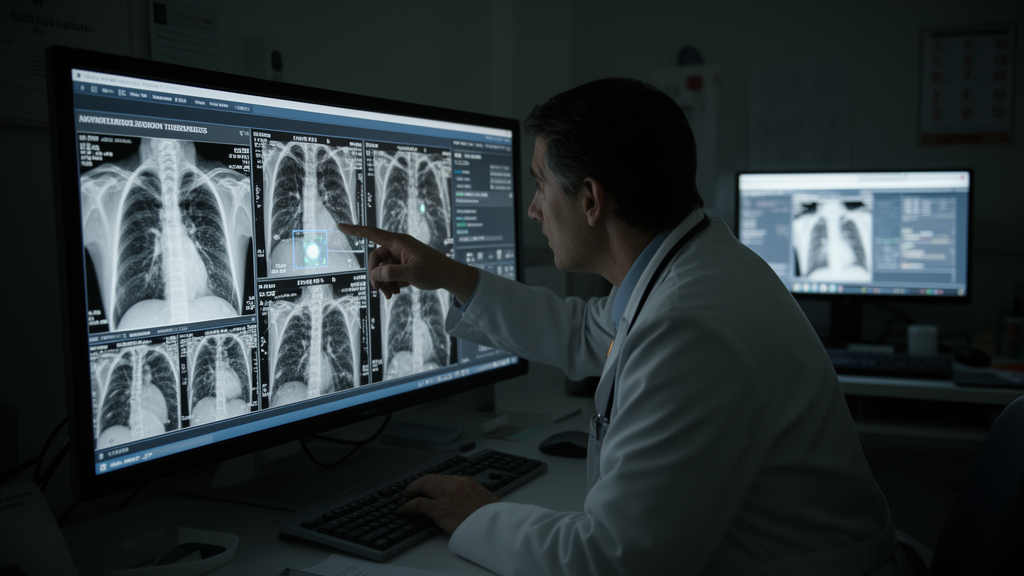
A lightweight deep-learning system identified active pulmonary tuberculosis from chest radiographs with an area under the receiver operating characteristic curve of 0.896 in a prospective clinical cohort, according to a multicenter study that also tested the model in 5,931 retrospective cases. The ShuffleNetV2 model separated active from non-active tuberculosis in 4,613 training cases, 1,318 retrospective external-validation cases and 560 prospectively collected patients, demonstrating consistent discrimination across retrospective and real-world testing. Its prospective sensitivity was 0.862 and specificity was 0.830, although probability estimates were not optimally calibrated and 33.2% of positive predictions were false positives at the selected threshold.
The distinction between active and non-active tuberculosis is central to disease control. Active tuberculosis involves replication of Mycobacterium tuberculosis , produces symptoms and is highly transmissible through the air. Non-active infection does not cause symptoms or transmit the bacteria, although people who have it retain a lifelong risk of progression to active disease.
The researchers noted that the World Health Organization estimated that 10.7 million people developed tuberculosis worldwide in 2024 and that the disease caused approximately 1.23 million deaths, including 150,000 deaths among people living with HIV. Accurate differentiation can help guide treatment decisions and public-health containment, but misclassification can also have serious consequences. Current assessment of tuberculosis activity may combine medical history, physical examination, chest imaging, sputum smear microscopy, mycobacterial culture and molecular testing, with some patients requiring biopsy or bronchoscopy.
Smear microscopy typically has a sensitivity of 50–60%, while culture can require two to eight weeks for a conclusive result. Chest radiography is comparatively accessible, produces images immediately and requires no contrast. The study therefore asked whether a compact neural network could analyze radiographs quickly enough to serve as an initial triage or decision-support tool, while leaving definitive activity assessment to clinical and microbiological evaluation.
The retrospective population came from four centers, with 4,613 patients used for training and 1,318 from two additional centers used for external validation. Together, these retrospective cohorts included 5,931 patients: 2,924 men and 3,007 women, with a mean age of 60.73 years. Of these patients, 2,755, or 46.5%, had active tuberculosis and 3,176, or 53.5%, had non-active tuberculosis.
Cough was the most frequently recorded symptom, reported in 3,553 patients, followed by expectoration in 3,385. Hemoptysis was reported in 671 patients, low-grade fever in 2,789, fatigue in 1,984, night sweats in 1,689, dyspnea in 286 and weight loss in 502. The prospective cohort comprised 560 patients at Maigaiti County Hospital whose data were collected from January 1, 2023, to January 1, 2024.
It included 285 men and 275 women, with a mean age of 60.73 ± 16.32 years; 159 patients, or 28.4%, had active tuberculosis and 401, or 71.6%, had non-active tuberculosis. The most common symptoms in this group were cough, reported in 328 patients, and expectoration, reported in 313. Low-grade fever affected 257 patients, fatigue 201, night sweats 157, hemoptysis 65, weight loss 48 and dyspnea 31.
Each patient contributed one chest radiograph to the evaluation. ShuffleNetV2 achieved an area under the curve, or AUC, of 0.926 in the training cohort, with a 95% confidence interval of 0.918–0.933. Its training sensitivity was 0.847, specificity was 0.851 and accuracy was 0.849.
Performance remained high during retrospective external validation: AUC was 0.917, accuracy was 0.836, sensitivity was 0.854 and specificity was 0.818. In the prospective cohort, AUC was 0.896, accuracy was 0.839, sensitivity was 0.862 and specificity was 0.830. The prospective confusion matrix contained 137 true positives, 333 true negatives, 68 false positives and 22 false negatives.
Positive predictive value was 0.668, whereas negative predictive value was 0.938, reflecting the relatively low prevalence of active tuberculosis in that cohort. Although prospective discrimination remained favorable, the model’s calibration curve departed from the ideal line, particularly at low and intermediate predicted probabilities. This meant that the model ranked active and non-active cases effectively, but its numerical probabilities did not consistently match the observed frequency of active tuberculosis.
One possible factor was the shift in case mix: active tuberculosis accounted for 44.8% of the training cohort and 52.2% of the retrospective external-validation cohort, but only 28.4% of prospective patients. Differences in recruitment period, institution, disease severity and radiographic presentation may also have contributed. The researchers said that site-specific recalibration using representative local data, followed by prospective monitoring of calibration and operating thresholds, would be needed before clinical implementation.
Comparisons with four other neural-network architectures showed that the lightweight design retained strong prospective discrimination. Under identical experimental conditions, ShuffleNetV2 produced a prospective AUC of 0.896, compared with 0.882 for ResNet50, 0.848 for DenseNet121, 0.687 for EfficientNet-B0 and 0.895 for ViT-Base/16. In retrospective external validation, the corresponding AUCs were 0.917, 0.930, 0.927, 0.817 and 0.927.
ShuffleNetV2 contained approximately 2.3 million parameters, versus 25.6 million for ResNet50, 8.0 million for DenseNet121, 5.3 million for EfficientNet-B0 and 86 million for ViT-Base/16. Its mean inference time was 0.9 seconds per case under the same hardware and timing conditions, compared with 2.4 seconds for ResNet50, 3.1 seconds for DenseNet121, 2.8 seconds for EfficientNet-B0 and 6.7 seconds for ViT-Base/16. Nine radiologists—three each at senior, intermediate and junior levels—independently assessed the same 560 prospective radiographs without model assistance.
Their AUCs ranged from 0.648 for one junior reader to 0.811 for one senior reader, and every unassisted individual reader scored below the model’s prospective AUC of 0.896. When one radiologist at each experience level reassessed the images with ShuffleNetV2 support, the senior reader’s AUC rose to 0.937, the intermediate reader’s to 0.902 and the junior reader’s to 0.897. The corresponding accuracies were 0.938, 0.921 and 0.902.
DeLong tests indicated statistically significant improvements for all three groups, with p-values below 0.001. The reader study therefore measured better diagnostic performance with model assistance, but it did not measure effects on treatment decisions, patient outcomes or health-system use. Subgroup analysis in the retrospective external-validation cohort found no significant differences in AUC by age, gender, occupation, residence or scanner type, with all reported p-values above 0.05.
Performance was therefore not confined to one tested demographic category or imaging platform, although the study did not establish fairness or equivalence across populations beyond those examined. Grad-CAM visualizations showed the highest attention over pulmonary abnormalities in representative active cases and over post-tuberculous scarring in non-active cases. Representative errors included an active case in which right clavicle overlap may have obscured an apical abnormality and a non-active case in which pleural calcification and chronic post-tuberculous changes may have been interpreted as active disease.
Such cases illustrate the kinds of overlapping anatomical findings associated with classification errors. The results support chest-radiograph artificial intelligence as a potential rapid triage or clinical decision-support tool, not as a stand-alone diagnosis. In the prospective cohort, 205 patients were predicted to have active tuberculosis but 68 did not, potentially leading to unnecessary isolation, further diagnostic procedures, resource use or inappropriate multidrug treatment if predictions were acted upon without confirmation.
A positive result should therefore prompt clinical evaluation and microbiological confirmation, including molecular testing and mycobacterial culture. The study did not include international cohorts, omitted substantial clinical and laboratory information, encountered errors in patients with atypical presentations and did not exhaustively compare every possible architecture or optimization method. It also did not evaluate effects on patient outcomes.
Larger international validation, site-specific recalibration and prospective assessment of clinical and health-system impact are needed before the model can support routine decisions.
Subject of Research: Evaluation of a deep-learning chest-radiograph model for distinguishing active from non-active pulmonary tuberculosis
Article Title: Deep learning based detection of active pulmonary tuberculosis from chest radiographs in a retrospective prospective multicenter study
Article References: Tuersun, A., Abudoubari, S., Xu, J., Ma, J., Nijiati, P., Warisi, X., Chen, X., Li, Y., Zou, X., Huang, C., & Nijiati, M. (2026). Deep learning based detection of active pulmonary tuberculosis from chest radiographs in a retrospective prospective multicenter study. iScience, 29(11), Article 117960. https://doi.org/10.1016/j.isci.2026.117960
Image Credits: AI Generated
DOI: 10.1016/j.isci.2026.117960
Keywords: active tuberculosis, chest radiography, deep learning, ShuffleNetV2, medical artificial intelligence, prospective validation, radiologist decision support, model calibration, tuberculosis screening, clinical triage, Deep, learning
News Source: Blake Davidson. (October 21, 2026). Research report: Deep learning based detection of active pulmonary tuberculosis from chest radiographs in a retrospective prospective multicenter study. Scienmag.