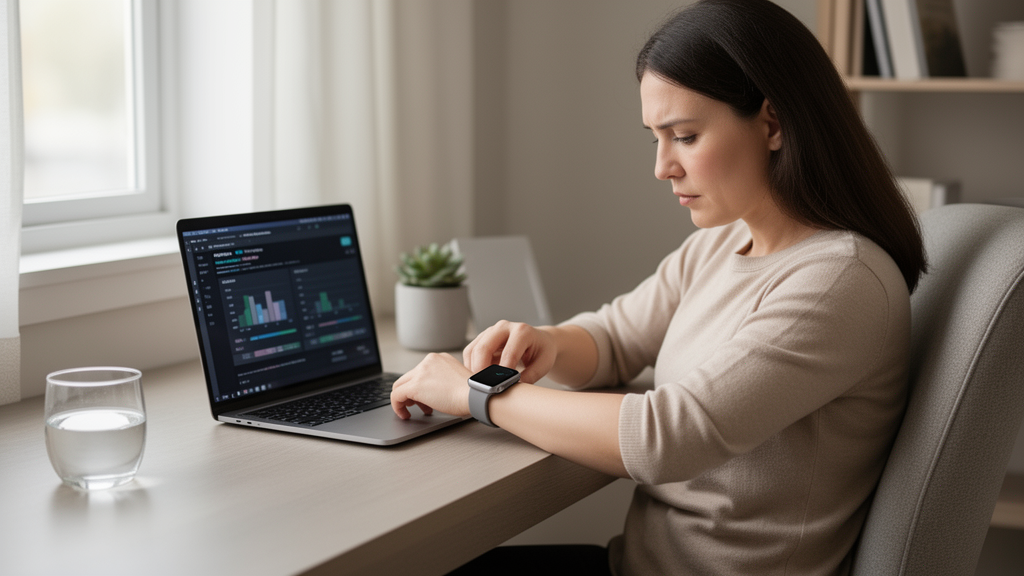
A personalized artificial intelligence model using Fitbit data forecast when women with chronic pelvic pain disorders were likely to enter prolonged sedentary periods, according to a peer-reviewed modeling study from the Icahn School of Medicine at Mount Sinai. The system predicted activity one hour ahead and identified forthcoming 15-minute periods of inactivity during waking hours, indicating that everyday wearable measurements could support timely, individualized movement prompts in a future intervention. The study demonstrated a forecasting capability, not a clinical benefit: researchers did not test whether delivering predictions as prompts reduced sitting time, relieved pelvic pain or improved quality of life.
The analysis included data from 134 women with chronic pelvic pain disorders, primarily endometriosis, and 61 healthy participants serving as a comparison group. Participants wore Fitbit devices for up to 90 days, producing minute-by-minute information about physical activity, heart rate and sleep. The work was a data and statistical analysis study of wearable-derived physiological and behavioral signals rather than a clinical trial of a movement intervention.
Its principal scope was forecasting sedentary bouts from longitudinal device data. Prospective studies would be required to determine whether the predictions could translate into useful changes in behavior or health. To develop the forecasting system, the research team used approximately 10 days of data from each participant to train individualized models that predicted activity levels one hour into the future.
The models were then evaluated against subsequent behavior, with particular attention to 15-minute sedentary episodes during waking hours. The researchers called a brief period of walking or standing an “exercise snack,” reflecting the potential use of a short movement opportunity rather than a conventional exercise session. Personalization was central to the approach: each model incorporated data collected from an individual participant instead of relying only on patterns shared across the population.
Relatively simple, interpretable models forecast prolonged sitting as accurately as the more computationally intensive deep-learning approaches evaluated in the study. That result challenges the assumption that health artificial intelligence must become increasingly complex to be useful for continuous monitoring. A lightweight model could potentially run on a phone or wearable, reducing computational demands and limiting the need to transmit sensitive data to remote servers.
That possibility may make the system more practical and support greater privacy, but the reported study did not establish that the complete method can run in real time on a consumer device or that on-device deployment has been validated at scale. The forecasting models also remained robust in the presence of incomplete data, including periods when participants removed their Fitbits or did not synchronize them. These interruptions can occur during everyday device use, and the reported robustness suggests that wearable-based predictions may remain meaningful under imperfect data collection rather than depending only on controlled laboratory conditions.
The finding does not establish accuracy across every possible pattern of device use, and the news release did not provide numerical performance estimates that would allow the simple and deep-learning models to be compared in detail. The central result is therefore the feasibility of forecasting prolonged sitting with lightweight models that tolerate some missing observations. The work was motivated by the burden of chronic pelvic pain, which the source material describes as affecting an estimated one in seven women and frequently occurring with conditions such as endometriosis, adenomyosis and uterine fibroids.
Pain, fatigue and other symptoms can make extended sitting more likely. General advice to “sit less and move more” may not fully account for the realities of daily life with these disorders. Although regular movement can help manage symptoms and improve overall health, the present research did not test whether movement improves outcomes in this population.
It asked whether routinely collected wearable data could anticipate inactivity closely enough to support a future digital prompt that is more precise and less disruptive than blanket reminders. Researchers envisioned using the forecasts in a just-in-time adaptive intervention, with a model issuing a small number of movement prompts at predicted times. A possible prompt would ask a participant to stand up or take a short walk before a prolonged sedentary episode began.
Unlike conventional step counting, the approach uses the time series of activity, heart rate and sleep data to anticipate a future state. It also differs from a generic notification system because the forecasts are individualized and are designed to reduce unnecessary alerts, which the investigators said could otherwise encourage users to ignore health applications. Whether people would respond to such alerts, remain engaged with the tool or experience better symptoms remains untested and will require prospective clinical trials.
Senior author Ipek Ensari, PhD, an assistant professor of artificial intelligence and human health at the Icahn School of Medicine and a member of the Hasso Plattner Institute of Digital Health at Mount Sinai, said the goal was to determine whether everyday wearable devices could serve as an early-warning system for prolonged sitting in women living with chronic pelvic pain. Lead author Jannes Jegminat, PhD, a former postdoctoral research fellow at the institution, said the team was surprised by the performance of the simplest models and argued that lightweight, interpretable approaches can be practical enough to run directly on a person’s device. These statements describe the method’s technical potential.
They do not report improved health outcomes, demonstrate that privacy protections have been clinically established or prove that users would benefit from fewer notifications. Published online on September 30, 2026, in npj Women’s Health under the title “Robust forecasting of sedentary bouts in chronic pelvic pain disorders for on-device learning and real-time deployment,” the paper provides an exploratory foundation for more targeted digital health support. The investigators suggested that the approach might also be relevant to other chronic conditions in which prolonged sitting contributes to poorer health outcomes, but the reported findings focus on women with chronic pelvic pain disorders and comparison participants without those disorders.
The research team is now working to incorporate the forecasting framework into a just-in-time adaptive intervention. That next stage will test whether AI-guided movement prompts actually reduce sedentary time, improve symptoms and enhance quality of life. Until prospective studies report those clinical outcomes, the strongest conclusion supported by this research is that wearable-based early warning of prolonged sitting is feasible, not that delivering the forecasts improves health.
Subject of Research: Wearable AI forecasting of prolonged sedentary periods in women with chronic pelvic pain disorders
Article Title: Wearable AI forecasts prolonged sitting in women with chronic pelvic pain
Article References: Wearable AI forecasts prolonged sitting in women with chronic pelvic pain. Original publication (Bibliographic details unavailable.)
Image Credits: AI Generated
DOI: Not provided
Keywords: wearable AI, chronic pelvic pain, endometriosis, sedentary behavior, Fitbit, machine learning, digital health, activity forecasting, personalized medicine, Wearable, forecasts, prolonged
News Source: Ophelia Keating. (October 21, 2026). Research report: Wearable AI forecasts prolonged sitting in women with chronic pelvic pain. Scienmag.