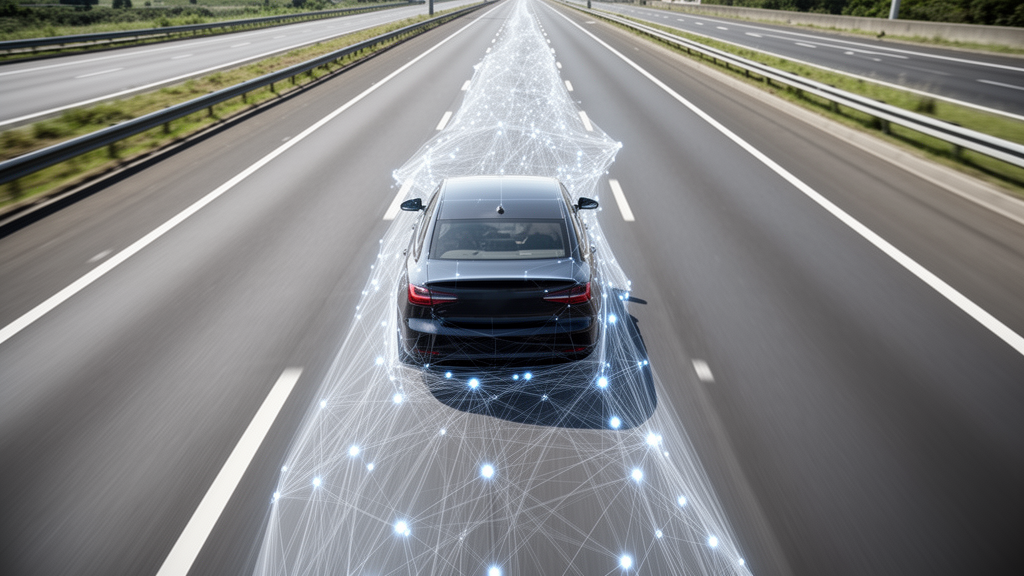
A machine-learning framework called GraphLane reduced the average error in predicted lane positions to 19.28 pixels on a row-anchor evaluation of the CULane driving dataset, according to a research study published in Frontiers of Artificial Intelligence. The supervised model also achieved a lane-existence F1-score of 0.9363 in the study’s principal test evaluation, while qualitative examples showed smoother lane curves in traffic, shadows, nighttime scenes and partially obscured road markings. These results apply to the authors’ custom evaluation of fixed lane slots and 25 keypoints per lane; they are not official CULane benchmark scores or evidence of performance in autonomous vehicles.
Lane localization is the task of estimating where painted lane boundaries lie in camera images. Its practical difficulty comes from the fact that lane markings are thin, elongated and easily lost behind vehicles, beneath shadows, at night or where paint is missing. Single-frame detectors can also produce fragmented or unstable curves when road visibility changes. GraphLane addresses these problems by treating localization as a structured spatio-temporal task rather than a collection of independent pixel or row predictions, combining visual evidence from the current image with information from the two preceding frames, learned relationships among lane keypoints, and constraints based on the geometry expected of roads.
The architecture receives an image sequence of three frames resized to 800 by 288 pixels. A lightweight convolutional backbone with residual blocks extracts spatial features from the current frame and processes each temporal frame with the same weights, keeping all three images in a common feature space. Global average pooling compresses each feature map, and a transformer encoder with two layers and eight attention heads combines the three-frame sequence. This temporal representation is fused with current-frame spatial information and broadcast to a graph whose nodes correspond to four predefined lane slots, each represented at 25 fixed row anchors between 40% and 100% of image height. Learnable node-identity and row embeddings distinguish the individual lane-keypoint hypotheses even though they share the same global scene context.
GraphLane then learns which nodes should exchange information. Its Dynamic Temporal Graph Construction module first estimates a nonnegative variance for each node and converts it to confidence through an exponential transformation. A multilayer perceptron evaluates concatenated pairs of node features to produce candidate edge weights, which are then reduced according to the confidence of the two nodes. The system retains the eight strongest connections for each node, symmetrizes the adjacency matrix and adds self-loops. Two graph-attention layers, each with four attention heads, propagate information through this sparse structure. Between the layers, node features are weighted by confidence and their uncertainty is re-estimated, allowing the second reasoning stage to account for how the first stage has changed each node. Separate heads regress horizontal coordinates and estimate the confidence of every lane keypoint.
Training combines coordinate regression, keypoint confidence, smoothness, lane topology, lane spacing, uncertainty and temporal consistency in a multi-objective loss. Smooth-L1 loss is applied only to valid annotated coordinates, while second-order differences along each predicted lane encourage locally smooth curvature. Other penalties discourage neighboring lanes from crossing and reduce deviations in the spacing between lane centers. The uncertainty term uses an error-dependent heteroscedastic Gaussian negative log-likelihood, linking predicted variance to actual localization error rather than simply rewarding uniformly small variance. A temporal graph-consistency term minimizes the mean-squared difference between confidence-weighted graph representations from consecutive frames. Models were trained with AdamW on CULane’s official training split, selected by validation loss and evaluated on the held-out test split.
Under the principal row-anchor protocol, GraphLane recorded precision of 0.9769, recall of 0.8990, an F1-score of 0.9363, accuracy of 0.9072 and lane-existence IoU of 0.8803. Its normalized mean absolute coordinate error was 0.0241, root mean squared error was 0.0464 and average localization error was 19.28 pixels. A bootstrap analysis using 1,000 resamples produced a 95% confidence interval of 0.9339 to 0.9387 for F1 and 18.80 to 19.74 pixels for average localization error. The evaluation compares predicted and annotated lanes by their fixed lane indices, uses a mean confidence threshold of 0.4 to decide whether each lane exists, and excludes invalid annotations from coordinate-error calculations. The IoU therefore describes overlap between lane-existence decisions, not pixel-level overlap between road curves.
Results differed substantially when GraphLane was assessed across every image in the official 34,680-image test split using the same row-anchor representation. Across that broader split, lane-existence F1 was 0.9013 and average localization error was 42.34 pixels. F1 was highest for Normal scenes at 0.9527, followed by Arrow at 0.9435, Hlight at 0.9406, Crowd at 0.9238, Shadow at 0.9184 and Curve at 0.9124. Performance was lower for Noline at 0.8803 and Night at 0.8607, consistent with weaker visibility. The Cross subset contained 3,122 images but no valid positive lane instances under the four-slot, 25-row-anchor representation, so positive-class and localization metrics were not applicable. This condition-wise result highlights the difficulty of evaluating lane geometry when the representation or annotations do not contain usable positive lanes.
Controlled comparisons with four internal baselines supported the value of combining the components, but also showed a computational trade-off. A CNN baseline had an average localization error of 29.73 pixels, while adding a temporal transformer alone produced 31.71 pixels. A fixed-chain graph convolutional network reached 61.05 pixels, and a fixed-topology graph-attention model reached 31.10 pixels. GraphLane’s 19.28-pixel error was the lowest among those models, although its F1 was slightly below that of the fixed graph-attention model, 0.9363 versus 0.9386. The full model used 3.81 million trainable parameters and ran at 88.64 frames per second with a reported latency of 11.28 milliseconds on an NVIDIA Tesla P100 GPU. The timing covered model forward passes for three-frame inputs after warm-up, excluding data loading, preprocessing and post-processing; it does not establish performance on automotive or embedded hardware.
Ablation experiments revealed that the proposed elements did not contribute in a simple, uniformly additive manner. Dynamic graph construction alone reduced average localization error from 27.70 to 23.75 pixels compared with the baseline, but recall fell from 0.8837 to 0.7556. Adding confidence-weighted graph construction raised recall to 0.9067, increased F1 to 0.9413 and reduced localization error to 16.29 pixels. Temporal consistency performed differently depending on the surrounding configuration: adding it without geometry-aware optimization worsened those intermediate results. In the complete formulation, however, removing temporal consistency lowered recall to 0.7596 and F1 to 0.8595 while slightly reducing localization error to 17.24 pixels. The authors interpret these interactions as evidence that the components work best as a combination rather than as independently effective additions.
The study also examined how GraphLane represented uncertainty and adapted its graph. Predicted variance correlated positively with absolute localization error across 490,041 valid validation keypoints, with a Pearson correlation of 0.5446 and a Spearman correlation of 0.6363; both relationships had p-values below 0.001. The learned graph retained about 15.7% of possible node connections after fixed top-eight sparsification. Its mean edge-change rate between consecutive inputs was low at 0.006, while the maximum difference could be substantially larger, and condition-wise Jaccard analysis indicated more edge variation in Arrow and Curve scenes than in crowded scenes. The authors caution that density alone does not prove adaptability because top-k pruning fixes the number of connections. The principal limitations are reliance on a single dataset, fixed row anchors, supervised annotations and a single GPU platform, leaving cross-dataset generalization, adverse-weather performance and deployment feasibility for future evaluation.
Subject of Research: Evaluation of a spatio-temporal graph neural network for image-based lane localization in urban driving scenes
Article Title: GraphLane: a spatio-temporal graph learning framework for lane localization
Article References: Gunasekaran, V., & Pandian, J. A. (2026). GraphLane: a spatio-temporal graph learning framework for lane localization. Frontiers in Artificial Intelligence, 9, Article 1946849. https://doi.org/10.3389/frai.2026.1946849
Image Credits: AI Generated
DOI: 10.3389/frai.2026.1946849
Keywords: lane localization, lane detection, graph neural networks, spatio-temporal learning, autonomous driving, computer vision, uncertainty estimation, CULane dataset, geometry-aware optimization, GraphLane, spatio-temporal, graph
News Source: Blake Davidson. (October 21, 2026). GraphLane links time and geometry to sharpen lane localization. Scienmag.