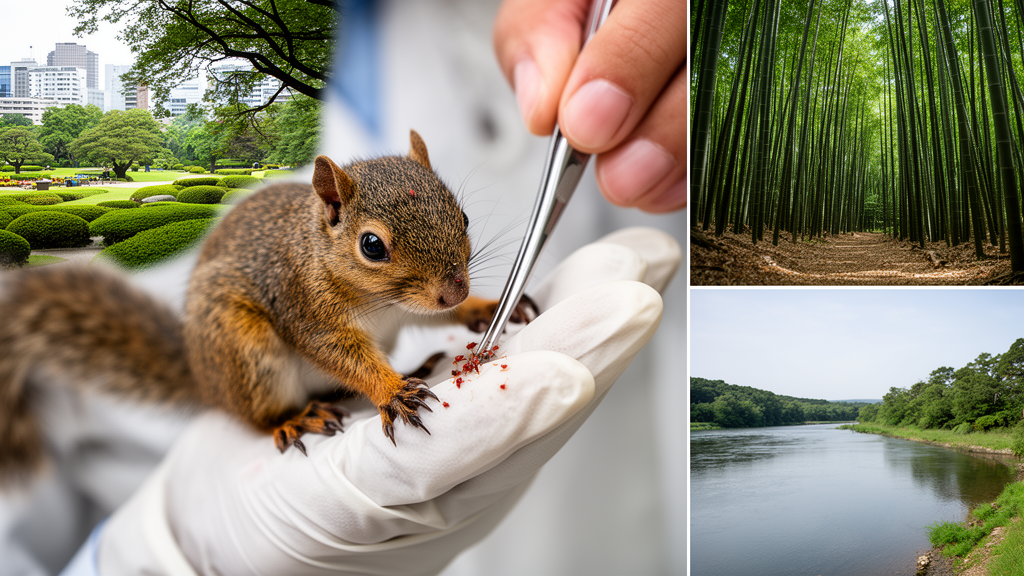
Invasive Pallas’s squirrels in Hamamatsu, Japan, carried a patchy assemblage of ticks, mites and fleas, with greater ectoparasite diversity recorded outside the urban core. A field study of 194 squirrels from 22 sites found no non-native ectoparasites among the animals examined. The results were consistent with parasite release followed by secondary acquisition of ectoparasite species already present in the local environment.
Researchers collected the squirrels between June 2019 and January 2021, sampling 96 males and 98 females. All ectoparasites recovered from the animals were identified using morphological and molecular approaches. The study examined an introduced species that has become established in several Japanese cities.
Hamamatsu City was selected because its invasion history and range expansion are well documented, allowing the researchers to investigate parasite assemblages in an invasive host across an urban–rural landscape. Not detecting non-native ectoparasites provides no evidence that the squirrels carried their ectoparasites with them when they were introduced. Instead, the observed combination of local parasite taxa and the absence of non-native species fits a scenario in which the invasive mammals lost part of their original parasite community and subsequently acquired parasites from the invaded landscape.
The authors describe this pattern as consistent with secondary local acquisition rather than as direct proof of a particular transmission route. Ectoparasite assemblages were distributed patchily across the sampled landscape, and diversity was higher outside the urban core. These observations indicate that the parasites carried by the squirrels were not distributed uniformly among sites.
These findings matter for how invasive species are evaluated in urbanized environments. Urban areas are major interfaces for biological invasions, where introduced species can interact with people and synanthropic wildlife. An ectoparasite inventory on the invasive host can therefore help describe its ecological contacts with the surrounding community, including the presence of arthropods that may function as vectors.
The study also demonstrates why examining only an invader’s original parasite load may provide an incomplete picture. Its ectoparasites were locally occurring species, and their composition varied geographically across Hamamatsu. This means that the parasite assemblage of an established invasive host can reflect conditions in the invaded landscape as well as the ecological history of the introduction itself.
The authors recommend combining information on resident host communities, natural history and biodiversity when evaluating invasive hosts that may contribute to zoonotic risk. The Hamamatsu observations support proactively characterizing wildlife around expanding populations of introduced mammals, while also showing the limits of a single-host parasite inventory. The study was observational and limited to the sampled squirrels and sites; it identified ectoparasite composition and spatial differences, but did not establish which animals supplied the parasites or quantify their implications for human health.
Subject of Research: Ectoparasite composition of invasive Pallas’s squirrels across urban and rural landscapes in Hamamatsu, Japan
Article Title: Differences in ectoparasite composition of invasive squirrels across urban and rural landscapes, with insights into local ectoparasite acquisition
Article References: Eguchi, Y., Shigematsu, Y., Suzuki, Y., Chijiiwa, A., Shimamoto, T., & Katahira, H. (2026). Differences in ectoparasite composition of invasive squirrels across urban and rural landscapes, with insights into local ectoparasite acquisition. Parasites & Vectors. https://doi.org/10.1186/s13071-026-07752-z
Image Credits: AI Generated
DOI: 10.1186/s13071-026-07752-z
Keywords: Pallas’s squirrel, ectoparasites, invasive species, urban ecology, ticks, trombiculid mites, fleas, Hamamatsu, Japan, zoonotic risk, Differences, ectoparasite
News Source: Gavin Prescott. (October 21, 2026). Invasive squirrels in Hamamatsu show patchy ectoparasite diversity across landscapes. Scienmag.