A combined single-cell RNA-sequencing, spatial and functional study has mapped distinct fibroblast populations in the normal human colon and identified four cancer-associated fibroblast subsets in colorectal cancer, providing a reference for the tissue’s complex mesenchyme. The analysis was guided by the well-characterized mouse colon and designed to address the diversity of normal colon fibroblasts that shapes tumor mesenchyme. This distinction matters because cancer-associated fibroblast subsets and nomenclature vary widely among colorectal cancer studies, limiting precise interpretation of the cells that promote tumorigenesis.
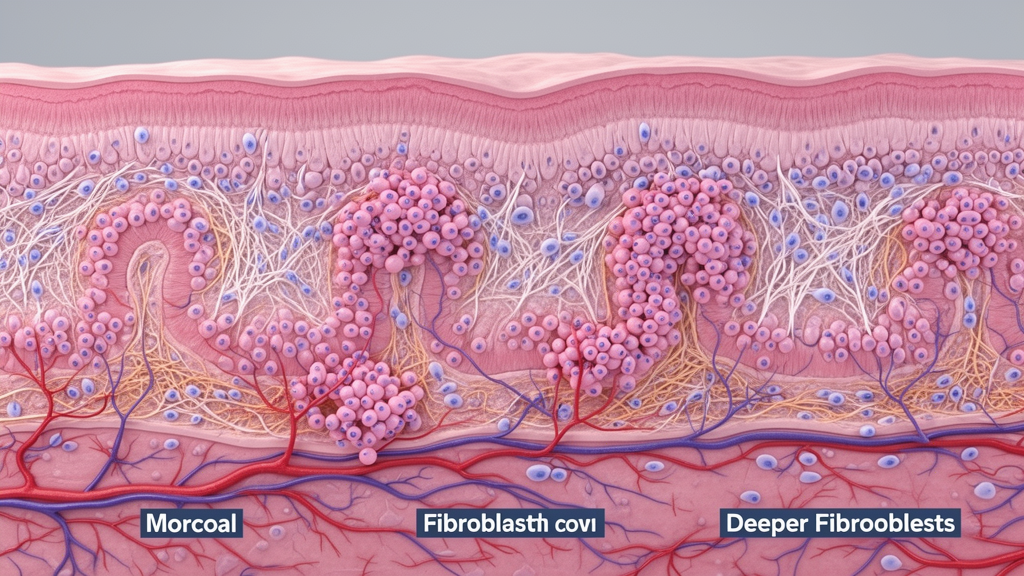
Researchers defined three major fibroblast populations in normal human colon tissue: subepithelial myofibroblasts, mucosa-associated fibroblasts and submucosa-associated fibroblasts. Each population was associated with a defined anatomical location, allowing the reference map to represent both cellular identity and its position within the organ. The study also characterized a previously underexplored population of muscle-embedded interstitial fibroblasts.
By including this population and the other anatomically defined fibroblast classes, the atlas captures a broader view of normal colon mesenchyme than a scheme based only on fibroblast states associated with tumors. Using the normal-colon reference, the team delineated four colorectal cancer-specific cancer-associated fibroblast subsets. These comprised inflammatory CAFs, matrix CAFs and two precursor populations, which the researchers termed pre-CAFs.
The mapping therefore separates several cellular states that might otherwise be grouped under the broad CAF label. CTHRC1 emerged as a robust marker of colorectal cancer-associated fibroblasts. The researchers also inferred transcriptional regulators associated with the mapped populations and defined distinct developmental trajectories linked to activation of inflammatory and matrix CAF programs.
These regulator and trajectory findings are presented as components of the atlas rather than demonstrated therapeutic targets. Together, the results form a spatially and transcriptionally resolved reference map of human normal colon fibroblasts and colorectal cancer mesenchymal subsets. Its immediate value is as a framework for mechanistic studies of fibroblast heterogeneity and for future work examining CAF-targeted therapies.
The supplied evidence does not report the number of patients or samples, the specific composition of the functional assays, or the extent of experimental validation for the inferred regulators and trajectories.
Subject of Research: Spatial and single-cell mapping of normal and colorectal cancer-associated colon fibroblasts
Article Title: An integrated spatially defined roadmap of normal and cancer-associated colon fibroblasts
Article References: Viitala, E. W., Salminen, E., Miihkinen, M., Lemmetyinen, T. T., Sévigny, M., Porvari, K. K., Malpani, T., Chalkidi, N., Stavropoulou, A., Päivinen, P. J., Kaprio, T., Hagström, J., Haglund, C., Mäkelä, T. P., Katajisto, P., Aittokallio, T., Koliaraki, V., & Ollila, S. (2026). An integrated spatially defined roadmap of normal and cancer-associated colon fibroblasts. Molecular Systems Biology. https://doi.org/10.1038/s44320-026-00247-0
Image Credits: AI Generated
DOI: 10.1038/s44320-026-00247-0
Keywords: colorectal cancer, cancer-associated fibroblasts, single-cell RNA sequencing, spatial mapping, colon mesenchyme, fibroblast heterogeneity, inflammatory CAFs, matrix CAFs, cellular atlases, developmental trajectories, integrated, spatially
News Source: Nathaniel Bowman. (October 21, 2026). An integrated spatially defined roadmap of normal and cancer-associated colon fibroblasts. Scienmag.