Researchers in Tianjin have designed a randomized controlled trial to test whether a penetrating needling technique linking two ankle acupoints produces better lower-limb motor recovery after stroke than separate needling at the same points. The study is a protocol: recruitment began on 31 March 2026, enrollment is expected to continue until 31 December 2026, and no efficacy results are available. At the First Teaching Hospital of Tianjin University of Traditional Chinese Medicine, the investigators plan to enroll 130 adults with subacute stroke and lower-limb motor dysfunction. Participants will be assigned in equal numbers to penetrating needling from Qiuxu (GB40) toward Zhaohai (KI6) or conventional separate needling at those acupoints, with both groups receiving the same schedule of conventional rehabilitation.
The planned trial has a prospective, parallel-group superiority design with outcome assessors blinded to treatment allocation. Its principal clinical endpoint is the Fugl-Meyer Assessment for Lower Extremity score at the end of treatment, measured within six hours of the final acupuncture session. The primary analysis will compare groups with analysis of covariance, adjusting for baseline scores. Additional clinical measures—the Berg Balance Scale, Manual Muscle Testing and Modified Ashworth Scale—will assess balance, strength and spasticity. Functional near-infrared spectroscopy and surface electromyography will also be recorded, but the protocol explicitly classifies their derived measures as exploratory and hypothesis-generating rather than confirmatory outcomes.
Both intervention groups will receive 12 acupuncture sessions over two weeks, six per week, with each needle retained for 30 minutes. The rehabilitation dose will also be matched: 30 minutes per day, five days per week, emphasizing lower-limb motor control, balance, transfers and gait according to each patient’s condition. Licensed acupuncture physicians with at least three years of clinical experience and standardized trial training will deliver treatment. Participants will be assessed before therapy and after the two-week course, while medication and other clinically indicated care may continue and will be recorded to account for background treatment differences.
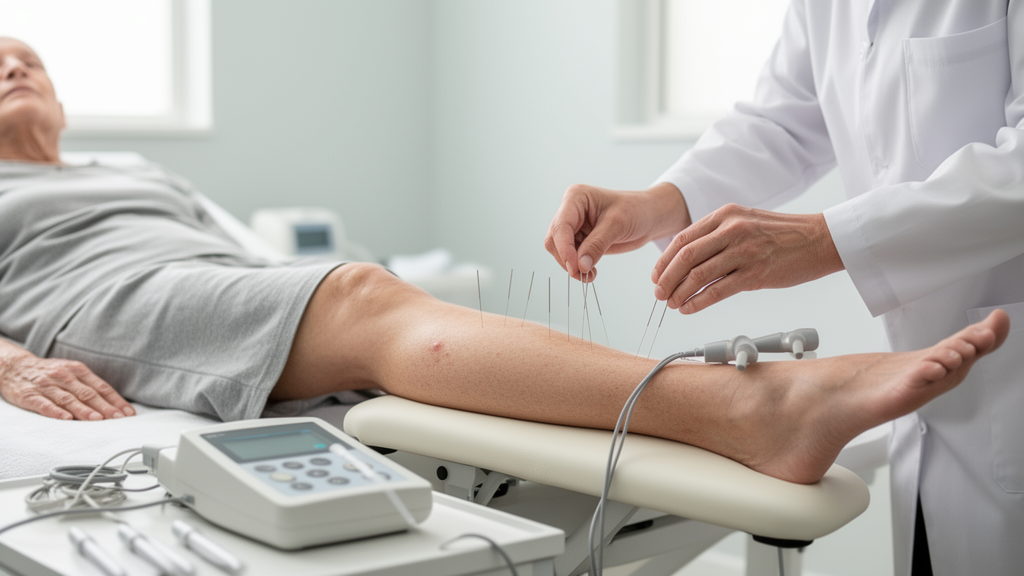
The experimental procedure uses one disposable sterile filiform needle measuring 0.30 × 75 mm. It enters Qiuxu, in the depression anterior and inferior to the lateral malleolus, at approximately 15–30 degrees to the skin and is advanced slowly through the anteroinferior ankle’s soft tissue toward the subcutaneous area corresponding to Zhaohai, which lies below the medial malleolus. The needle does not pierce the skin at Zhaohai. The comparator uses two 0.25 × 40 mm needles, one at each point, with insertion depths of approximately 15–25 mm. In both groups, needles are twirled after insertion and every 10 minutes during retention, with soreness, numbness or distension used to identify deqi.
Because the two arms differ in needle number and size, insertion depth, tissue trajectory and extent of local stimulation, the trial compares complete treatment packages rather than isolating a single technical feature. Any observed difference therefore could not be attributed to needle trajectory alone. The design also does not test acupuncture against no treatment or a sham intervention, so it cannot establish the effect of acupuncture itself. The investigators instead ask which of two active, standardized procedures produces the larger short-term clinical difference when each is used as an adjunct to the same rehabilitation program. Practitioners cannot be blinded to the visibly different procedures, although participants will know that both groups receive active acupuncture.
To reduce assessment and analysis bias, an independent statistician will generate the allocation sequence with fixed blocks of four, and assignments will be concealed in sequentially numbered opaque envelopes until consent and baseline assessment are complete. Outcome assessors, staff acquiring the physiological signals, data-entry personnel and statisticians will remain blinded. Acupuncture practitioners will be excluded from assessment, instrument acquisition, data management and analysis, while statistical groups will be masked as A and B. Emergency unblinding is reserved for situations in which knowledge of the intervention is considered essential for immediate management of a serious adverse event or another urgent condition.
The exploratory brain measurements will use functional near-infrared spectroscopy to examine task-related oxygenated hemoglobin in eight motor-related regions of interest and resting-state connectivity between them. Recordings will include an eight-minute eyes-closed rest and a structured affected-side ankle-dorsiflexion task. The primary signal analysis will focus on eight task-related regional estimates and 28 resting-state interregional connections, with false-discovery-rate adjustment applied separately within those exploratory families. Surface electromyography will assess bilateral tibialis anterior and medial gastrocnemius activity during affected-side dorsiflexion, emphasizing affected-to-unaffected ratios for average rectified values. Missing or technically unusable instrument files will not be numerically imputed, and bad near-infrared channels will not be replaced with neighboring data.
The sample-size calculation was based on the lower-limb Fugl-Meyer endpoint and an anticipated standardized difference of 0.45, a planning assumption rather than an effect already observed between the two techniques. Using a two-sided significance level of 5%, 80% power and a baseline-to-follow-up correlation of 0.50, the calculation required 58.14 participants per group. Allowing for 10% attrition produced 64.60 participants per group, rounded to 65, for a total of 130. The primary analysis will follow the intention-to-treat principle, using multiple imputation for missing clinical scores under a missing-at-random assumption and reporting complete-case and per-protocol analyses as sensitivity checks.
Safety monitoring will focus on persistent or severe pain, bleeding, subcutaneous hematoma, needle-related fainting, infection, persistent sensory abnormality and suspected nerve injury. Acupuncture may be suspended or stopped for events including severe pain, overt bleeding, an enlarging hematoma, local infection, clinical deterioration or a participant’s request to withdraw. Because the study is single-center and has no planned interim efficacy analysis, an independent data-monitoring committee is not planned; the principal investigator, research team and hospital ethics committee will oversee safety and protocol conduct. The design is supported by an institutional ethics approval, and all participants must provide written informed consent. Although the work could yield a useful comparison between reproducible needling protocols, its short treatment period, lack of practitioner blinding and coupled procedural differences will limit conclusions about long-term benefit, causal mechanisms and generalizability to other rehabilitation settings.
Subject of Research: A randomized trial protocol comparing two acupuncture needling techniques for subacute post-stroke lower-limb motor recovery
Article Title: Penetrating needling from Qiuxu (GB40) to Zhaohai (KI6) versus separate needling for post-stroke lower-limb motor dysfunction: an assessor-blinded randomized controlled trial protocol
Article References: Zhang, J., Wang, L., Tian, Z., Wang, M., Fan, J., Liu, X., Cui, C., Qian, Y., Zhang, R., Liu, Y., & Wan, C. (2026). Penetrating needling from Qiuxu (GB40) to Zhaohai (KI6) versus separate needling for post-stroke lower-limb motor dysfunction: an assessor-blinded randomized controlled trial protocol. Frontiers in Neurology, 17, Article 1911011. https://doi.org/10.3389/fneur.2026.1911011
Image Credits: AI Generated
DOI: 10.3389/fneur.2026.1911011
Keywords: stroke rehabilitation, lower-limb motor dysfunction, acupuncture, randomized controlled trial, fNIRS, surface electromyography, neurorehabilitation, clinical trial protocol, Penetrating, needling, Qiuxu, GB40
News Source: Cassandra Pierce. (October 21, 2026). Trial protocol tests two acupuncture techniques for post-stroke leg recovery. Scienmag.