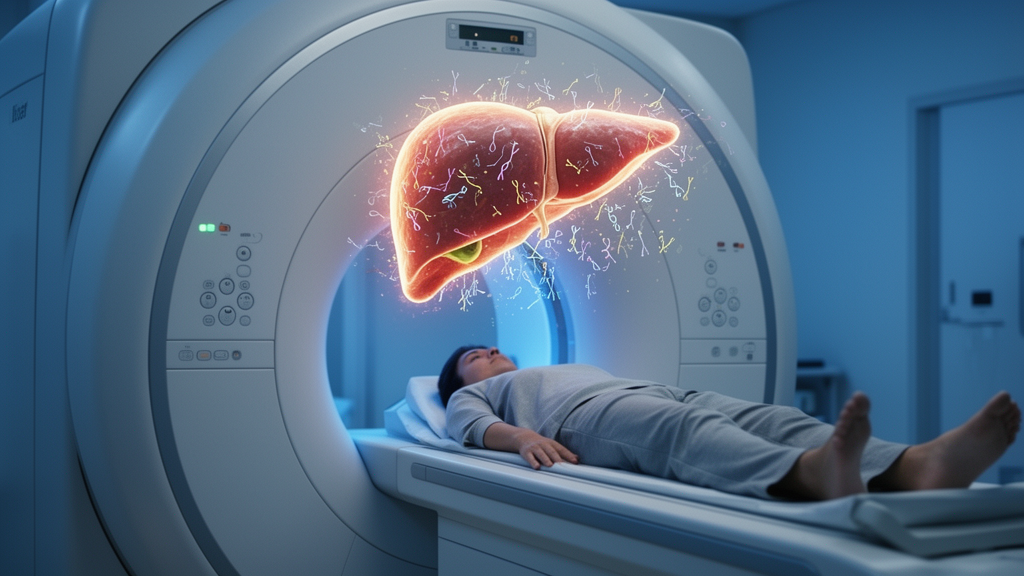
A genome-wide association meta-analysis using magnetic resonance imaging data from 71,488 people of European ancestry identified 60 independent loci associated with liver triglyceride content, including 31 loci not previously reported. The researchers also estimated SNP-based heritability of MRI-derived liver triglyceride content at 25% and nominated candidate effector genes at 48 loci. Of the 31 newly identified signals, 14 were associated with clinically diagnosed metabolic dysfunction-associated steatotic liver disease in a separate meta-analysis of 42,163 cases and 1,646,254 controls.
The study further linked inherited susceptibility to liver fat with metabolic and inflammatory protein pathways and with elevated odds of cirrhosis and hepatocellular carcinoma. The analysis combined three nonoverlapping UK Biobank datasets in which liver triglyceride content was represented by MRI-derived proton density fat fraction, or PDFF. The largest newly processed group included 35,179 participants whose scans were analyzed with an established abdominal MRI segmentation pipeline.
A second group comprised 35,109 participants with a Perspectum-derived PDFF measure, and the third contained 1,200 participants with PDFF obtained from a single-slice gradient-echo acquisition. Because the acquisition and image-processing methods differed, the investigators analyzed the three datasets separately before combining their summary statistics through fixed-effect inverse-variance-weighted meta-analysis. Each association model used whole-genome regression adjusted for age at MRI, sex, age squared and interactions with sex, BMI at MRI, genotyping array and the first 10 ancestry principal components.
PDFF values were transformed to a rank-based inverse normal distribution for the primary analysis. Participants shared between datasets were removed to preserve independence, and more than 9 million common imputed variants were tested after filtering for minor allele frequency above 1%, imputation quality above 0.8 and Hardy–Weinberg equilibrium P values above 1 × 10⁻¹⁰. A sensitivity analysis rescaled the three PDFF measurements to a common scale before repeating the association analysis, while another examined lead-variant associations after additional adjustment for alcohol intake at the imaging visit.
Quality control was particularly important for the 42,028 scans processed in the present study. The investigators examined measures of the PDFF distribution, liver-mask boundary, motion-related signal and isolated high-fat voxels, then applied five unsupervised anomaly-detection methods: robust Mahalanobis distance, isolation forest, robust random cut forest, local outlier factor and one-class support vector machine. A model combining the 99th percentile of PDFF values inside the eroded liver mask with isolation forest achieved 0.93 precision in fivefold cross-validation and flagged 0.70% of scans in the subset with reference PDFF measurements.
Applying the selected threshold to the full dataset excluded 188 scans from downstream analysis. Independent associations were identified through linkage-disequilibrium clumping followed by conditional and joint multiple-SNP analysis. The researchers then fine-mapped signals around each lead variant with PolyFun-derived per-SNP priors and the SuSiE method, which allowed up to 10 causal variants per region.
Gene prioritization combined fine-mapped variants with evidence from FLAMES, a framework integrating SNP-to-gene information and statistical convergence, and CALDERA, a model incorporating regulatory, expression and chromatin features. Liver bulk RNA-sequencing data from 217 people in the MAFALDA study were also used for expression quantitative trait locus mapping and colocalization. A colocalization posterior probability above 0.8 was considered strong evidence that the liver-fat and nearby gene-expression signals were driven by the same causal variant.
The new imaging signals were tested against clinical outcomes in additional European-ancestry datasets. The MASLD analysis combined UK Biobank data with the Million Veteran Program, FinnGen Release 12, deCODE and Intermountain, with participants who had PDFF measurements excluded to avoid overlap. Analyses of hepatocellular carcinoma used the first four of those resources, while cirrhosis was examined using summary statistics from nine studies containing 15,225 cases and 1,564,786 controls.
When a liver-fat lead variant was unavailable in a target analysis, the researchers selected a correlated proxy where possible, using European linkage disequilibrium from the 1000 Genomes Project and, when necessary, a UK Biobank reference panel. The clinical results statistically validated 14 of the 31 newly identified imaging loci for MASLD; they did not show that a particular locus caused an individual case of disease. The team built two polygenic scores.
One was calculated from the weighted effects of the 60 independent lead variants, while a genome-wide score used summary statistics and functional genomic annotations to estimate joint effects across many SNPs. In UK Biobank analyses that excluded people with available PDFF data, the highest decile of the genome-wide score was associated with 2.71-fold higher odds of cirrhosis and 7.47-fold higher odds of hepatocellular carcinoma compared with the lowest decile. The models adjusted for age, sex, age squared and interactions with sex, BMI, the first 10 genetic principal components and array batch.
Prospective analyses used age as the underlying timescale, excluded participants who already had the relevant diagnosis at baseline and found no evidence that the proportional-hazards assumption was violated. To examine molecular pathways associated with the genetic signal, the investigators analyzed 2,923 plasma proteins measured with the Olink Explore 3072 platform in the UK Biobank Pharma Proteomics Project. After adjustment for demographic, clinical, technical and genetic factors, proteins associated with the genome-wide liver-fat score were enriched for pathways involving metabolic remodeling and inflammation.
Tissue-origin annotations showed liver-enriched protein signatures increasing as genetic risk rose, whereas visceral adipose tissue signatures decreased. The researchers also compared the liver-fat score with scores for atrial fibrillation, BMI, coronary artery disease, cardiovascular disease, glycated hemoglobin, blood lipids, hypertension and diabetes. Separately, MAGMA analyses using healthy human single-cell expression data tested whether genes with stronger liver-fat associations were preferentially expressed in particular cell types.
Several limitations shape the interpretation of these findings. The primary imaging sample came from the UK Biobank and was restricted to participants of European ancestry, so the results do not directly establish the architecture of liver-fat inheritance in other populations. The three imaging datasets also used different acquisition or derivation methods and required either separate analysis or harmonization.
The 25% heritability estimate was generated within the study’s statistical model rather than serving as an individual-level probability. Candidate effector genes remain functional candidates, and the liver expression analysis was restricted to 217 people and variants near expressed genes. The disease estimates compare risk groups, not absolute outcomes for a particular person, while the proteomic results identify associations and pathway enrichments without testing whether changing those pathways would prevent disease.
Taken together, the study provides a larger genetic map of quantitative liver triglyceride content and evaluates how that map relates to clinically diagnosed steatotic liver disease, cirrhosis and hepatocellular carcinoma. The results distinguish continuous liver triglyceride content from overt disease, showing that some variants influencing the imaging phenotype also show statistical associations with clinical outcomes while leaving the effector mechanisms and individual clinical value of the risk scores to be established.
Subject of Research: Genome-wide genetic determinants of MRI-derived liver triglyceride content in European-ancestry participants
Article Title: Genome-wide analyses identify 60 loci associated with liver triglyceride content
Article References: Jamialahmadi, O., Mowlaei, S., Gelev, K. Z., Mancina, R. M., Flagiello, V., Kozlitina, J., Pajukanta, P., Valenti, L., & Romeo, S. (2026). Genome-wide analyses identify 60 loci associated with liver triglyceride content. Nature Genetics. https://doi.org/10.1038/s41588-026-02794-6
Image Credits: AI Generated
DOI: 10.1038/s41588-026-02794-6
Keywords: liver fat, genome-wide association study, MRI, proton density fat fraction, steatotic liver disease, polygenic risk score, cirrhosis, hepatocellular carcinoma, effector genes, UK Biobank, Genome-wide, analyses
News Source: Juliet Wilcox. (October 21, 2026). 60 genetic loci linked to liver fat in European-ancestry MRI study. Scienmag.