• HOME
  • NEWS
  • EXPLORE
    • CAREER
      • Companies
      • Jobs
    • EVENTS
    • iGEM
      • News
      • Team
    • PHOTOS
    • VIDEO
    • WIKI
  • BLOG
  • COMMUNITY
    • FACEBOOK
    • INSTAGRAM
    • TWITTER
Wednesday, October 21, 2026
BIOENGINEER.ORG
No Result
View All Result
  • Login
  • HOME
  • NEWS
  • EXPLORE
    • CAREER
      • Companies
      • Jobs
        • Lecturer
        • PhD Studentship
        • Postdoc
        • Research Assistant
    • EVENTS
    • iGEM
      • News
      • Team
    • PHOTOS
    • VIDEO
    • WIKI
  • BLOG
  • COMMUNITY
    • FACEBOOK
    • INSTAGRAM
    • TWITTER
No Result
View All Result
Bioengineer.org
No Result
View All Result
Home NEWS Science News Chemistry

Corn-stalk composite slows fertilizer release in laboratory soil tests

by
October 21, 2026
in Chemistry
Reading Time: 2 mins read
0
Corn-stalk composite slows fertilizer release in laboratory soil tests

Corn-stalk composite slows fertilizer release in laboratory soil tests

Share on FacebookShare on TwitterShare on LinkedinShare on RedditShare on Telegram

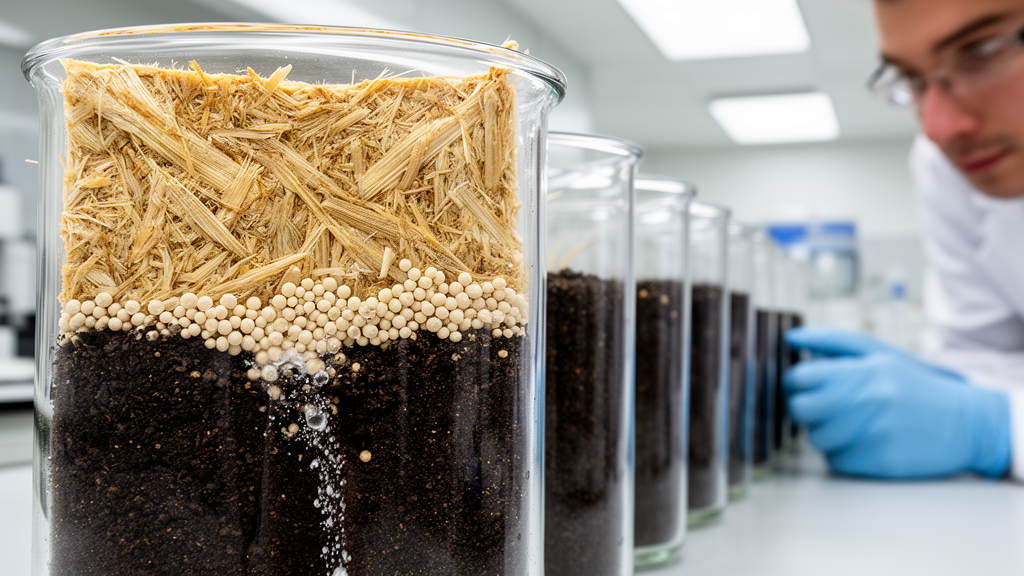
A phytic-acid-modified corn-stalk composite superabsorbent adsorbed substantial quantities of fertilizer solution and reduced early nutrient release when incorporated into soil, according to a laboratory materials study. Researchers prepared the composite, abbreviated PCS-SAPs, through graft copolymerization of itaconic acid, acrylamide, vinyl pyrrolidone and phytic-acid-treated corn stalk material. Tests of different corn-stalk contents showed that fertilizer-solution adsorption first increased and then decreased as the proportion of phytic-acid-treated corn stalk rose.

The maximum reported in this series occurred at 15 wt% PCS, where the material adsorbed 106 g of urea solution per gram and 22 g of potassium dihydrogen phosphate, or KDP, solution per gram. A separately optimized PCS-SAP formulation achieved reported adsorption capacities of 360.5 g/g for urea solution and 40.5 g/g for KDP solution. These figures measure the mass of solution adsorbed per gram of material, rather than the mass of pure urea or phosphate retained.

The clearest slow-release result came from soil tests using an addition of 0.5 wt% PCS-SAPs. Under those conditions, the cumulative urea released over five days decreased from 83.04% without the composite to 47.56% with it. KDP release over 2.5 days fell from 89.14% to 73.96%.

The measurements therefore show reduced early release over the specified test periods. They do not establish how long the slower release persists, how the material behaves across different soils or whether the same effects occur under field conditions. Ultrasonic pretreatment partially destroyed its crystal structure and severely disrupted the original fibrous framework.

Radical copolymerization then further reduced crystallinity and converted the corn-stalk component to an amorphous phase. The researchers associated these changes with a greater specific surface area and more homogeneous dispersion within the polymer matrix. The resulting PCS-SAPs displayed a rough, porous and fluffy morphology, while the water-swollen material formed interpenetrating network skeletons with interconnected pores.

The study frames PCS-SAPs as a possible agricultural material for retaining fertilizer solutions and slowing release, with potential relevance to arid regions. Its reported attributes include low cost, high fertilizer adsorption, favorable slow-release behavior and environmental compatibility, but the supplied abstract does not provide comparative cost data or direct environmental measurements. The evidence presented here is limited to fabrication, characterization, adsorption capacities and laboratory release tests.

Subject of Research: Materials engineering of corn-stalk superabsorbents for fertilizer adsorption and slow release

Article Title: Adsorption and slow release of fertilizer by phytic acid-modified corn stalk composite superabsorbents

Article References: Li, Y., Wan, T., Yang, H., Liu, J., & Zhao, L. (2026). Adsorption and slow release of fertilizer by phytic acid-modified corn stalk composite superabsorbents. Polymer Bulletin, 83(12), Article 688. https://doi.org/10.1007/s00289-026-06735-5

Image Credits: AI Generated

DOI: 10.1007/s00289-026-06735-5

Keywords: corn stalk composite, superabsorbent polymer, fertilizer adsorption, slow-release fertilizer, phytic acid, urea, potassium dihydrogen phosphate, graft copolymerization, laboratory soil test, agricultural materials, Adsorption, slow

News Source: Bethany Barker. (October 21, 2026). Corn-stalk composite slows fertilizer release in laboratory soil tests. Scienmag.


Tags: adsorptionagricultural materialscorn stalk compositefertilizer adsorptiongraft copolymerizationlaboratory soil testphytic acidpotassium dihydrogen phosphateslowslow-release fertilizersuperabsorbent polymerurea
Share12Tweet7Share2ShareShareShare1

Related Posts

DQ-1 laser satellite matches passive carbon dioxide monitors

DQ-1 laser satellite matches passive carbon dioxide monitors

October 21, 2026
Experimental study reports ordered polar vortices in lead-free BaTiO3/SrTiO3 superlattices on silicon

Experimental study reports ordered polar vortices in lead-free BaTiO3/SrTiO3 superlattices on silicon

October 21, 2026

Experimental photonic crystal scintillator raises X-ray light output 4.64-fold

October 21, 2026

Near-Freezing Water Balances Oxygen Evolution Activity and Catalyst Stability

October 21, 2026

POPULAR NEWS

  • SGLT2 inhibitors show modest, uncertain benefit for functional mitral regurgitation

    SGLT2 inhibitors show modest, uncertain benefit for functional mitral regurgitation

    29 shares
    Share 12 Tweet 7
  • Texas TSWV isolate loses detectable Tsw recognition but retains tomato resistance

    29 shares
    Share 12 Tweet 7
  • Energy-Aware UAV Planner Cuts Simulated Monitoring Mission Time by Nearly 60%

    29 shares
    Share 12 Tweet 7
  • Corn-stalk composite slows fertilizer release in laboratory soil tests

    29 shares
    Share 12 Tweet 7

About

We bring you the latest biotechnology news from best research centers and universities around the world. Check our website.

Follow us

Recent News

SGLT2 inhibitors show modest, uncertain benefit for functional mitral regurgitation

Texas TSWV isolate loses detectable Tsw recognition but retains tomato resistance

Energy-Aware UAV Planner Cuts Simulated Monitoring Mission Time by Nearly 60%

Subscribe to Blog via Email

Enter your email address to subscribe to this blog and receive notifications of new posts by email.

Join 85 other subscribers
  • Contact Us

Bioengineer.org © Copyright 2023 All Rights Reserved.

Welcome Back!

Login to your account below

Forgotten Password?

Retrieve your password

Please enter your username or email address to reset your password.

Log In
No Result
View All Result
  • Homepages
    • Home Page 1
    • Home Page 2
  • News
  • National
  • Business
  • Health
  • Lifestyle
  • Science

Bioengineer.org © Copyright 2023 All Rights Reserved.