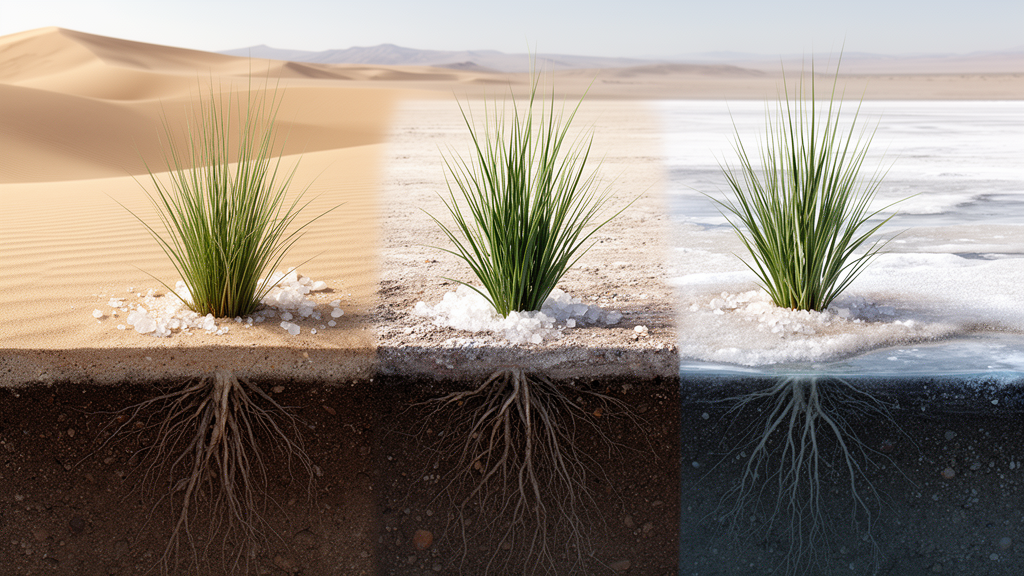
A field comparison of the desert grass Panicum turgidum found coordinated physiological changes in plants growing across sand dunes, sandy plains and saline areas, including shifts in photosynthetic pigments, stress-related metabolites, antioxidant compounds and tissue ions. The research, published in The Science of Nature, examined plants already occupying habitats with different salinity conditions rather than testing the grass in a controlled restoration experiment. At the saline end of the environmental gradient, soil electrical conductivity reached 41.3 ± 0.3 dS m⁻¹, while sodium and chloride concentrations reached 4967.9 ± 0.2 mg L⁻¹ and 2431.7 ± 0.3 mg L⁻¹, respectively. The findings identify traits that may be relevant to future studies of saline-land restoration and desert environments, but they do not demonstrate restoration effectiveness.
For the study, researchers selected five subsites in each of the three habitats and applied the quadrat method for vegetative sampling. Soil physicochemical features were measured alongside photosynthetic pigments, biochemical traits and ionic contents in root and stem tissues. Soil electrical conductivity and the concentrations of sodium and chloride increased from the dune sites toward the saline environments, documenting a distinct salinity gradient. The sampling design allowed researchers to compare physiological conditions among plants inhabiting the different environments. It was an observational field comparison, however, and the supplied findings do not describe an experiment in which P. turgidum was planted to establish vegetation or restore degraded land.
The clearest change in photosynthetic measurements was a marked decline in chlorophyll a and chlorophyll b under saline conditions, suggesting a stress effect on photosynthesis. The plants simultaneously accumulated several stress-related metabolites. In the saline environments, proline reached 294.8 ± 1.13 µg g⁻¹ fresh weight, free amino acids reached 1593.7 ± 2.83 µg g⁻¹ fresh weight, soluble proteins reached 1706.5 ± 1.07 µg g⁻¹ fresh weight, and total soluble sugars reached 28.71 ± 0.44 mg g⁻¹ dry weight. These compounds increased gradually across the environmental gradient. The parallel accumulation of osmolytes and other stress-related metabolites indicates a coordinated physiological response associated with osmotic adjustment, even as reduced chlorophyll levels signaled stress affecting the photosynthetic system.
Antioxidant compounds also accumulated as salinity increased. Flavonoid concentration reached 3.846 ± 0.04 mg g⁻¹ dry weight in the saline environments, while phenolics reached 11.35 ± 0.01 µg g⁻¹ fresh weight. Their greater accumulation was associated with improved protection against oxidative stress, and it occurred alongside changes in osmolytes and photosynthetic pigments rather than as an isolated response. Ion regulation completed the observed pattern: sodium and chloride accumulated in both roots and stems, while potassium and calcium remained at controlled levels. Taken together, the measurements show salt accumulation combined with controlled essential-ion levels, osmotic adjustment and antioxidant resistance. These coordinated traits may help explain how P. turgidum persists in saline desert habitats, although the study does not establish which mechanisms are necessary for survival, how quickly populations adapt or whether the grass can reproduce, spread and restore degraded sites. The authors therefore present the species as a candidate for further investigation in saline-land restoration and desert-environment studies rather than as a demonstrated restoration intervention.
Subject of Research: Physiological responses of the desert grass Panicum turgidum across habitats with increasing soil salinity
Article Title: Assessing physiological traits responses of Panicum turgidum under desert environments: a prospect for desert restoration
Article References: Akram, M., Naz, N., Karimova, S. I., Hassan, H. M. M., Iqbal, U., Hamed, L. M. M., Badr, E. A., El-Mogy, M. M., Mahmoud, H. H., & Ameen, F. A. (2026). Assessing physiological traits responses of Panicum turgidum under desert environments: a prospect for desert restoration. The Science of Nature, 113(6), Article 138. https://doi.org/10.1007/s00114-026-02184-2
Image Credits: AI Generated
DOI: 10.1007/s00114-026-02184-2
Keywords: Panicum turgidum, desert grass, plant salinity tolerance, soil salinity, osmotic adjustment, antioxidant compounds, ion regulation, photosynthetic pigments, saline habitats, land restoration, Assessing, physiological
News Source: Drew Townsend. (October 21, 2026). Desert grass shows coordinated salt-tolerance traits across three habitats. Scienmag.