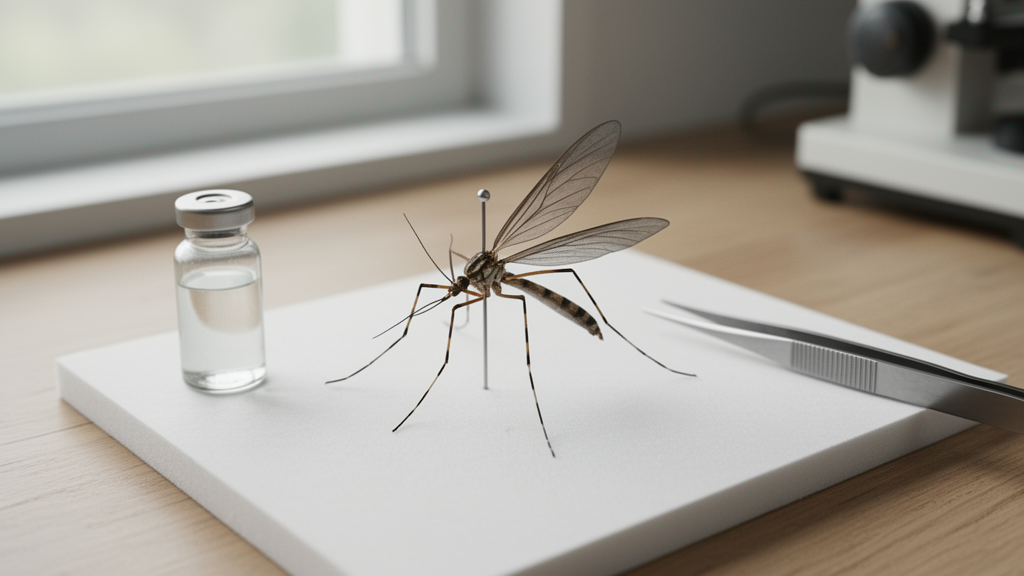
A taxonomic study of 14 adult crane fly specimens from North Korea identified four species in the subgenus Tipula (Vestiplex), including the newly described Tipula (Vestiplex) longistila sp. nov. The study also documented new distribution records for three previously known species, bringing the number of Vestiplex species recorded from North Korea to seven. The specimens were collected by Wiesław Krzemiński and Edward Palik in 1981 and 1989 during the fifth and twelfth expeditions of researchers from the Institute of Systematics and Evolution of Animals of the Polish Academy of Sciences to North Korea. Adult specimens were photographed, and male hypopygia were removed, boiled in 10% sodium hydroxide for five to 10 minutes, and examined in glycerine under a stereomicroscope.
Images of dissected terminalia were assembled with focus-stacking software and edited in Adobe Photoshop. The researchers followed the adult descriptive terminology of Cumming and Wood, while adopting the term “genital bridge” from Dobrotworsky. The examined material is deposited at the Institute of Systematics and Evolution of Animals of the Polish Academy of Sciences in Kraków, Poland.
Tipula (Vestiplex) longistila is known from two male specimens collected at Samjiyon in North Korea’s Ryanggang Province on 3 August 1989. The holotype and paratype have body lengths of 16.4–17.3 mm, wing lengths of 17.4–17.8 mm and antenna lengths of 5.3–5.5 mm. The female of the species remains unknown.
The new species is distinguished by antennae that extend beyond the wing base when bent backward, a yellow abdomen with three longitudinal stripes, horn-shaped posterolateral extensions on tergite 9, and an elongate inner gonostylus with a claw-shaped apex and acute lower beak. Its gonocoxite lacks an apical outgrowth. The specific epithet combines the Latin words “longus,” meaning long, and “stilus,” meaning pointed, referring to the elongate inner gonostylus.
The authors place the new species in the leucoprocta species group and note its morphological similarity to Tipula (Vestiplex) quadricorna, described from Ningxia, China. They distinguish the North Korean species by the horn-shaped posterolateral lobes and split median tooth of tergite 9, the claw-shaped inner gonostylus with an acute lower beak, and the simple gonocoxite. Tipula (Vestiplex) dhalma was reported for the first time from the Korean Peninsula, based on one male and two females collected at Samjiyon in 1989.
The species had previously been described from the Russian Far East. An additional North Korean record was documented for Tipula (Vestiplex) kuwayamai, represented by a female collected at Paeksong-ir in South Pyongyang Province in 1981. This species was previously known from the Russian Far East, China, Japan, North Korea and South Korea.
The study also provides an updated, illustrated identification key for the seven Vestiplex species reported from the Korean Peninsula. For males, the key uses terminal characters such as the gonocoxite, gonostylus and tergite 9, together with body size, wing pattern and abdominal markings. For females, it uses wing development and pattern, cercus structure, sternite 8 and hypogynial valves.
The conclusions are based on the examined museum specimens, including only male material for the newly described species.
Subject of Research: Taxonomic study of North Korean crane flies in the subgenus Tipula (Vestiplex)
Article Title: Additions to the crane fly subgenus Tipula ( Vestiplex ) Bezzi, 1924 ( Diptera , Tipulidae ) for North Korea, with the description of a new species
Article References: Starkevich, P., & Syratt, M. (2026). Additions to the crane fly subgenus Tipula (Vestiplex) Bezzi, 1924 (Diptera, Tipulidae) for North Korea, with the description of a new species. Deutsche Entomologische Zeitschrift, 73(1), 49-57. https://doi.org/10.3897/dez.73.171303
Image Credits: AI Generated
Keywords: crane flies, Tipulidae, Tipula, Vestiplex, taxonomy, new species, North Korea, distribution records, species identification, Additions, crane, subgenus
News Source: Drew Townsend. (October 21, 2026). Taxonomic study identifies new North Korean crane fly species and three distribution records. Scienmag.