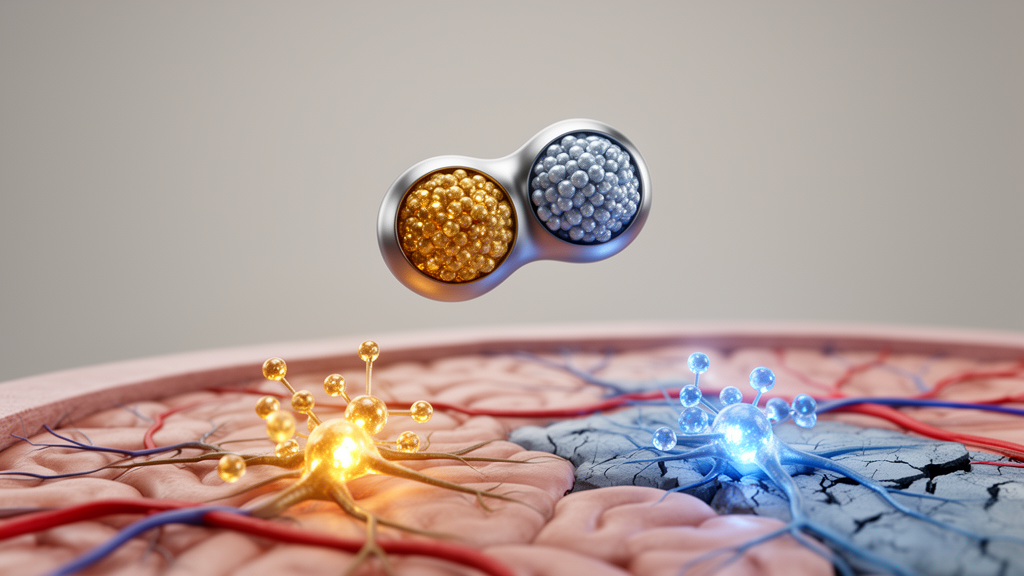
A newly synthesized adamantane-nitrone hybrid called TA1 reduced cerebral infarct volume in a mouse model of transient middle cerebral artery occlusion, according to an experimental study that combined cell assays, an in vitro blood-brain barrier model, and acute mouse testing. In treated mice, infarct volume fell from approximately 32.97% in untreated occlusion animals to approximately 14.33%, a larger reduction than that achieved with the comparison compound tetramethylpyrazine nitrone, or TBN.
Researchers at Nantong University designed four related compounds, TA1 through TA4, by combining a nitrone-pyrazine group derived from TBN with substituted adamantane structures. The compounds were prepared in three steps: condensation of 3,5,6-trimethylpyrazine-2-carbaldehyde with substituted adamantylamines, oxidation of the resulting imines with m-chloroperoxybenzoic acid, and heating the imine N-oxides in refluxing acetonitrile for 48 hours. Column chromatography yielded compounds with reported purity above 95%, while nuclear magnetic resonance spectroscopy and high-resolution mass spectrometry were used to characterize their structures.
TA1 was selected for further testing after it showed the strongest neuroprotective activity and the lowest cytotoxicity among the four hybrids. In PC12 rat pheochromocytoma cells and SH-SY5Y human neuroblastoma cells, survival remained above 90% after 24 hours of exposure to 100 micromolar TA1. Under oxygen-glucose deprivation and reoxygenation, an experimental model of ischemia-like cellular injury, viability in BV2 murine microglial cells, PC12 cells, and SH-SY5Y cells fell to about 50% of corresponding control values.
TA1 at 50 or 100 micromolar improved survival in a concentration-dependent manner, with survival exceeding 75% at 100 micromolar. At the same concentration, TA1 produced a greater restorative effect than TA2, TA3, TA4, or TBN. Annexin V-FITC and propidium iodide flow cytometry also showed that TA1 reduced the elevated apoptosis rate caused by oxygen-glucose deprivation and reoxygenation in BV2 cells, with a greater effect than an equal concentration of TBN.
In separate experiments, tert-butyl hydroperoxide was used to induce oxidative damage in BV2 cells. Fluorescent probes measured intracellular calcium, mitochondrial membrane potential, reactive oxygen species, and peroxynitrite. The injury model produced increased calcium fluorescence, mitochondrial depolarization, and higher signals for reactive oxygen species and peroxynitrite. TA1 reversed these measured changes in a dose-dependent manner and generally produced stronger effects than TBN under the same conditions.
For blood-brain barrier testing, the researchers established Transwell monolayers using mouse brain microvascular endothelial bEnd.3 cells. The apparent permeability coefficient for TA1 was 6.73 × 10⁻⁶ cm/s, compared with 5.16 × 10⁻⁶ cm/s for TBN. Following oxygen-glucose deprivation and reoxygenation, sodium fluorescein permeability in the model group increased to approximately 219% of the normoxic control value. Treatment reduced permeability to approximately 148% with TBN and 113% with TA1. These were in vitro endothelial-monolayer measurements and did not quantify TA1 exposure in the intact animal brain.
The in vivo experiment used 163 ICR and C57BL/6J mice across sham, middle cerebral artery occlusion, TBN, and two TA1 dose groups. Investigators administered TBN at 136 micromoles per kilogram or TA1 at 67 or 136 micromoles per kilogram intravenously at the onset of reperfusion, with saline given to sham and untreated occlusion groups. The principal endpoint was 24 hours after reperfusion, while neurological and behavioral outcomes were assessed at 48 hours. Separate cohorts were used for infarct measurement, edema, behavior, molecular analysis, histopathology, and safety evaluation, and behavioral and histological assessments were performed with blinding.
TA1-treated mice had less brain edema than untreated occlusion animals. Histological examinations showed neuronal damage and loss of Nissl substance in the hippocampal CA1, CA3, and dentate gyrus regions and cortex of untreated occlusion mice, while TA1 produced more pronounced preservation of neuronal architecture and Nissl substance in a dose-related pattern. TA1 also improved performance on the modified Zea Longa neurological scale, cylinder forelimb-use test, and corner-turn test compared with untreated occlusion mice. The report did not establish that TA1 improved edema or behavioral outcomes more than TBN.
Western blot analysis of ischemic penumbra tissue linked the observed effects to several measured pathways. TA1 restored Nrf2 and HO-1 protein levels, which had been reduced after occlusion, and shifted apoptosis-related proteins by reducing Bax and cleaved caspase-3 while increasing Bcl-2. It also reduced cytosolic phosphorylated IκBα and nuclear phosphorylated p65, markers associated with NF-κB signaling. At the higher TA1 dose, several molecular effects were stronger than those observed with equimolar TBN. These pathway measurements provide mechanistic associations with the cellular and mouse outcomes; they do not establish efficacy in humans.
Safety was assessed after one intravenous TA1 dose of 136 micromoles per kilogram. At 48 hours, measured red blood cell counts, hemoglobin, platelet counts, alanine aminotransferase, aspartate aminotransferase, urea, and creatinine were within normal ranges, and heart, liver, spleen, lung, and kidney histopathology showed preserved structural integrity without detected abnormalities. The study assessed acute efficacy and short-term tolerability only: brain penetration was evaluated in vitro, pharmacokinetics and quantitative brain exposure were not established, and outcomes were measured within 24 to 48 hours. The findings therefore support TA1 as an experimental candidate for further investigation, not as a clinically established treatment for ischemic stroke.
Subject of Research: Preclinical evaluation of an adamantane-nitrone hybrid for ischemic stroke neuroprotection
Article Title: Novel adamantane-nitrone hybrids: design, synthesis, and their multi-target neuroprotective effects against ischemic stroke
Article References: Lu, H., Zheng, J., Luo, N., Zhang, C., Liu, X., Wang, X., Liu, Y., Ling, Y., & Su, X. (2026). Novel adamantane-nitrone hybrids: design, synthesis, and their multi-target neuroprotective effects against ischemic stroke. Frontiers in Pharmacology, 17, Article 1974944. https://doi.org/10.3389/fphar.2026.1974944
Image Credits: AI Generated
DOI: 10.3389/fphar.2026.1974944
Keywords: ischemic stroke, adamantane-nitrone hybrid, TA1, blood-brain barrier, oxidative stress, calcium overload, neuronal apoptosis, neuroinflammation, middle cerebral artery occlusion, mouse study, cell model, Novel
News Source: Cassandra Pierce. (October 21, 2026). Adamantane-nitrone hybrid TA1 reduces ischemic brain injury in mouse and cell studies. Scienmag.