An experimental photonic crystal scintillator developed by researchers in China and the United States increased average light output by approximately 4.64-fold and improved the signal-to-noise ratio of X-ray imaging by 13 dB while maintaining spatial resolution better than 25 μm. The device was tested as a 25 mm-diameter wafer rather than in a clinical setting, and the authors identified residual structural defects and compatibility with other scintillator materials as remaining development issues.
The research team was led by Associate Professor Feng Peng of Chongqing University, with colleagues from the 26th Institute of China Electronics Technology Group Corporation and Stevens Institute of Technology. The peer-reviewed study, “Scalable Photonic Crystal Scintillators for High-Performance X-ray Imaging in Photon-Starved Regimes,” was published online in Opto-Electronic Advances on September 16, 2026.
X-ray scintillators absorb high-energy X-ray photons and convert them into visible light that can be recorded by a camera or photodetector and used to reconstruct an image. High-density inorganic scintillators such as cerium-doped gadolinium aluminum gallium garnet, or GAGG:Ce, offer strong X-ray stopping power and high luminescence efficiency. However, a mismatch between the refractive index of the scintillator and that of the surrounding air or packaging medium can trap generated light through total internal reflection. The source reports that as many as 90% of photons may remain confined inside the material in waveguide modes, reducing the light available to the detector.
This limitation is especially relevant to thin scintillators used for high-resolution or low-dose imaging. Increasing scintillator thickness can improve X-ray detection sensitivity, but it can also increase lateral diffusion of scintillation light and reduce spatial resolution. The researchers therefore focused on the light-extraction interface rather than the bulk of the scintillator, testing whether a periodic structure could release optical modes otherwise confined inside the material.
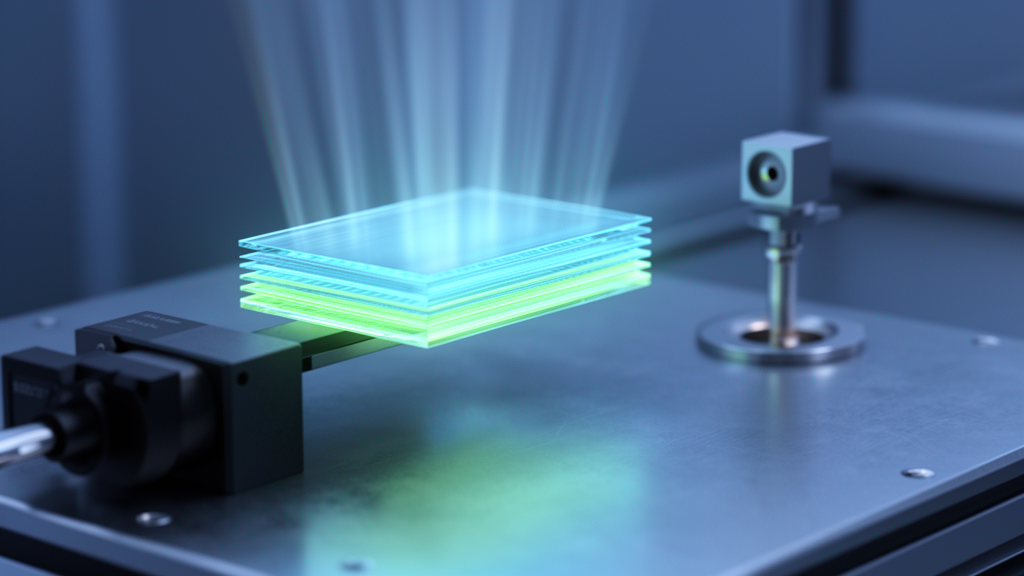
To create the structure, the team used an interfacial self-assembly process driven by a surface-tension gradient in an ethanol-water binary solvent system. The process combined surfactant-assisted interfacial densification with vibration-free drainage transfer. The result was a macroscopically continuous monolayer of hexagonal close-packed polystyrene nanospheres on a 25 mm-diameter GAGG:Ce scintillator wafer. The periodic photonic crystal supplies additional in-plane momentum, allowing modes trapped within the scintillator to couple into free-space radiation modes through momentum matching and Bragg diffraction.
The fabrication approach was intended to address limitations in two established methods. Top-down lithography is precise but requires costly equipment and complex processing, and it is difficult to apply to large-area brittle scintillator substrates. Bottom-up self-assembly can be less expensive, but large-area films formed by that approach may contain cracks, vacancies, and multi-crystal domains that reduce brightness gains or introduce imaging artifacts. The reported strategy was proposed and experimentally validated for producing large-area photonic crystal scintillators through interfacial self-assembly.
In experiments, the modified scintillator produced an approximately 4.64-fold increase in average light output and a 13 dB improvement in X-ray imaging signal-to-noise ratio. It also maintained spatial resolution better than 25 μm. These measurements indicate that the interface treatment improved light extraction without sacrificing spatial resolution in the tested device; they do not establish clinical performance, patient benefit, or the minimum radiation dose required for a particular diagnostic application.
The source identifies photon-starved X-ray imaging as the intended operating context, including possible applications in low-dose medical diagnosis, rapid security inspection, and high-precision industrial non-destructive testing. These are proposed application areas rather than demonstrated clinical or field deployments in the reported experiment. The technology was also presented as a potential route toward lower-dose and higher-definition X-ray imaging under weak-signal conditions.
Several limitations remain. Residual defects in the self-assembled structure may still have a minor effect on resolution, and the authors state that the process requires further optimization to remove those defects. They also call for investigation of compatibility with a broader range of scintillator materials. The study was supported by the Natural Science Foundation of Chongqing, the Development Foundation of the 26th Institute of China Electronics Technology Group Corporation, the Beijing Natural Science Foundation, and China’s National Key Research and Development Program.
Subject of Research: Experimental photonic crystal scintillators for high-performance X-ray imaging under photon-starved conditions
Article Title: New photonic crystal scintillator paradigm boosts low-cost X-ray imaging sensitivity
Article References: New photonic crystal scintillator paradigm boosts low-cost X-ray imaging sensitivity. Original publication (Bibliographic details unavailable.)
Image Credits: AI Generated
DOI: Not provided
Keywords: photonic crystals, X-ray imaging, scintillators, light extraction, GAGG:Ce, self-assembly, signal-to-noise ratio, spatial resolution, low-dose imaging, photonic, crystal, scintillator
News Source: Bethany Barker. (October 21, 2026). Experimental photonic crystal scintillator raises X-ray light output 4.64-fold. Scienmag.