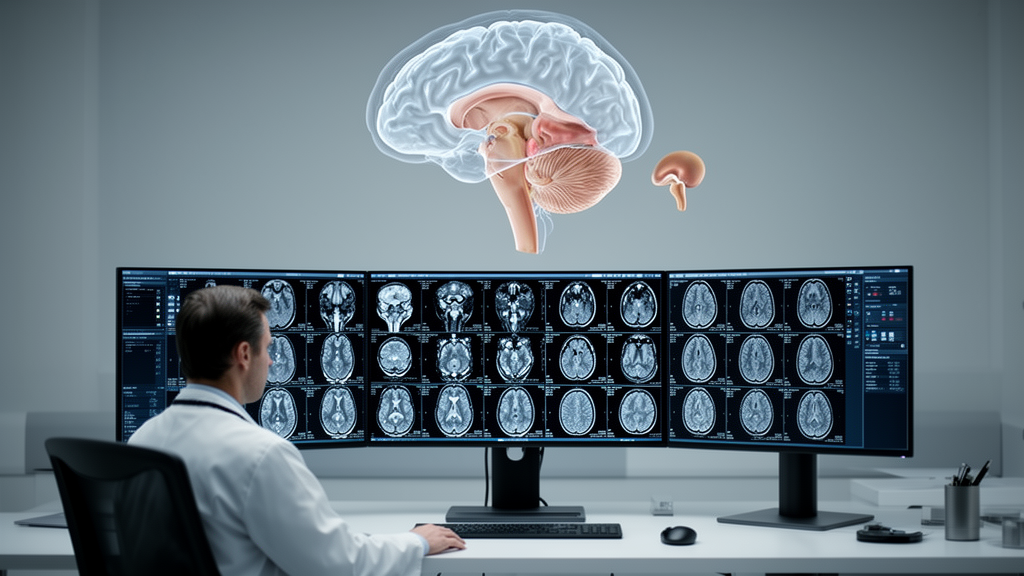
A multicentre evaluation found that the artificial-intelligence tool SynthSR produced high overall agreement with reference-standard measurements of hippocampal volume in autoimmune encephalitis and related disorders, but systematically overestimated volume and showed substantial individual variability. The study included 102 patients from the Australian Autoimmune Encephalitis Consortium and 28 controls. Researchers compared hippocampal measurements from SynthSR-processed scans with measurements from high-resolution reference-standard T1-weighted structural images.
Overall, the intraclass correlation coefficient was 0.88, with a 95% confidence interval of 0.74–0.94. SynthSR generates synthetic 1-mm isotropic structural brain images, allowing scans acquired under different conditions to be placed into a common processing framework. In this multicentre study, investigators processed MRI scans with SynthSR and quantified hippocampal volume using FastSurfer.
They examined 27 low-resolution counterpart scans and 76 contrast-enhanced scans; one patient contributed both types. The population and design therefore tested SynthSR in a clinical setting involving heterogeneous image inputs, although the supplied findings do not establish how the tool performs across every acquisition protocol, disease stage or demographic group. The analysis showed that SynthSR processing systematically increased hippocampal-volume estimates compared with the reference-standard scans.
Despite that bias, relative consistency between the SynthSR-processed and original reference-standard measurements remained high, with the intraclass correlation coefficient of 0.88 and 95% confidence interval of 0.74–0.94. Agreement for synthetic images derived from low-resolution scans was moderate, with an intraclass correlation coefficient of 0.75 and 95% confidence interval of 0.36–0.90. In comparison, agreement between low-resolution images processed with SynthSR and corresponding SynthSR-processed reference-standard scans was excellent, reaching an intraclass correlation coefficient of 0.90 with a 95% confidence interval of 0.76–0.96.
These comparisons describe degrees of agreement among processed measurements; they do not demonstrate that acquisition differences caused the discrepancies. Contrast enhancement did not substantially alter measured performance, but the investigators cautioned that including contrast-enhanced images may require caution. In the longitudinal analysis, no statistically significant difference in measured volumetric change was detected between SynthSR-processed scans and reference-standard counterparts.
The wide limits of agreement nevertheless indicated substantial individual-level variability in estimated changes. Taken together, the results indicate that SynthSR can support group-level volumetric analyses when images are handled through a consistent processing pipeline, but its systematic overestimation, variable individual agreement and broad longitudinal limits make it unreliable for determining hippocampal-volume change in an individual patient.
Subject of Research: Evaluation of SynthSR for MRI harmonization and hippocampal-volume analysis in autoimmune encephalitis and related disorders
Article Title: Evaluating SynthSR for MRI harmonization and quantitative analysis of hippocampal volume in autoimmune neurologic diseases
Article References: Seery, N., Rowsthorn, E., Zia, A., Beech, P., Wesselingh, R., Kavnoudias, H., Rushen, T., Law, M., Vivash, L., Sanfilippo, P., Butzkueven, H., Harding, I. H., & Monif, M. (2026). Evaluating SynthSR for MRI harmonization and quantitative analysis of hippocampal volume in autoimmune neurologic diseases. Scientific Reports. https://doi.org/10.1038/s41598-026-76158-9
Image Credits: AI Generated
DOI: 10.1038/s41598-026-76158-9
Keywords: SynthSR, MRI harmonization, hippocampal volume, autoimmune encephalitis, artificial intelligence, medical imaging, quantitative MRI, FastSurfer, clinical MRI, Evaluating, harmonization, quantitative
News Source: Colin Clarke. (October 21, 2026). SynthSR supports group MRI analysis but overestimates hippocampal volume. Scienmag.