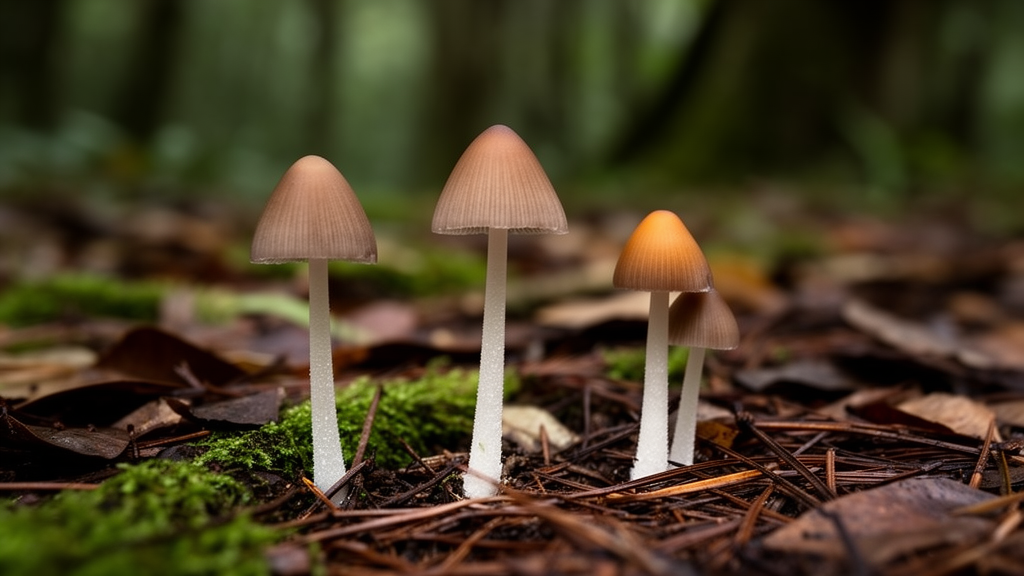
A morphological and phylogenetic study identified three previously unknown species of the mushroom genus Pholiotina in China: Pholiotina constrictibasidiata, P. raribasidiata and P. jilinensis. The new species were represented by specimens collected in Jilin Province and the Xizang Autonomous Region between 2023 and 2025 and were recognized through distinct combinations of microscopic characters and phylogenetic positions.
Pholiotina is a genus of small agaricoid fungi in the family Bolbitiaceae and order Agaricales. Its members are predominantly saprotrophic and occur in grasslands, sandy soils, decaying wood and humus layers. The genus has a complicated taxonomic history, and recent studies based on morphological and phylogenetic evidence divided the formerly broader Pholiotina into Pholiotina, Conocybula and Conobolbitina. In its restricted sense, Pholiotina comprises taxa with a well-developed veil and is organized into the sections Pholiotina, Vestitae and Intermediae.
For the taxonomic analysis, the researchers combined field collection and microscopic examination with DNA sequencing. Voucher specimens were deposited in the Fungarium of Jilin Agricultural University. DNA was extracted from the specimens, and the ITS, 28S and tef1-α regions were amplified and sequenced. Twenty-one new sequences were added to data retrieved from GenBank. The resulting concatenated matrix contained 94 sequences and 3,308 aligned base pairs, with aligned lengths of 893 base pairs for ITS, 1,308 for 28S and 1,107 for tef1-α.
Phylogenetic trees were inferred by maximum likelihood analysis in IQ-TREE 3 with 1,000 standard bootstrap replicates and by Bayesian inference in MrBayes v3.2.7a for 1,000,000 generations. Species of Psathyrella and Candolleomyces were used as outgroups. The maximum-likelihood and Bayesian trees had nearly identical topologies, differing only at poorly supported branches. Pholiotina was recovered as a strongly supported monophyletic clade, with Bayesian posterior probability and maximum-likelihood bootstrap support of 1/99.
The three new species were placed in separate sections and series. P. constrictibasidiata was assigned to section Pholiotina, series Teneroides, while P. raribasidiata was placed in section Vestitae, series Appendiculata. P. jilinensis belonged to section Intermediae, series Brunnea. The analyses also identified two principal evolutionary lineages within Pholiotina: one containing section Pholiotina and the other containing sections Vestitae and Intermediae.
P. constrictibasidiata was represented by two specimens collected in Chomo County, Xigazê City, Xizang, on 24 July 2025 at an elevation of 3,610 metres. It grew scattered on plateau grasslands. Its most distinctive feature is the shape of the basidia, which are predominantly subutriform to cylindrical with a median constriction. It also has mainly utriform cheilocystidia. Its basidiospores measured 9–10.4 µm long, with extreme measurements of 9–10.8 µm, and had germ pores 1–2 µm in diameter. The species was negative for the tested ammonia reaction.
P. raribasidiata was collected in Changchun City, Jilin Province, in September 2024, where it occurred scattered in the moss layer of grasslands. Its name refers to the relative scarcity of its basidia: the ratio of basidia to basidioles was less than 1/20. Other distinguishing characters included an applanate mature pileus and long-necked lageniform to nettle hair-shaped cheilocystidia, some sub-lecythiform and some with swollen apices. Its basidiospores measured 7.6–10.3 µm long, with extremes of 7.2–11 µm, and possessed germ pores 0.5–2 µm in diameter. The tested ammonia reaction was negative.
P. jilinensis was described from Jilin Province, with collections from Red Leaf Valley and other forest locations in Jilin and Changchun cities. It was found in summer and autumn on humus in broad-leaved forests and on rotten wood sticks. The species has lecythiform cheilocystidia, four-spored basidia, basidiospores without germ pores and no pileocystidia. Its basidiospores measured 6.5–7.7 µm long, with extremes of 6–7.9 µm. Unlike P. bispora, which reacted negatively, P. jilinensis produced a weakly positive ammonia reaction with diamond-shaped crystals.
The additions raise the recognized totals to 29 species in section Pholiotina, 10 in section Vestitae and 16 in section Intermediae. The analysis also exposed unresolved questions about the genus. Section Vestitae appeared paraphyletic, while several species morphologically assigned to section Pholiotina had uncertain placements on poorly supported branches. Sequence data were unavailable for roughly 20 known species worldwide, and the type species of the monotypic series Resinosocystidiata had not been sequenced. The authors therefore state that additional specimens and molecular data are needed to improve branch support and permit further revision of the genus.
Subject of Research: Taxonomic identification and phylogenetic placement of three new Pholiotina species from China
Article Title: Three new species of Pholiotina ( Bolbitiaceae , Agaricales ) from China
Article References: Deng, J.-L., & Song, H.-B. (2026). Three new species of Pholiotina (Bolbitiaceae, Agaricales) from China. MycoKeys, 139, 277-302. https://doi.org/10.3897/mycokeys.139.201595
Image Credits: AI Generated
DOI: 10.3897/mycokeys.139.201595
Keywords: Pholiotina, fungal taxonomy, new species, Bolbitiaceae, Agaricales, China, phylogenetics, molecular analysis, mycology, Three, species, scientific research
News Source: Roger Howard. (October 20, 2026). Morphological and phylogenetic study identifies three new Pholiotina species from China. Scienmag.