A taxonomic study combining morphology, mitochondrial DNA and comparison with previously described species identified the bumblebee goby Brachygobius jennie as a new species from southern China. The authors proposed it as the first formally reported member of the genus Brachygobius from China and the smallest species described in the genus, with all 106 collected specimens measuring less than 9 mm in standard length.
Researchers collected the fish in April 2025 from shallow waters beside mangroves on Hengqin Island, Guangdong Province, on the western bank of the Zhujiang River Estuary near Macau. They captured 106 specimens with a D-type hand net and selected 31 for the type series. Most were immediately euthanized on ice and preserved in 5% formaldehyde for morphological examination, while three were preserved in 95% ethanol for genetic analysis. A few living specimens were photographed before being euthanized and fixed. The specimens were ultimately deposited in the Museum of Biology at Sun Yat-sen University.
The investigation used stereomicroscopy and ImageJ-based measurements to assess the unusually small type specimens. The researchers recorded body proportions, scale rows and fin-ray counts, and examined coloration in living and preserved fish under natural light. Vertebral counts were obtained by micro-CT imaging from three specimens. Head canal pores and papillae rows were not recorded because they were difficult to observe in specimens smaller than 9 mm standard length and are not diagnostic characters for most Brachygobius species.
The principal diagnostic traits were the fish’s small size and pigmentation. Brachygobius jennie has four complete or nearly complete, relatively narrow black bars behind the head, including two positioned posterior to the anal-fin base. The first bar is narrow and extends onto the first dorsal fin without reaching the midventral line. The second is chevron-shaped, lies below the second dorsal fin and reaches the midventral line and anal fin. Predorsal scales are present, and the black bars remain distinct. These features distinguish the new species from congeners including B. mekongensis, which has five often faint bars and lacks predorsal scales, and from B. kabiliensis and B. nunus, whose second bars do not reach the midventral line.
Genetic comparisons were based on a mitochondrial cytochrome oxidase subunit I, or COI, barcode fragment sequenced from three new specimens. The researchers combined the three new sequences with 29 archived sequences representing six of the eight valid species recognized at the time, then conducted a maximum-likelihood analysis with 1,000 bootstrap replicates. The new sequences and an archived specimen from the Leizhou Peninsula formed a monophyletic group within Brachygobius with 100% bootstrap support. The new species was resolved as the sister lineage of B. kabiliensis, although that relationship had lower support of 82%, and the three newly generated sequences of B. jennie were identical.
Uncorrected COI distances from B. jennie to other members of the genus ranged from 10.25% for B. kabiliensis to 15.49% for a lineage from Bangkok identified as Brachygobius sp. “Bangkok.” The study notes that these values exceed the commonly used 2–3% interspecific threshold for COI identification, although the phylogenetic analysis did not include sequences for two recognized species, B. xanthozona and B. mekongensis. The molecular results therefore provide concordant but incomplete genus-wide comparative coverage.
The type series consists of a holotype measuring 7.66 mm standard length and 30 paratypes measuring 4.16–8.98 mm, all from the same Hengqin Island locality in April 2025. Diagnostic counts include six unsegmented first-dorsal-fin spines, eight segmented rays in each of the second dorsal and anal fins, 12–16 pectoral-fin rays, fused pelvic fins with 5+5 rays, 20–24 segmented caudal-fin rays and 24 longitudinal scale rows. Micro-CT imaging of three specimens yielded vertebral counts of 24. Live fish had a whitish, somewhat translucent body with visible internal structures, four distinct black bars and a black saddle between the dorsal fins. Some possible males had a yellowish caudal peduncle and two bright yellow caudal-fin spots; preserved fish retained the black markings but lost the yellow coloration.
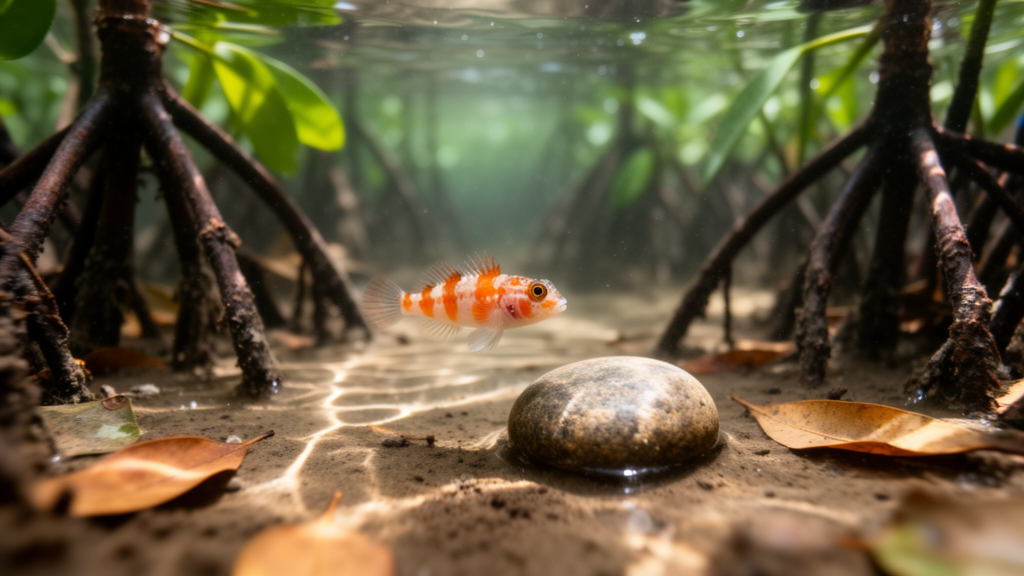
The authors report that the species is presently known from Hengqin Island and inferred from a COI sequence archived from the Leizhou Peninsula, roughly 300 km southwest, although that sequence had previously been misidentified as Butis butis. The type habitat consists of mangrove wetlands with clean brackish water, a slow current and a silty bottom. The available specimens did not permit certain sex determination, no female carried eggs, and the maturity size remains unknown, leaving aspects of the species’ reproductive biology unresolved.
Because every one of the more than 100 specimens examined measured less than 9 mm standard length, B. jennie is the smallest described member of Brachygobius; all other species in the genus were reported to reach at least 18.0 mm standard length. The study’s authors note that extreme miniaturization can be associated with changes in morphology, physiology, life history and ecology, including morphological simplification, paedomorphosis, genome-size reduction and niche specialization. They therefore identify the new fish as potentially useful for research into the developmental and evolutionary consequences of vertebrate miniaturization, while the unknown maturity size and unresolved reproductive characteristics limit conclusions about its life history.
Subject of Research: Taxonomic description of the miniature bumblebee goby Brachygobius jennie from Guangdong, China, using morphology and mitochondrial COI analysis.
Article Title: Brachygobius jennie , a new bumblebee goby ( Teleostei , Oxudercidae ) from Hengqin Island, Guangdong Province, China
Article References: Tian, J., Wu, J., Lan, C., Lavoué, S., & Huang, J. (2026). Brachygobius jennie , a new bumblebee goby (Teleostei, Oxudercidae) from Hengqin Island, Guangdong Province, China. Zoosystematics and Evolution, 102(3), 853-863. https://doi.org/10.3897/zse.102.184142
Image Credits: AI Generated
Keywords: Brachygobius jennie, new fish species, bumblebee goby, China, Hengqin Island, taxonomy, marine biodiversity, COI barcoding, miniature fish, mangrove wetlands, Brachygobius, jennie
News Source: Juliet Wilcox. (October 20, 2026). Morphological and genetic study identifies miniature bumblebee goby as new species from China. Scienmag.