A cytogenetic study of the hangingfly Bittacus cirratus found extensive variation in chromosome number and morphology, including supernumerary B chromosomes that ranged from punctiform and ring-shaped forms to large or coiled structures. The animal-cell study also documented irregular meiotic segregation, loss and nondisjunction of these chromosomes, with frequent aggregation of B chromosomes in one of the two secondary spermatocytes.
The research focused on male B. cirratus, a member of Mecoptera for which the presence of B chromosomes had previously been unknown. More than 2,800 eukaryotic species have been reported to possess these additional chromosomes, and insects are frequent hosts, but their detailed meiotic behavior and morphology remain unevenly studied. The findings provide the first documented account of B chromosomes in Mecoptera and show that the hangingfly has a particularly variable chromosome system compared with the relatively stable karyotypes reported for other hangingfly species.
Adults were collected in August 2020 from the Qinling Mountains in Shaanxi Province, China, at elevations of 1,450–1,500 meters. The insects were reared with larvae maintained at 16 ± 2 °C, pupae at 21 ± 2 °C and adults at 23 ± 2 °C, while relative humidity was held at 75% ± 10%. Larvae were fed freshly killed yellow mealworm larvae, and adults received frozen house fly pupae. Chromosome spreads were prepared from testes of third- and fourth-instar larvae and pupae, then examined using C-banding with Giemsa, DAPI fluorescence staining and chromosome morphometry.
Diploid chromosome numbers ranged from 2n = 30 to 36, while haploid numbers ranged from n = 13 to 19. Thirty-four percent of the cells examined had 31 chromosomes and 19% had 33; among haploid counts, n = 15 and n = 16 occurred at frequencies of 36% and 30%, respectively. The observed male karyotype was 2n = 30 + XO + 0–5 B chromosomes. Karyotypes also varied in their complement of metacentric, submetacentric, subtelocentric and telocentric chromosomes, and one to four pairs of heteromorphic homologues were observed during meiosis.
The B chromosomes were morphologically diverse. Some were smaller than A chromosomes, others were approximately the same size, and others were larger; observed forms included punctiform, ring-shaped, bicentric and coiled chromosomes. Most B chromosomes behaved as univalents during meiosis, although some formed bivalents or trivalents. They had no or one chiasma, compared with an average of 1.5 chiasmata per A chromosome at diplotene. Across 50 cells examined at that stage, the mean total chiasma count was 23.5, with a range of 13–32.
At metaphase I, univalent, bivalent and trivalent B chromosomes assembled at the equatorial plate and oriented toward the poles. At anaphase I, most moved independently toward one pole, one tiny B chromosome remained attached to an A chromosome, and the sex chromosome moved prematurely toward one pole. The majority of ring-shaped B chromosomes became invisible at this stage, corresponding to an estimated loss probability of about 70%. The authors proposed three observed or hypothesized routes by which univalent B chromosomes could avoid loss: association with a nonhomologous chromosome, accumulation near one spindle pole so that the chromosome entered one telophase-I nucleus, and escape by relatively large size, which they tentatively linked to unequal spindle formation and stronger directional movement.
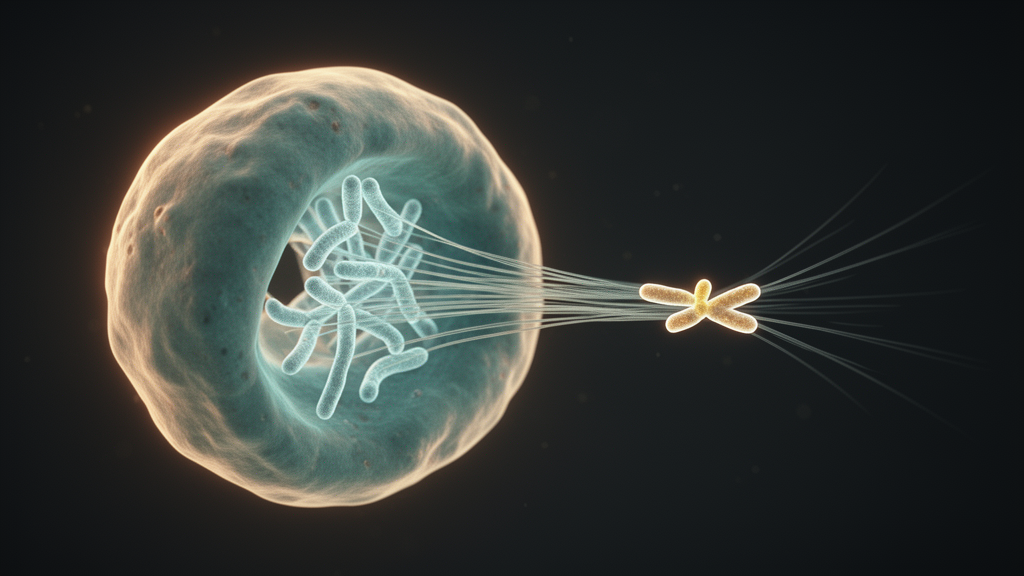
At meiosis II, B chromosomes tended to aggregate in one of the two secondary spermatocytes, and the chromosome-number difference between daughter cells was at least two in 60% of cases. This asymmetric distribution was interpreted by the authors as transmission above the Mendelian expectation of 0.5, or chromosome drive, although the study did not directly measure transmission across generations. A large coiled B chromosome was also observed crossing over with itself, while one metacentric B chromosome lacking sister chromatids moved prematurely toward a pole. Most B chromosomes separated from their sister chromatids at anaphase II, but some underwent nondisjunction, and one punctiform B chromosome separated normally at telophase I.
Based on the abundance of rearrangements among A chromosomes, the researchers proposed that the B chromosomes of B. cirratus derive from multiple A chromosomes. In their evolutionary model, ancestral A chromosomes fragmented into proto-B chromosomes with sticky ends. These elements then fused, acquired DNA sequences or duplicated, followed by further duplication, inversion and translocation. The scenario accounts for the observed punctiform, ring-shaped, bicentric and large forms, although the origin remains a hypothesis rather than a directly reconstructed evolutionary history.
The study is limited to cytogenetic observations from a population collected in one part of China, and its proposed links among B-chromosome size, spindle asymmetry, transmission advantage and individual fitness were not tested directly. The authors noted that B. cirratus is widely distributed from Russia to China and that B chromosomes often occur in species with broad geographic or host ranges, but those associations do not establish a fitness effect. Biogeographical and cytogenetic studies of different populations would be needed to determine the functional significance of the observed chromosomal diversity.
Subject of Research: Cytogenetic and meiotic analysis of supernumerary B chromosomes in the hangingfly Bittacus cirratus
Article Title: Dynamic meiotic behavior and evolutionary insights of supernumerary B chromosomes in the hangingfly Bittacus cirratus ( Mecoptera , Bittacidae )
Article References: He, L.-L., Miao, Y., Wang, H.-H., Zhang, J., & Hua, B.-Z. (2025). Dynamic meiotic behavior and evolutionary insights of supernumerary B chromosomes in the hangingfly Bittacus cirratus (Mecoptera, Bittacidae). Comparative Cytogenetics, 19, 91-107. https://doi.org/10.3897/compcytogen.19.153340
Image Credits: AI Generated
DOI: 10.3897/compcytogen.19.153340
Keywords: B chromosomes, Bittacus cirratus, Mecoptera, chromosome drive, meiotic segregation, cytogenetics, hangingfly, karyotype variation, non-Mendelian inheritance, Dynamic, meiotic, behavior
News Source: Gavin Prescott. (October 20, 2026). Cytogenetic study reveals highly variable B chromosomes and irregular meiotic transmission in the hangingfly Bittacus cirratus. Scienmag.