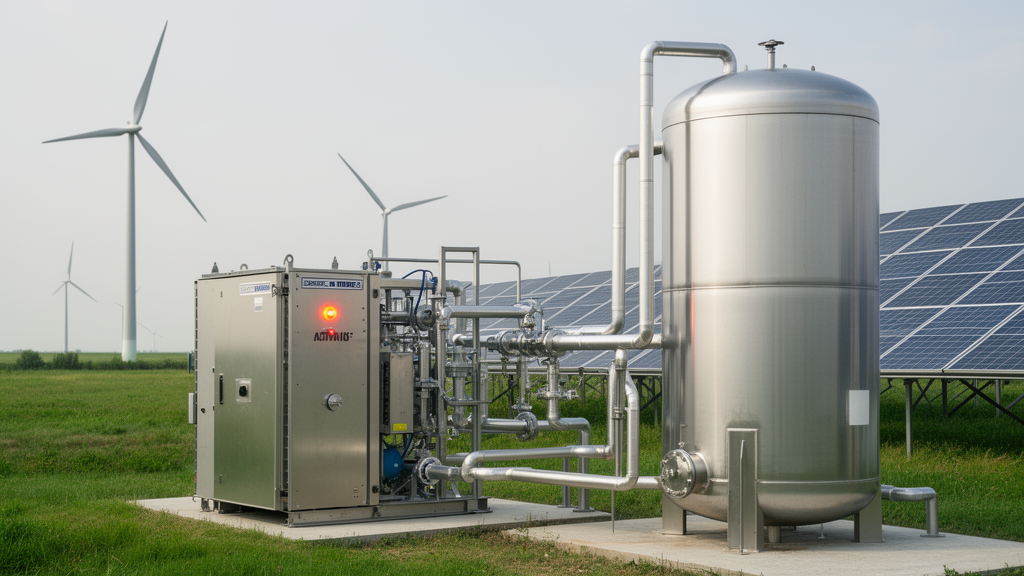
A factory-scale modeling study of a laminate-flooring plant in Shiraz, Iran, found that adding a proton-exchange membrane electrolyzer to a solar, wind, biogas and battery system cut unused renewable electricity from 37.1% to 9.36%, while converting the surplus into an estimated 3,869 kilograms of hydrogen per year. The hydrogen-assisted system retained a 100% renewable fraction in the simulation and was ultimately ranked the most sustainable option by a multi-criteria analysis, although its levelized cost of energy was higher than that of the lowest-cost configuration without hydrogen production. The findings point to power-to-hydrogen as a way to improve the utilization of stand-alone renewable systems at energy-intensive sites, while also showing that the economic case depends on capital costs, resource conditions and assumptions about the value of hydrogen.
The analysis was based on operational data from the active manufacturing facility rather than a generic industrial load. Researchers used measured electricity demand, hourly and monthly load patterns, solar irradiation, wind conditions, fuel assumptions and other site information to model an off-grid microgrid. The plant operates throughout the year and uses electricity for raw-material preparation, pressing, cutting, slotting, painting and packing. Compressors, pressing units, boiler and chiller systems, and dust extraction were its largest consumers, while lighting and administrative loads made smaller contributions. Shiraz was selected as the case-study location because of its substantial solar resource and usable wind conditions, while wood residue generated by the factory was treated as a biogas feedstock.
The modeled system combined photovoltaic panels, wind turbines, a controllable biogas generator, batteries, power converters and a PEM electrolyzer with hydrogen storage. HOMER Pro version 3.14 evaluated feasible configurations at hourly intervals over a year and optimized them primarily for net present cost and levelized cost of energy. A cycle-charging strategy governed dispatch: renewable electricity first served the industrial load, then charged the battery once surplus power became available. After the battery reached its maximum state of charge, the electrolyzer could operate when excess power exceeded its minimum load ratio and remained below its rated capacity. Hydrogen was stored and sold rather than used inside the factory. Any electricity that could neither be stored nor converted was curtailed.
Without an electrolyzer, the economically strongest arrangement combined photovoltaics, one wind turbine, the biogas generator and a battery bank. It had a levelized cost of energy of $0.1130 per kilowatt-hour and a net present cost of $653,012.20, but 37.1% of its generated electricity went unused. Adding a wind turbine to a similar solar-biogas-battery case barely changed either cost or curtailment, indicating that the added wind contribution was limited under the modeled conditions. A wind-biogas-battery system reduced excess electricity to 10.4%, but its levelized cost rose to $0.1756 per kilowatt-hour. The poorest surplus-management outcomes occurred in configurations with 53.1% to 56% excess electricity, while the biogas-and-battery case eliminated surplus generation but depended heavily on fuel availability and carried a levelized cost of $0.2118 per kilowatt-hour.
Adding a 100-kilowatt PEM electrolyzer and hydrogen tank altered both the dispatch and the economics of the renewable systems. In the configuration with photovoltaics, wind, biogas and batteries, excess electricity fell from 37.1% to 9.36%, while annual hydrogen output reached 3,869 kilograms. Its net present cost increased to $919,084.80 and its levelized cost to $0.1590 per kilowatt-hour. Removing the wind turbine produced a closely matched solar-biogas-battery system: excess electricity declined slightly further to 9.19%, annual hydrogen production was 3,762 kilograms, and the net present cost was $919,874.30. A wind-biogas-battery configuration nearly eliminated curtailed electricity, at 0.0059%, but generated only 934 kilograms of hydrogen per year and had a levelized cost of $0.2216 per kilowatt-hour.
The hydrogen pathway also changed how the factory’s resources were used during operation. In the modeled solar-wind-biogas-battery case, photovoltaic output peaked at 272 kilowatts in summer and totaled 501,981 kilowatt-hours per year. The electrolyzer generally activated when solar output exceeded 150 kilowatts, averaging 20.5 kilowatts of input and 0.422 kilograms of hydrogen per operating hour. Because the electrolyzer absorbed power that otherwise would have been curtailed, the biogas generator concentrated its operation in nighttime and other periods of weak renewable availability. It averaged 110 kilowatts of electrical output and consumed an annual overall energy input of 184,375 kilowatt-hours. The authors interpret this flexible operation as a reduction in fuel use and generator wear, although the study did not test long-term component degradation.
An exergy analysis was used to distinguish the quantity of energy produced from the quality of useful work or chemical energy available in that energy. Across the electrolyzer-based scenarios, the solar-biogas-battery system selected by the multi-criteria ranking had an exergy efficiency of 39.22%, while the solar-wind-biogas-battery design reached 39.91%. Without the electrolyzer, the reported overall exergy efficiency was 37.72%. Photovoltaic conversion accounted for approximately 86% of exergy destruction in that baseline system, compared with about 13% for the biogas generator and 1% for the wind turbine. The electrolyzer itself introduced 2.46% of the modeled destruction, but redirecting surplus electricity into hydrogen increased the product exergy and raised the overall efficiency by about 2.2 percentage points.
The seasonal exergy results showed why maximum output cannot be treated as maximum thermodynamic performance. Solar irradiation and photovoltaic production increased toward summer, yet the gap between incident solar energy and available solar exergy widened as temperatures rose, reducing the potential for useful work. The wind turbine reached its highest electricity production in spring and summer but recorded higher exergy efficiency in autumn, indicating that stronger generation was accompanied by additional irreversibility. The electrolyzer produced the most hydrogen when electrical input was plentiful, but its highest exergy efficiency occurred in January, when output was comparatively low. The biogas generator showed only slight seasonal variation, making it less sensitive to changing ambient conditions than the solar and wind components.
Because cost alone could not distinguish configurations with different levels of curtailment, emissions and thermodynamic performance, the researchers combined an analytic hierarchy process with the Technique for Order of Preference by Similarity to Ideal Solution. The decision matrix weighed cost of energy at 30%, carbon dioxide emissions at 32%, excess electricity at 19% and exergy efficiency at 19%. The solar-biogas-battery-electrolyzer configuration ranked first, with a closeness coefficient of 0.65883, narrowly ahead of the solar-wind-biogas-battery system at 0.65765. Its estimated annual carbon dioxide emissions were 2.04 kilograms in the reported scenario table. The wind-biogas-battery system ranked third despite 58.52% exergy efficiency and almost no excess electricity, while the oversized solar-wind-battery configuration ranked fifth because its $0.3718 per kilowatt-hour cost and 31.95% exergy efficiency offset its zero reported emissions.
Sensitivity analysis showed that local solar availability had the strongest influence on both cost and emissions, whereas wind speed mattered more for emissions than for levelized cost because it could displace nighttime generator operation. Across the tested range of 3 to 7 kilowatt-hours per square meter per day of global horizontal irradiance, the reported levelized cost declined from $0.187 to $0.103 per kilowatt-hour. In a combined resource test, moving from 3 kilowatt-hours per square meter per day and a 2-metre-per-second wind speed to 7 kilowatt-hours per square meter per day and 6 metres per second corresponded to a cost reduction of 33% and an 87.5% reduction in carbon dioxide emissions. Raising photovoltaic capital costs had a larger effect than wind-turbine cost changes because the modeled system was centered on the solar array. These results remain model estimates for one industrial site and depend on the assumed $5 per kilogram hydrogen price, equipment costs, discount and operating assumptions, biomass fuel data, and the 20-year lives assumed for selected components such as the photovoltaic modules, wind turbine and electrolyzer; the authors recommend broader market testing and degradation models before wider deployment.
Subject of Research: Techno-economic and exergy assessment of a hydrogen-integrated renewable energy system for an industrial site in Shiraz, Iran.
Article Title: Energy-oriented design and comprehensive exergy-based evaluation of a hybrid renewable system with green hydrogen production from excess electricity for industrial energy demand
Article References: Mousavi, S. A., Abbasi, Y., Asadi, A., Safarpour, M., & Vaziri Rad, M. A. (2026). Energy-oriented design and comprehensive exergy-based evaluation of a hybrid renewable system with green hydrogen production from excess electricity for industrial energy demand. Results in Engineering, 32, Article 113583. https://doi.org/10.1016/j.rineng.2026.113583
Image Credits: AI Generated
DOI: 10.1016/j.rineng.2026.113583
Keywords: renewable energy, green hydrogen, industrial microgrid, PEM electrolyzer, exergy analysis, biogas, solar photovoltaic, wind power, battery storage, multi-criteria decision analysis, Energy-oriented, design
News Source: Faith Mcneil. (October 20, 2026). Iran factory model finds hydrogen curbs renewable power curtailment. Scienmag.