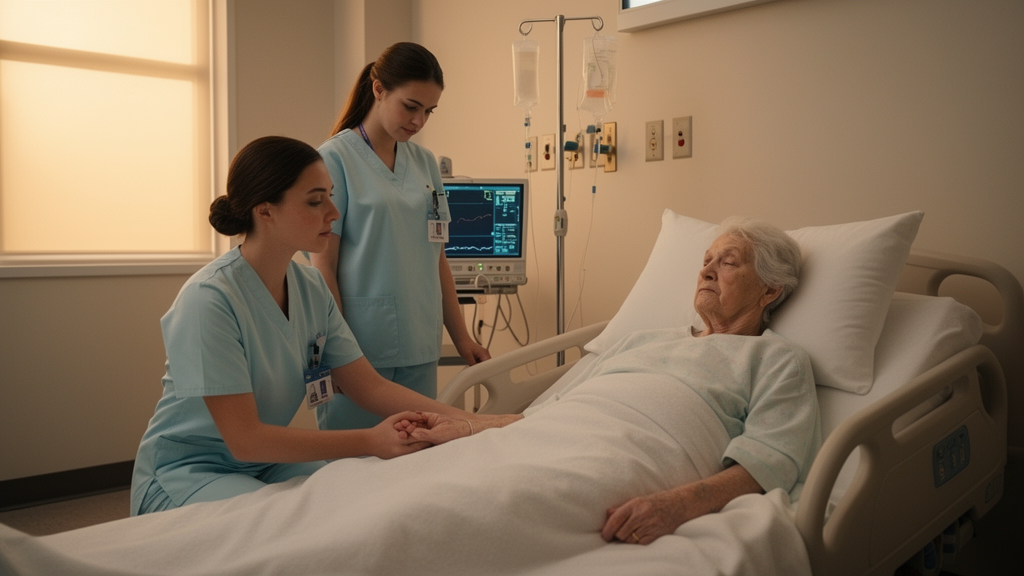
A single-group pretest–posttest study reported that an 80-minute, scalable end-of-life care simulation was associated with improved objective clinical competence, knowledge and self-reported confidence among third-year undergraduate nursing students in Japan. The findings, summarized in the study abstract, were observed in a small volunteer cohort at one national university and do not establish that the program caused the changes. The researchers called for larger controlled studies to confirm the results.
Twenty-seven of approximately 80 eligible third-year students enrolled voluntarily, and 25 completed all evaluations. The intervention was adapted from a previously evaluated small-group scenario for delivery to approximately 25–30 students in one session. Students participated through direct care roles, structured observation, small-group discussion and sequential debriefing. Objective structured clinical examination assessments were conducted before the program and two weeks later. Knowledge and confidence were measured at baseline, immediately after the program and at the two-week follow-up.
The primary outcome was OSCE-assessed clinical competence. Mean scores for physical assessment skills increased from 3.08 ± 1.50 at baseline to 5.96 ± 1.17 two weeks after the program, a mean difference of 2.88 (95% CI 1.95–3.81; p < 0.001) with a reported Cohen’s dz of 1.285. Scores for psychological care skills increased from 3.40 ± 2.80 to 7.80 ± 3.92, a mean difference of 4.40 (95% CI 2.57–6.23; p < 0.001), with Cohen’s dz of 0.990.
Knowledge scores rose from 7.00 ± 2.29 at baseline to 8.16 ± 1.57 immediately after the simulation and 8.20 ± 1.47 two weeks later; the Friedman test result was p = 0.001, with Kendall’s W = 0.262. Confidence in physical and psychological care also changed over time, although the abstract did not provide the corresponding numerical results. The study’s uncontrolled one-group design, single-university setting, small volunteer sample and short follow-up restrict causal interpretation. Two enrolled students did not complete all evaluations, and larger controlled studies are required to determine whether the observed improvements are reproducible and attributable to the program.
Subject of Research: Short-term outcomes of a scalable end-of-life care simulation for third-year nursing students in Japan
Article Title: A scalable simulation program for end-of-life care education in undergraduate nursing students: changes in OSCE-assessed clinical competence, knowledge, and confidence—a quasi-experimental one-group pretest-posttest study
Article References: Tamaki, T., Inumaru, A., Yokoi, Y., Fujii, M., Ohno, Y., & Tsujikawa, M. (2026). A scalable simulation program for end-of-life care education in undergraduate nursing students: changes in OSCE-assessed clinical competence, knowledge, and confidence—a quasi-experimental one-group pretest-posttest study. BMC Nursing. https://doi.org/10.1186/s12912-026-05358-5
Image Credits: AI Generated
DOI: 10.1186/s12912-026-05358-5
Keywords: nursing education, end-of-life care, simulation, clinical competence, OSCE, knowledge, self-reported confidence, quasi-experimental study, scalable, program, end-of-life, care
News Source: Ophelia Keating. (October 20, 2026). Quasi-experimental study links scalable end-of-life care simulation with short-term competence gains in nursing students. Scienmag.