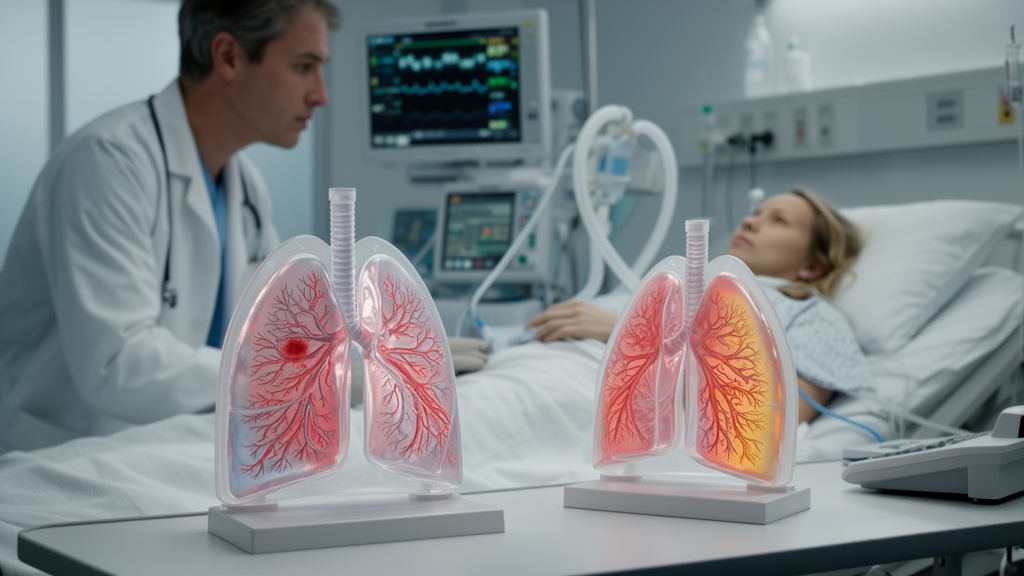
Acute respiratory distress syndrome is not one disease with one biological course, but a variable mixture of lung injury, systemic inflammation and organ dysfunction, according to a review examining how molecular, physiological and imaging data might be combined to identify biologically distinct subphenotypes. The authors argue that the most reproducible division separates patients into hyperinflammatory and hypoinflammatory groups, although this framework does not yet define a universally applicable treatment rule. The review, published in Frontiers in Pharmacology, traces the path from ARDS pathobiology toward classification systems that could support more targeted enrollment and treatment in clinical trials.
ARDS is a clinical syndrome of acute hypoxemic respiratory failure and bilateral lung opacities that develops after direct pulmonary insults such as pneumonia or aspiration, or indirect insults such as sepsis, trauma or pancreatitis. Its Berlin definition helps distinguish it from cardiac failure and fluid overload, but the diagnostic criteria do not capture major differences in the injury to alveolar epithelium, pulmonary endothelium, blood vessels and other organs. Even with lung-protective ventilation, prone positioning and neuromuscular blockade, in-hospital mortality remains about 30% to 40%. A patient classified simply as having ARDS may therefore have very different combinations of inflammation, tissue damage, circulatory strain and mechanical vulnerability.
The central hyperinflammatory and hypoinflammatory framework is generated most often through latent class analysis or related data-driven methods using plasma biomarkers, including interleukin-6, interleukin-8, soluble tumor necrosis factor receptor 1 and angiopoietin-2. Hyperinflammatory patients tend to have greater organ dysfunction, shock and metabolic acidosis, with mortality exceeding 40% in several cohorts. The hypoinflammatory group generally has less systemic inflammation and better survival, although its reported outcomes have not been uniform across studies. Hyperinflammatory status is more common early in critical illness, and longitudinal analyses indicate that some patients transition toward a less inflammatory state. That dynamism argues against relying on a single measurement made at admission and supports reassessment as an illness evolves.
At the tissue level, ARDS begins with disruption of the alveolar-capillary barrier, allowing protein-rich fluid to enter the lungs and impairing gas exchange. Angiopoietin-2, high-mobility group box 1 and receptor for advanced glycation end products are among the mediators linked to endothelial and epithelial injury, while mitochondrial dysfunction in alveolar type II cells may connect oxidative stress with impaired surfactant production, defective fluid clearance and fibrosis. Immune differences are similarly complex. Transcriptomic studies associate the hyperinflammatory state with innate immune activation, granulopoiesis, interferon signaling and stress responses, whereas relatively greater expression of adaptive immune genes has been observed in hypoinflammatory profiles. Metabolic studies also associate the more inflammatory group with lipid dysregulation and a shift toward glycolysis.
Those systemic patterns do not necessarily represent what is happening inside the alveoli. Classifications based on bronchoalveolar lavage fluid overlap only partly with those based on plasma, and one study found no significant differences in local inflammatory mediators between plasma-defined “reactive” and “uninflamed” groups. Bronchoalveolar classifications containing interleukin-6, von Willebrand factor, soluble programmed cell-death receptor 1 and neutrophil percentage have instead correlated closely with oxygenation and ventilatory measures. Lung-microbiome findings likewise show limited concordance with circulating inflammatory classes, even though greater bacterial burden, reduced diversity and gut-associated bacterial translocation have been associated with heightened inflammation. The mismatch means that a patient labeled hypoinflammatory in blood may still have substantial pulmonary injury requiring a different therapeutic strategy.
Respiratory mechanics and imaging reveal another axis of heterogeneity. Machine-learning models using compliance, driving pressure, ventilation ratio and mechanical power distinguish restrictive cases with poor distensibility, gas-exchange impairment and elevated risk of ventilator-induced lung injury from more efficient physiological profiles. Rising ventilation ratio or mechanical power can identify worsening trajectories associated with mortality and fewer ventilator-free days. Computed tomography can separate focal disease, characterized by gravity-dependent consolidation, from diffuse disease with widespread ground-glass opacities or consolidation. Focal lungs tend to be less recruitable and may be harmed by indiscriminate increases in positive end-expiratory pressure, or PEEP, whereas diffuse lungs may recruit and improve oxygenation with higher PEEP or prone positioning. Imaging patterns overlap only weakly with inflammatory biomarker classes, indicating that morphology and systemic biology capture different dimensions of injury.
Circulatory complications introduce further distinctions. Analyses combining echocardiography and hemodynamic data have identified four cardiovascular profiles: normal ventricular function, right ventricular dilation with preserved systolic function, right ventricular dilation with impaired contraction and hyperdynamic left ventricular function. Patients with dilation and systolic impairment had 90-day mortality of 78% in one analysis, while a COVID-19 ARDS cohort reported 73% in the corresponding group. Right ventricular strain may reflect pulmonary hypertension, hypoxic vasoconstriction, microthrombi and elevated intrathoracic pressure. In patients receiving venovenous extracorporeal membrane oxygenation, retrospective classifications have separated “wet,” “dry” and “fibrotic” profiles. The fibrotic group had a more prolonged course and elevated risk of intracranial hemorrhage, but these retrospective associations do not establish that phenotype-based anticoagulation or other interventions improve outcomes.
Mechanisms involving regulated cell death add both opportunities and cautions. Ferroptosis has been linked to iron accumulation, lipid peroxidation, glutathione depletion and impaired antioxidant defenses in epithelial, endothelial, macrophage and neutrophil compartments. Ferrostatin-1, liproxstatin-1, melatonin and dipyridamole have reduced ferroptosis-related lung injury in various animal and cellular models, and a nonrandomized dipyridamole study included only five patients with moderate-to-severe ARDS. Pyroptosis, especially in alveolar and recruited macrophages, can amplify cytokine release, damage signals and barrier disruption through inflammasome and gasdermin pathways. Human studies have linked these signals with outcomes, but they do not directly demonstrate active pyroptotic death in vivo, and no clinical trial has established that selectively inhibiting it improves ARDS outcomes. Neither process has yet been validated as a separate clinical subphenotype.
Translation depends first on classification tools that are rapid, inexpensive, reproducible and simple enough for bedside use. The review describes simplified models based on small sets of biomarkers and clinical variables, including angiopoietin-2, soluble tumor necrosis factor receptor 1, procalcitonin and bicarbonate, and a two-marker score using interleukin-8 and soluble ST2 among patients receiving high-flow nasal oxygen. These tools require independent, multicenter prospective validation, including assessment of whether they predict treatment response rather than merely prognosis. Prospective randomized trials would need to assign patients with validated subtypes to targeted interventions or standard care, account for transitions between phenotypes and test whether enrichment improves statistical power. Candidate approaches include immunomodulation for hyperinflammatory disease, morphology-guided PEEP, personalized ventilation and targeted prevention of right ventricular failure, but none should be treated as established subtype-specific therapy on the current evidence.
Future systems may combine clinical observations, continuous ventilator data, imaging, blood biomarkers, transcriptomics, proteomics, metabolomics and microbiome measurements. Artificial intelligence could detect nonlinear patterns across these sources, while longitudinal monitoring could create an evolving digital representation of each patient rather than a fixed label. The review cites early multimodal models that combine CT radiomics with clinical information, and ongoing work is collecting ventilator waveforms, imaging and biospecimens to define biologically grounded endotypes. Major obstacles remain, including standardized data collection, transportability between hospitals, interpretability, privacy and prospective clinical validation. The practical advance is thus not a claim that ARDS has already become a precision-medicine disease, but that its traditional diagnostic label can increasingly be decomposed into testable biological and physiological states that might reveal which patients are likely to benefit from which interventions.
Subject of Research: Biological, physiological and imaging-based subphenotypes of acute respiratory distress syndrome
Article Title: Acute respiratory distress syndrome subphenotypes: the translational path from pathobiology to precision medicine
Article References: Shao, H., Bai, T., Zhang, T., Qiao, Y., & Li, Y. (2026). Acute respiratory distress syndrome subphenotypes: the translational path from pathobiology to precision medicine. Frontiers in Pharmacology, 17, Article 1947054. https://doi.org/10.3389/fphar.2026.1947054
Image Credits: AI Generated
DOI: 10.3389/fphar.2026.1947054
Keywords: acute respiratory distress syndrome, ARDS subphenotypes, precision medicine, hyperinflammation, biomarkers, lung inflammation, mechanical ventilation, right ventricular dysfunction, clinical trials, artificial intelligence, Acute, respiratory
News Source: Ophelia Keating. (October 20, 2026). ARDS subphenotypes offer a path toward personalized critical care. Scienmag.