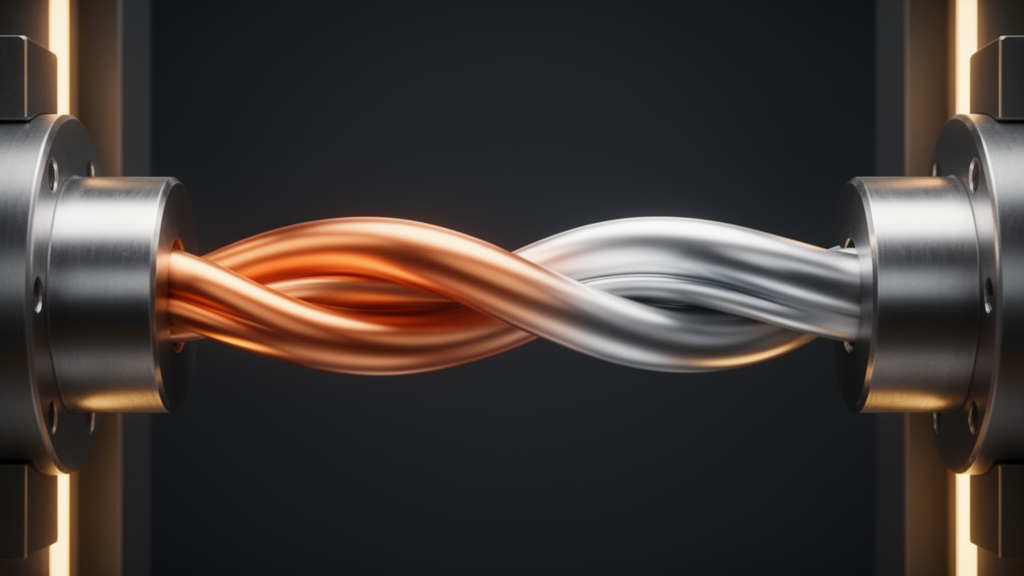
An experimental study of four copper-silver cast alloys found that silver content and the starting phase arrangement strongly influenced how the materials responded to high-pressure torsion. Alloys containing 3 and 6 at% Ag developed a single-phase, supersaturated structure at the highest strains, whereas the 20 and 60 at% Ag alloys retained an inhomogeneous multiphase structure associated with shear banding.
The researchers investigated commercially available CuAg cast alloys containing 3, 6, 20 and 60 at% silver. Disks 8 mm in diameter and 1 mm thick were subjected to high-pressure torsion at room temperature under a pressure of 5 GPa and quasi-constrained conditions. Samples were deformed for 1, 5, 10 or 50 rotations. The rotational speed was 0.2 min−1 for the one- and five-rotation samples and 0.6 min−1 for those deformed for 10 and 50 rotations, a difference associated with time constraints and efforts to limit heating.
After deformation, Vickers hardness was measured along the disk cross-section using a 500 gf load and a 15-second dwell time, with indents spaced 250 µm apart. Microstructures were examined by scanning electron microscopy at a radius of 3 mm. Shear strain was calculated from the final disk thickness, radius and number of rotations. These measurements described both the radial hardness response and the structural changes at selected strains, but the study did not directly determine phase fractions or comprehensive grain-size distributions.
The as-received CuAg structures differed substantially with composition. The 3 at% Ag alloy consisted predominantly of a nearly pure copper matrix containing a bimodal distribution of silver precipitates. The larger particles had a mean size of 3 ± 1.3 µm, while the smaller population measured 44 ± 22 nm. The 6 at% Ag alloy also had bimodal silver precipitates, with larger particles averaging 2.5 ± 0.9 µm and smaller ones 33 ± 19 nm. By contrast, the 20 at% Ag alloy contained about 40 vol% eutectic phase forming a network around primary copper grains. The 60 at% Ag alloy had the eutectic composition and displayed lamellar regions together with larger silver-rich areas containing globular copper precipitates.
For the 3 and 6 at% Ag alloys, hardness followed a four-stage pattern associated with the two silver-particle populations. The 3 at% alloy rose from an initial 158 ± 7 HV0.5 to approximately 265 HV0.5 at a shear strain of about 30, entered a slight plateau extending to a strain near 100, hardened again more gradually and reached about 290 HV0.5 beyond a strain near 400. The 6 at% alloy increased from about 152 ± 7 HV0.5 to approximately 290 HV0.5 by a strain near 35, paused through a strain around 100, then rose more strongly to a final plateau of about 350 HV0.5 beyond a strain near 400.
Scanning electron micrographs showed silver precipitates elongating into lamellae aligned with the shear direction as the copper matrix was refined. At strains around 330, the lamellae had become thinner, but by strains of approximately 1,600 to 1,700 the lamellar contrast was no longer visible, supporting complete dissolution of the silver-rich lamellae in the dilute alloys. The authors interpret the four-stage response qualitatively: the finer precipitate fraction was proposed to dissolve at lower strain, while the coarser fraction refined during the intermediate plateau and dissolved later. They note that this interpretation is consistent with earlier microscopy and atomistic work cited in the study.
The higher-silver alloys behaved differently. In the 20 and 60 at% Ag alloys, alternating copper and silver lamellae developed at moderate strains, followed by multiple shear bands at higher strains. After 50 rotations, their structures remained inhomogeneous rather than becoming homogeneous single-phase solutions. The reported final triplex architecture comprised shear-band regions, retained copper and silver phases, and regions in which supersaturation was inferred from comparisons with earlier powder-based alloy studies. Hardness increased continuously and then entered a plateau with substantial local scatter. The 20 at% alloy also showed an unusual intermediate hardness decrease in the 10-rotation sample, which the authors associated with shear-band formation rather than experimental error.
A comparison with powder-compacted CuAg material indicated that casting and powder consolidation produced broadly similar final structures but different hardness trajectories. Cast and powder Cu-6at%Ag samples could both reach a supersaturated structure, yet the cast material showed the four-stage response described above, while the powder material showed three stages. The authors attributed this difference to the more uniform silver-particle distribution after powder blending and consolidation. Plateau hardness in the powder-based Cu-6at%Ag alloy was about 20 HV0.5 higher; they proposed that natural oxide layers and higher impurity levels in the powder could account for the difference.
Across the four alloys, initial hardness ranged from 138 to 158 HV0.5, while maximum values after deformation ranged from 290 to 389 HV0.5. The Cu-20at%Ag alloy reached the highest maximum hardness, despite retaining its inhomogeneous structure, while the fully supersaturated Cu-6at%Ag alloy was softer. The authors suggested that smaller grains may occur within the shear bands, but said that in-depth grain-size and phase-fraction measurements would be needed to test that explanation. The study also cautioned that the maximum 50-rotation condition cannot be treated as a universal steady state. Whether still higher strains could homogenize the shear-band-dominated structures remained unresolved, and the 60 at% Ag alloy did not reach a fully homogeneous structure within the investigated range.
Subject of Research: Experimental study of silver-content-dependent deformation and hardening in CuAg cast alloys during high-pressure torsion
Article Title: Influence of Ag-content on the deformation behavior of CuAg cast alloys during high-pressure torsion
Article References: Hohenwarter, A., Zeiler, S., & Bachmaier, A. (2026). Influence of Ag-content on the deformation behavior of CuAg cast alloys during high-pressure torsion. Journal of Materials Science. https://doi.org/10.1007/s10853-026-13746-0
Image Credits: AI Generated
DOI: 10.1007/s10853-026-13746-0
Keywords: CuAg alloys, high-pressure torsion, severe plastic deformation, silver content, microstructure, hardening, supersaturation, shear bands, materials science, Influence, Ag-content, deformation
News Source: Neil Sanderson. (October 20, 2026). Silver content and initial structure shape hardening in high-pressure-torsion CuAg cast alloys. Scienmag.