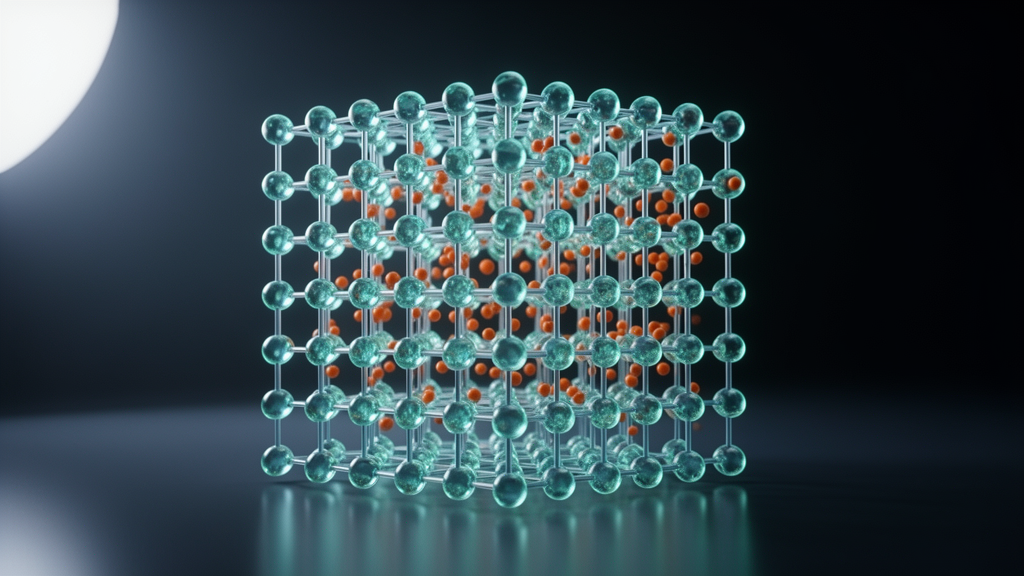
An experimental study of two equimolar five-cation rare-earth oxides found that both HEO-Lu and HEO-Tb formed single-phase cubic bixbyite structures, including a terbium-containing material whose single-component oxide instead exhibited oxygen non-stoichiometry, mixed valence and triclinic symmetry. The findings show that multication mixing was compatible with retention of the cubic framework, but the authors cautioned that configurational entropy could not be isolated experimentally from cation-size effects, oxygen stoichiometry, local strain, kinetics or processing history.
The researchers compared reference sesquioxides Gd₂O₃, Dy₂O₃, Y₂O₃, Yb₂O₃ and Lu₂O₃ with HEO-Lu and HEO-Tb, both having the nominal composition (Dy₀.₂Y₀.₂Gd₀.₂Yb₀.₂X₀.₂)₂O₃, where X was lutetium or terbium. The multicomponent materials were prepared by coprecipitating aqueous rare-earth nitrate solutions with ammonium carbonate at a carbonate-to-cation molar ratio of 10, followed by calcination at 800 °C. Laboratory X-ray diffraction, synchrotron total scattering, thermogravimetric analysis, differential scanning calorimetry, heat-capacity measurements, X-ray photoelectron spectroscopy and optical absorption spectroscopy were used to assess phase structure, composition, thermal behavior, oxidation state and band gaps.
The reference sesquioxides adopted the cubic bixbyite structure with space group Ia-3 and showed essentially constant mass from 25 to 1,000 °C during thermogravimetric analysis under dry nitrogen. Their differential scanning calorimetry traces contained no detectable endothermic or exothermic events, consistent with stable stoichiometry and no detected phase or oxygen-sublattice transitions. Terbium oxide behaved differently: the material analyzed was effectively Tb₁₁O₂₀, and it underwent sequential mass losses of about 1.0% near 700 K and 1.9% at 950 K under nitrogen. The measured cumulative loss of 2.9% agreed with the theoretical 2.78% for the pathway Tb₁₁O₂₀ to Tb₇O₁₂ and then Tb₂O₃.
Laboratory diffraction showed that HEO-Lu and HEO-Tb both crystallized as single-phase cubic bixbyite oxides, with no detected secondary phases or peak splitting. In contrast, the single-component terbium material produced reflections assigned to triclinic Tb₁₁O₂₀ with space group P-1. Synchrotron total-scattering measurements of HEO-Tb gave sharp, symmetric cubic reflections and pair distribution functions with well-defined Ln–O and Ln–Ln correlations. No coherent sequence of residual peaks matched the characteristic correlations expected for Tb₁₁O₂₀-type environments, and no additional local distortions or terbium-rich short-range order were detected at the measurement resolution.
The cubic HEO-Tb phase persisted after direct calcination at 800 °C for one or two hours and at 1,500 °C for one hour, as well as after an additional 16 hours at either 800 or 1,500 °C. Scanning electron microscopy coupled with energy-dispersive X-ray spectroscopy found substantially uniform, co-localized distributions of Dy, Y, Gd, Yb and Tb after treatment at 1,500 °C for one and 16 hours, with no detected micrometer-scale terbium enrichment or depletion. These results support substantial thermal and compositional robustness across the investigated processing window, although ex situ measurements do not establish that the phase is the global equilibrium free-energy minimum.
Surface-sensitive X-ray photoelectron spectroscopy found that the main Tb 3d component of HEO-Tb was centered at 147.7 eV, consistent with trivalent terbium, and no intensity was detected in the characteristic Tb⁴⁺ region at 152–156 eV. The measurement excluded detectable Tb⁴⁺ at the surface but could not distinguish intermediate oxidation states or assess the bulk composition. Thermogravimetric analysis of HEO-Tb instead measured a 0.94% mass loss near 700 K, close to the 0.92% expected for a nominal M₂O₃.₂ composition, which the authors interpreted as consistent with some terbium being oxidized during synthesis in air and subsequently reduced under nitrogen.
HEO-Lu closely followed the molar average heat capacity of its constituent oxides. HEO-Tb instead had a systematically higher heat capacity and could not be described as a simple weighted combination of the pure oxides. Its curve included a shallow feature of approximately 10 kJ mol⁻¹ K⁻¹ spanning 450–510 K and a broader, stronger feature of about 40 kJ mol⁻¹ K⁻¹ from 700 to 760 K. The authors associated these positive deviations with phonon broadening and enhanced low-frequency vibrational activity associated with chemical disorder, while noting that compositional dilution, disrupted terbium–terbium connectivity and local chemical environments could also contribute.
Optical absorption measurements gave band gaps of 4.9 eV for HEO-Lu and 4.8 eV for HEO-Tb. These were wider than the measured gaps of Lu₂O₃ at 4.4 eV and Tb₂O₃ at 4.5 eV, respectively, and were not equimolar averages of the constituent values. Y₂O₃, Gd₂O₃ and Dy₂O₃ had gaps of approximately 4.8–4.9 eV, while Yb₂O₃ measured 4.6 eV. The high-entropy results were consistent with reduced defect-related absorption and, in HEO-Tb, the absence of detectable mixed-valence intragap states under the measurement conditions, although the spectra alone do not establish configurational entropy as the unique cause.
The study covered only two equimolar five-cation compositions produced by one wet-chemical route and examined over a defined range of thermal and atmospheric conditions. The authors described the materials as very likely robust high-entropy oxides rather than universally established entropy-stabilized oxides. Local chemical short-range order, nanoscale segregation, extremely slow decomposition and transformations at other oxygen chemical potentials could not be excluded. The reported evidence therefore supports retention of a homogeneous cubic bixbyite framework and altered thermal, optical and oxygen-handling behavior, while leaving the independent contribution of configurational entropy unresolved.
Subject of Research: Experimental study of structural, thermal, optical and oxygen-handling behavior in two five-cation rare-earth high-entropy oxides
Article Title: Entropy-assisted stabilization of cubic bixbyite phases in multicomponent rare-earth oxides
Article References: de Nigris, A., Spiridigliozzi, L., Dell’Agli, G., & Ambrosone, L. (2026). Entropy-assisted stabilization of cubic bixbyite phases in multicomponent rare-earth oxides. Journal of Materials Science, 61(42), 32656-32672. https://doi.org/10.1007/s10853-026-13752-2
Image Credits: AI Generated
DOI: 10.1007/s10853-026-13752-2
Keywords: rare-earth oxides, high-entropy oxides, bixbyite structure, terbium, configurational entropy, crystal structure, phonon behavior, band gap, oxygen handling, Entropy-assisted, stabilization, cubic
News Source: Denise Maddox. (October 20, 2026). Entropy-assisted stabilization of cubic bixbyite phases in multicomponent rare-earth oxides. Scienmag.