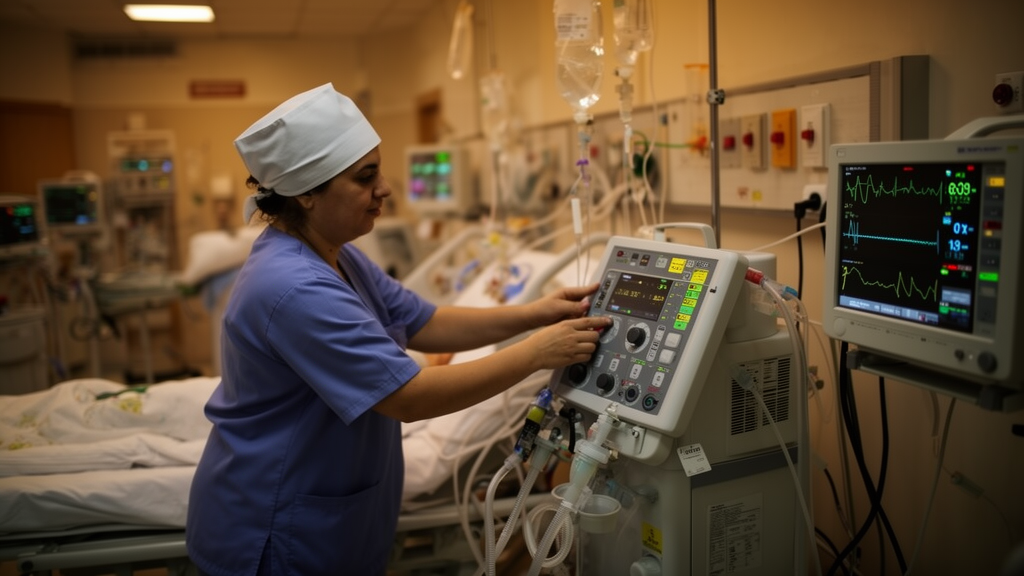
A descriptive cross-sectional study reported that intensive-care nurses in four hospitals in Amara City, Iraq, had moderate overall knowledge of mechanical ventilation but showed substantial gaps in several safety-related topics. Among 152 participating nurses, the mean score on a 20-item assessment was 0.40 ± 0.117. The study classified 65.8% of participants as having moderate knowledge, 26.3% as having poor knowledge and 7.9% as having good knowledge. These results concern nurses’ measured knowledge rather than observed patient harm.
The study abstract describes recruitment between November 20, 2024, and July 15, 2025, at four governmental hospitals: Al-Shaheed Al-Sadder Teaching Hospital, Al-Hakeem Teaching Hospital, Al-Zahrawi Surgical Hospital and Child & Maternal Hospital. Participants were selected through non-probability purposive sampling and had to have at least one year of ICU experience and direct involvement in caring for mechanically ventilated patients. Data came from a structured, self-administered questionnaire covering demographic characteristics and 20 knowledge questions, each scored as one point for a correct answer and zero for an incorrect answer.
The largest measured gaps involved forced artificial respiration, for which 90.8% of nurses answered incorrectly; interpretation of high-pressure alarms, with 89.5% incorrect; and prevention of ventilator-associated pneumonia, with 81.6% incorrect. The primary inferential analysis was a hierarchical multiple linear regression using the continuous knowledge score for all 152 participants. Together, personal characteristics, experience-related variables and training-related variables accounted for 48.2% of the variance in knowledge, with an adjusted R² of 0.456. The training block added 0.183 to R², and the block-level change was significant at p < 0.001.
An exploratory binary logistic regression examined the 12 nurses who reached the study’s adequate-knowledge threshold. In that small model, each additional year of ICU experience was associated with an odds ratio of 1.21 for adequate knowledge, while participation in at least five training sessions was associated with an odds ratio of 4.40. The investigators cautioned that the model had approximately three events per predictor, was neither adequately powered nor internally validated, and was therefore exploratory. Its reported correct-classification rate of 82.9% and area under the curve of 0.871 may be optimistic.
The study also used a failure mode and effects analysis-derived Patient-Safety Risk Index, calculated from the same item-level error rates as the knowledge score. Because this index is a severity- and detectability-weighted transformation of those data, its inverse relationship with knowledge is not independent evidence that patients experienced harm. The research did not directly assess patient outcomes, clinical errors, deterioration or deaths. Accordingly, its findings identify measured knowledge deficits and associated training and experience variables among the participating nurses in Amara City, but do not establish the frequency or clinical consequences of unsafe practice. The investigators proposed prospective evaluation of structured simulation-based ventilation training, alarm-management and ventilator-associated pneumonia bundle education, and tier-based clinical decision support; the study itself did not test those interventions or demonstrate clinical benefit.
Subject of Research: Measured mechanical-ventilation knowledge among ICU nurses in four hospitals in Amara City, Iraq
Article Title: Hidden knowledge gaps in mechanical ventilation care: a multicenter study of ICU nurses’ competence and patient safety risks in Iraq
Article References: Arrar, A. A., Radhi, T. A., Hussein, H. A., Hassooni, M. K., Hafedh, M. H., & Saber, A. F. (2026). Hidden knowledge gaps in mechanical ventilation care: a multicenter study of ICU nurses’ competence and patient safety risks in Iraq. BMC Nursing. https://doi.org/10.1186/s12912-026-05371-8
Image Credits: AI Generated
DOI: 10.1186/s12912-026-05371-8
Keywords: mechanical ventilation, ICU nursing, knowledge assessment, patient safety, ventilator alarms, ventilator-associated pneumonia, Iraq, cross-sectional study, Hidden, knowledge, gaps, mechanical
News Source: Ophelia Keating. (October 20, 2026). Hidden knowledge gaps in mechanical ventilation care: a multicenter study of ICU nurses’ competence and patient safety risks in Iraq. Scienmag.