• HOME
  • NEWS
  • EXPLORE
    • CAREER
      • Companies
      • Jobs
    • EVENTS
    • iGEM
      • News
      • Team
    • PHOTOS
    • VIDEO
    • WIKI
  • BLOG
  • COMMUNITY
    • FACEBOOK
    • INSTAGRAM
    • TWITTER
Tuesday, October 20, 2026
BIOENGINEER.ORG
No Result
View All Result
  • Login
  • HOME
  • NEWS
  • EXPLORE
    • CAREER
      • Companies
      • Jobs
        • Lecturer
        • PhD Studentship
        • Postdoc
        • Research Assistant
    • EVENTS
    • iGEM
      • News
      • Team
    • PHOTOS
    • VIDEO
    • WIKI
  • BLOG
  • COMMUNITY
    • FACEBOOK
    • INSTAGRAM
    • TWITTER
No Result
View All Result
Bioengineer.org
No Result
View All Result
Home NEWS Science News Agriculture

Agronomic performance and leaf-morphological evaluation of basil (Ocimum basilicum L.) germplasm under the environmental conditions of Adana

by
October 20, 2026
in Agriculture
Reading Time: 2 mins read
0
Agronomic performance and leaf-morphological evaluation of basil (Ocimum basilicum L.) germplasm under the environmental conditions of Adana

Screening 90 Basil Genotypes Reveals Super-Yielders for Mediterranean Biomass Farming

Share on FacebookShare on TwitterShare on LinkedinShare on RedditShare on Telegram

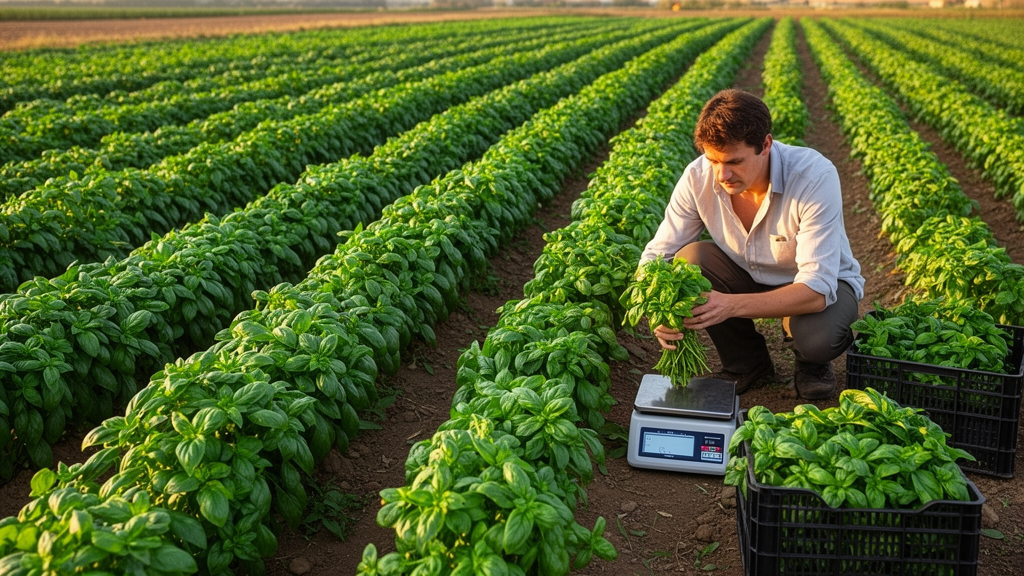
A field evaluation of 90 basil (Ocimum basilicum L.) genotypes conducted in Adana, Türkiye, during the 2023 and 2024 growing seasons found substantial variation in agronomic and leaf traits, with MT30 and MT76 showing the strongest measured performance for industrial biomass production. The study used an augmented randomized block design with four checks. Because the supplied evidence is an abstract from an early, open-access version of a peer-reviewed article, these results are summarized from the abstract rather than from an assessment of the full study.

MT30 and MT76 recorded the highest mean annual cumulative fresh herb yields, at 41,776.7 and 35,149.0 kg/ha, respectively. MT30 also had the highest mean annual cumulative dry herb yield, 6,610.4 kg/ha, and the highest mean annual cumulative dry leaf yield, 3,971.1 kg/ha. The reported results indicate that this genotype combined high biomass measurements with relatively high plant height and canopy diameter. These values describe performance in the tested environment and seasons; the abstract does not establish that the same rankings would occur elsewhere.

The collection also differed in plant architecture and leaf characteristics. MT89 had the greatest measured branching capacity, averaging 18.3 branches per plant. For leaf morphology, MT72 had the highest overall mean leaf area, 23.9 cm², and leaf width, 4.9 cm. The corresponding means for MT80 were 20.5 cm² and 4.4 cm. Multivariate analyses separated the evaluated germplasm into distinct yield-oriented and morphology-oriented genotype groups, according to the abstract.

Variation among genotypes was highly significant for most agronomic and leaf traits examined. Phenotypic coefficients of variation generally exceeded genotypic coefficients, while heritability and genetic advance were high for major yield-related traits. The authors interpreted these findings as evidence of selection potential within the evaluated germplasm. Based on the two-season field trial in Adana, they identified MT30 and MT76 as candidate genotypes for high industrial biomass production, MT80 as a resource for a large-leaf ideotype and MT89 for a branching ideotype. They also proposed these genotypes as possible parental material for cultivar development and future breeding programs. The study’s conclusions are bounded by its evaluation of 90 genotypes at one location over two growing seasons, as described in the abstract.

Subject of Research: Field evaluation of 90 basil genotypes for biomass yield, plant architecture and leaf morphology in Adana

Article Title: Agronomic performance and leaf-morphological evaluation of basil (Ocimum basilicum L.) germplasm under the environmental conditions of Adana

Article References: Barut, M., & Tansi, L. S. (2026). Agronomic performance and leaf-morphological evaluation of basil (Ocimum basilicum L.) germplasm under the environmental conditions of Adana. BMC Plant Biology. https://doi.org/10.1186/s12870-026-10010-0

Image Credits: AI Generated

DOI: 10.1186/s12870-026-10010-0

Keywords: basil, Ocimum basilicum, germplasm evaluation, biomass yield, leaf morphology, plant branching, heritability, Mediterranean agriculture, Agronomic, performance, leaf-morphological, evaluation

News Source: Alan Morgan. (October 20, 2026). Agronomic performance and leaf-morphological evaluation of basil (Ocimum basilicum L.) germplasm under the environmental conditions of Adana. Scienmag.


Tags: Agronomicbasilbiomass yieldevaluationgermplasm evaluationheritabilityleaf morphologyleaf-morphologicalMediterranean AgricultureOcimum basilicumperformanceplant branching
Share12Tweet7Share2ShareShareShare1

Related Posts

Greenhouse study finds treatment-specific responses in cactus pear under reduced soil-water target

Greenhouse study finds treatment-specific responses in cactus pear under reduced soil-water target

October 20, 2026
Serotonin and 24-epibrassinolide enhance physiological performance and saffron quality under water deficit: evidence from two-year field and multivariate analyses

Serotonin and 24-epibrassinolide enhance physiological performance and saffron quality under water deficit: evidence from two-year field and multivariate analyses

October 20, 2026

Single-dataset orange image benchmark reports 99.12% accuracy with ViT, PCA and SVM

October 20, 2026

Conserved β-tubulin as a target of ivermectin in plant-parasitic nematodes: molecular modelling and experimental protection of potato

October 20, 2026

POPULAR NEWS

  • Kinetic model reproduces Sri Lanka dengue patterns after adding climate and social factors

    Kinetic model reproduces Sri Lanka dengue patterns after adding climate and social factors

    29 shares
    Share 12 Tweet 7
  • Kazakhstan’s registered syphilis incidence fell 21.9% from 2022 to 2025, surveillance study reports

    29 shares
    Share 12 Tweet 7
  • Agronomic performance and leaf-morphological evaluation of basil (Ocimum basilicum L.) germplasm under the environmental conditions of Adana

    29 shares
    Share 12 Tweet 7
  • Systematic review links workplace blood screening economics to structured follow-up, with limited evidence on productivity

    29 shares
    Share 12 Tweet 7

About

We bring you the latest biotechnology news from best research centers and universities around the world. Check our website.

Follow us

Recent News

Kinetic model reproduces Sri Lanka dengue patterns after adding climate and social factors

Kazakhstan’s registered syphilis incidence fell 21.9% from 2022 to 2025, surveillance study reports

Agronomic performance and leaf-morphological evaluation of basil (Ocimum basilicum L.) germplasm under the environmental conditions of Adana

Subscribe to Blog via Email

Enter your email address to subscribe to this blog and receive notifications of new posts by email.

Join 85 other subscribers
  • Contact Us

Bioengineer.org © Copyright 2023 All Rights Reserved.

Welcome Back!

Login to your account below

Forgotten Password?

Retrieve your password

Please enter your username or email address to reset your password.

Log In
No Result
View All Result
  • Homepages
    • Home Page 1
    • Home Page 2
  • News
  • National
  • Business
  • Health
  • Lifestyle
  • Science

Bioengineer.org © Copyright 2023 All Rights Reserved.