• HOME
  • NEWS
  • EXPLORE
    • CAREER
      • Companies
      • Jobs
    • EVENTS
    • iGEM
      • News
      • Team
    • PHOTOS
    • VIDEO
    • WIKI
  • BLOG
  • COMMUNITY
    • FACEBOOK
    • INSTAGRAM
    • TWITTER
Tuesday, October 20, 2026
BIOENGINEER.ORG
No Result
View All Result
  • Login
  • HOME
  • NEWS
  • EXPLORE
    • CAREER
      • Companies
      • Jobs
        • Lecturer
        • PhD Studentship
        • Postdoc
        • Research Assistant
    • EVENTS
    • iGEM
      • News
      • Team
    • PHOTOS
    • VIDEO
    • WIKI
  • BLOG
  • COMMUNITY
    • FACEBOOK
    • INSTAGRAM
    • TWITTER
No Result
View All Result
Bioengineer.org
No Result
View All Result
Home NEWS Science News Technology

Relatively low Nb and Ta additions balance corrosion and passive-film performance in Ti–Zr medium-entropy alloys

by
October 20, 2026
in Technology
Reading Time: 2 mins read
0
Relatively low Nb and Ta additions balance corrosion and passive-film performance in Ti–Zr medium-entropy alloys

Nb and Ta Alloying Reshapes Corrosion Chemistry of Biomedical Ti–Zr Medium-Entropy Alloys

Share on FacebookShare on TwitterShare on LinkedinShare on RedditShare on Telegram

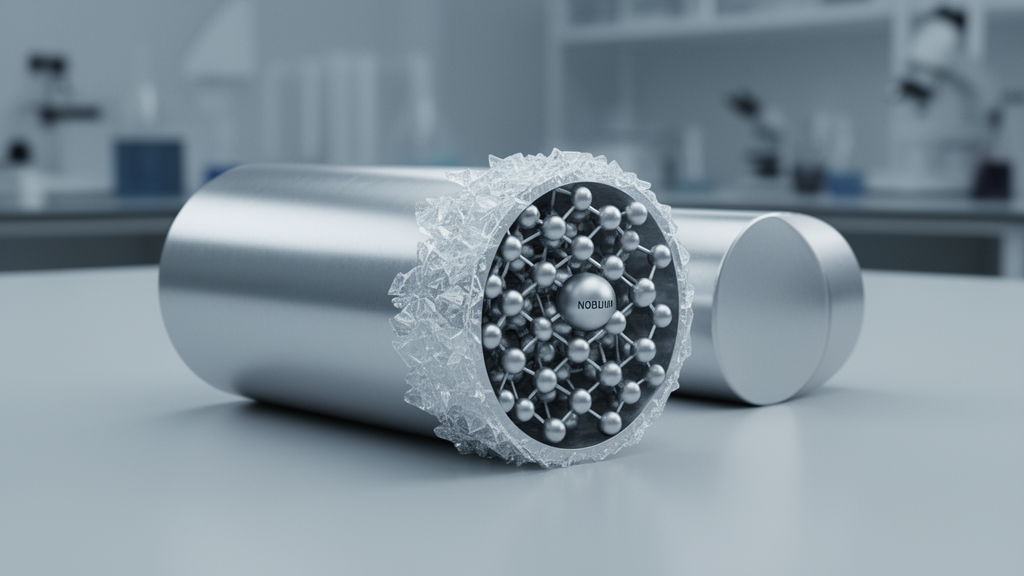
Relatively low additions of niobium or tantalum provided a better balance of corrosion resistance, passive-current response, high-potential film stability and early cell adhesion in Ti–Zr-based medium-entropy alloys tested in phosphate-buffered saline (PBS), according to the study abstract. The research is an experimental materials-science study using in vitro electrochemical, surface-characterization and early cell-adhesion assessments; it does not establish clinical benefits for biomedical implants.

The investigators fabricated Ti–Zr–Nb and Ti–Zr–Ta alloy series with different niobium and tantalum contents by vacuum arc melting. Commercially pure titanium and Ti–6Al–4V served as reference materials. X-ray diffraction and electron backscatter diffraction were used to examine phase constitution and microstructure, while electrochemical measurements assessed corrosion behavior and passive-film responses in PBS. Gibbs free energy analysis and early cell-adhesion assessments were also performed, as summarized in the abstract.

Increasing the Nb or Ta content promoted a change from α′/α″/β multiphase structures toward β-dominated matrices, with Nb showing the stronger β-stabilizing effect. Corrosion resistance did not improve monotonically with increasing alloy content. Ta5 had the lowest corrosion current density among the investigated alloys, at 1.13 × 10⁻⁶ A cm−2, whereas Nb4 had the lowest passive current density among the designed alloys, at 2.60 × 10⁻⁵ A cm−2. Nb10 and Ta10 showed higher interfacial impedance near the open-circuit potential, but they also had higher corrosion and passive current densities and an earlier rise in current during anodic polarization. These measurements indicate that high interfacial impedance near open-circuit potential did not necessarily correspond to stable anodic passivation.

X-ray photoelectron spectroscopy identified passive films based on TiO₂ and ZrO₂ that also contained Nb- or Ta-containing oxide species. The reported Gibbs free energy analysis indicated that formation of the high-valence oxides was thermodynamically favorable. Overall, the abstract reports that relatively low Nb or Ta additions produced a better combined balance of the evaluated corrosion, passivation and early cell-adhesion properties than higher additions. Because the supplied evidence is an abstract rather than the full article, the precise protocols, uncertainty estimates, statistical results and detailed limitations of the cell-adhesion assessment are not available here; the findings should not be interpreted as evidence of implant performance or patient outcomes.

Subject of Research: Experimental evaluation of Nb and Ta alloying effects on corrosion, passive films and early cell adhesion in Ti–Zr medium-entropy alloys

Article Title: Effect of Nb and Ta alloying on corrosion behavior and passive film chemistry of biomedical Ti–Zr-based medium-entropy alloys in PBS solution

Article References: Hu, S., Wei, P., Liu, Y., Chen, Z., & Liu, D. (2026). Effect of Nb and Ta alloying on corrosion behavior and passive film chemistry of biomedical Ti–Zr-based medium-entropy alloys in PBS solution. Journal of Materials Science, 61(43), 34147-34172. https://doi.org/10.1007/s10853-026-13760-2

Image Credits: AI Generated

DOI: 10.1007/s10853-026-13760-2

Keywords: Ti–Zr medium-entropy alloys, niobium alloying, tantalum alloying, corrosion behavior, passive films, electrochemistry, XPS, cell adhesion, Effect, alloying, corrosion, behavior

News Source: Denise Maddox. (October 20, 2026). Relatively low Nb and Ta additions balance corrosion and passive-film performance in Ti–Zr medium-entropy alloys. Scienmag.


Tags: alloyingBehaviorCell Adhesioncorrosioncorrosion behavioreffectelectrochemistryniobium alloyingpassive filmstantalum alloyingTi–Zr medium-entropy alloysXPS
Share12Tweet7Share2ShareShareShare1

Related Posts

Systematic review finds adaptive AI-cybersecurity strategies and workforce gaps define national policy options

Systematic review finds adaptive AI-cybersecurity strategies and workforce gaps define national policy options

October 20, 2026
Simulated hybrid framework identifies and localizes module-level faults in 3 × 5 photovoltaic array

Simulated hybrid framework identifies and localizes module-level faults in 3 × 5 photovoltaic array

October 20, 2026

Research report: Diffusion in the liquid Al–In alloy when approaching the miscibility gap

October 20, 2026

Simulated wireless-channel tests show CLEAR improves image reconstruction under fading, Doppler shift and phase noise

October 20, 2026

POPULAR NEWS

  • Six lncRNAs show prognostic associations in a gastric cancer study with small tissue validation

    Six lncRNAs show prognostic associations in a gastric cancer study with small tissue validation

    29 shares
    Share 12 Tweet 7
  • Relatively low Nb and Ta additions balance corrosion and passive-film performance in Ti–Zr medium-entropy alloys

    29 shares
    Share 12 Tweet 7
  • Systematic review finds adaptive AI-cybersecurity strategies and workforce gaps define national policy options

    29 shares
    Share 12 Tweet 7
  • Greenhouse study finds treatment-specific responses in cactus pear under reduced soil-water target

    29 shares
    Share 12 Tweet 7

About

We bring you the latest biotechnology news from best research centers and universities around the world. Check our website.

Follow us

Recent News

Six lncRNAs show prognostic associations in a gastric cancer study with small tissue validation

Relatively low Nb and Ta additions balance corrosion and passive-film performance in Ti–Zr medium-entropy alloys

Systematic review finds adaptive AI-cybersecurity strategies and workforce gaps define national policy options

Subscribe to Blog via Email

Enter your email address to subscribe to this blog and receive notifications of new posts by email.

Join 85 other subscribers
  • Contact Us

Bioengineer.org © Copyright 2023 All Rights Reserved.

Welcome Back!

Login to your account below

Forgotten Password?

Retrieve your password

Please enter your username or email address to reset your password.

Log In
No Result
View All Result
  • Homepages
    • Home Page 1
    • Home Page 2
  • News
  • National
  • Business
  • Health
  • Lifestyle
  • Science

Bioengineer.org © Copyright 2023 All Rights Reserved.