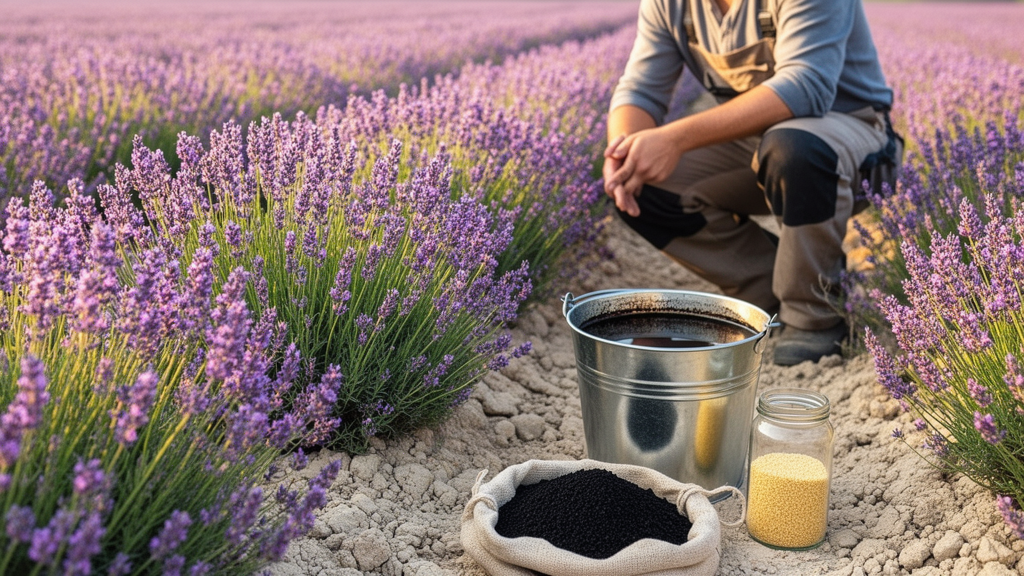
A controlled greenhouse pot trial found that applying poultry manure extract together with humic acid and dry yeast produced the strongest growth, essential-oil output and biochemical results in lavender grown in sandy soil. At the second harvest, the combined treatment yielded 243.3 g of fresh biomass and 65.4 g of dry biomass per plant, with an essential-oil content of 2.6% and a yield of 1.7 g per plant.
The experiment was conducted over two successive seasons, in 2024 and 2025, at the Central Laboratory for Agricultural Climate, Agricultural Research Center in Giza Governorate, Egypt. Uniform Lavandula multifida seedlings were planted in 30 cm plastic pots filled with sand and maintained in a greenhouse. Each pot contained three plants. Soil moisture was held at 65% of field capacity, and the five treatments were delivered through irrigation every 15 days.
The treatment groups consisted of full-strength Hoagland nutrient solution, poultry manure extract alone, poultry manure extract with humic acid, poultry manure extract with dry yeast, and poultry manure extract enriched with both humic acid and dry yeast. Humic acid and dry yeast were each applied at 5 g L⁻¹. The nutrient concentrations, particularly nitrogen, phosphorus and potassium, were not standardized among treatments because the investigators were evaluating the manure-extract treatments as practical alternatives to conventional Hoagland solution under water-deficit conditions.
Plants were harvested twice, 75 and 195 days after transplanting. The researchers measured growth, photosynthetic pigments, essential-oil content and composition, phenolics, flavonoids, carbohydrate and crude-protein concentrations, free-radical scavenging activity, tissue mineral concentrations, and nitrogen, phosphorus and potassium uptake. Essential oils were obtained by hydrodistillation and analyzed by gas chromatography–mass spectrometry. The completely randomized design used four replicates per treatment, with eight pots and three plants in each replicate.
At the second harvest, plants receiving all three organic inputs reached the highest measured values for plant height, branch number, fresh weight and dry weight: 84 cm, 16 branches per plant, 243.3 g per plant and 65.4 g per plant, respectively. The same treatment had the highest chlorophyll a, chlorophyll b and carotenoid concentrations, at 1.1, 0.9 and 0.8 mg g⁻¹. Pigment concentrations were higher than in the Hoagland treatment but generally lower at the second harvest than at the first.
The three-input combination also produced the highest essential-oil content and yield at the second harvest, reaching 2.6% and 1.7 g per plant. It yielded the greatest eucalyptol amount, 276.2 mg per plant. The Hoagland control, however, recorded the highest camphor amount at the second harvest, 103.5 mg per plant, and the highest total oxygenated monoterpenes, 407.6 mg per plant. Thus, the combined treatment improved total oil production and eucalyptol accumulation without increasing every individual oil constituent to the maximum observed level.
Biochemical measurements also peaked under the combined treatment in the second harvest. It recorded 25.5% total carbohydrates, 22.2 mg g⁻¹ total phenols, 9.9 mg g⁻¹ total flavonoids and 61.3% free-radical scavenging activity. Nitrogen uptake reached 1.8 g per plant at the second harvest. The highest phosphorus and potassium uptake values, 0.7 and 0.9 g per plant, occurred under the combined treatment at the first harvest. Tissue nitrogen, phosphorus and potassium concentrations were also highest under the combination, at 2.9%, 0.8% and 1.1%, respectively.
Two-way analysis of variance found effects from treatment, harvest time and their interaction across multiple measured traits. The reported interaction effects were highly significant for several biomass, pigment, essential-oil and antioxidant measures, while many other differences were significant at P ≤ 0.05. Because the statistical analysis used average data from the two seasons, the results characterize the combined two-year pot experiment rather than variability in every individual season.
The findings are bounded by the controlled greenhouse design, use of sand-filled pots, water-deficit conditions and unequal nutrient concentrations across treatments. The researchers did not establish that the organic combination caused all differences through a single mechanism, and the pot study did not test commercial field conditions, long-term soil-health effects or optimized application rates. The authors therefore called for field-scale validation and further assessment of rates, long-term effects and performance across environments before drawing conclusions about commercial use in sandy and arid regions.
Subject of Research: A controlled pot trial of combined organic biostimulants for lavender productivity and essential-oil production in sandy soil.
Article Title: Enhancing lavender productivity in sandy soils using combined applications of poultry manure extract, humic acid, and dry yeast
Article References: Aboud, F. S., Abd-Rabbu, H. S., & Khalid, K. A. (2026). Enhancing lavender productivity in sandy soils using combined applications of poultry manure extract, humic acid, and dry yeast. Scientific Reports, 16(1), Article 31854. https://doi.org/10.1038/s41598-026-70264-4
Image Credits: AI Generated
DOI: 10.1038/s41598-026-70264-4
Keywords: lavender, sandy soils, poultry manure extract, humic acid, dry yeast, essential oils, plant biostimulants, greenhouse experiment, Enhancing, productivity, sandy, soils
News Source: Alan Morgan. (October 20, 2026). Combined organic biostimulants boost lavender growth and oil yield in greenhouse sandy-soil trial. Scienmag.