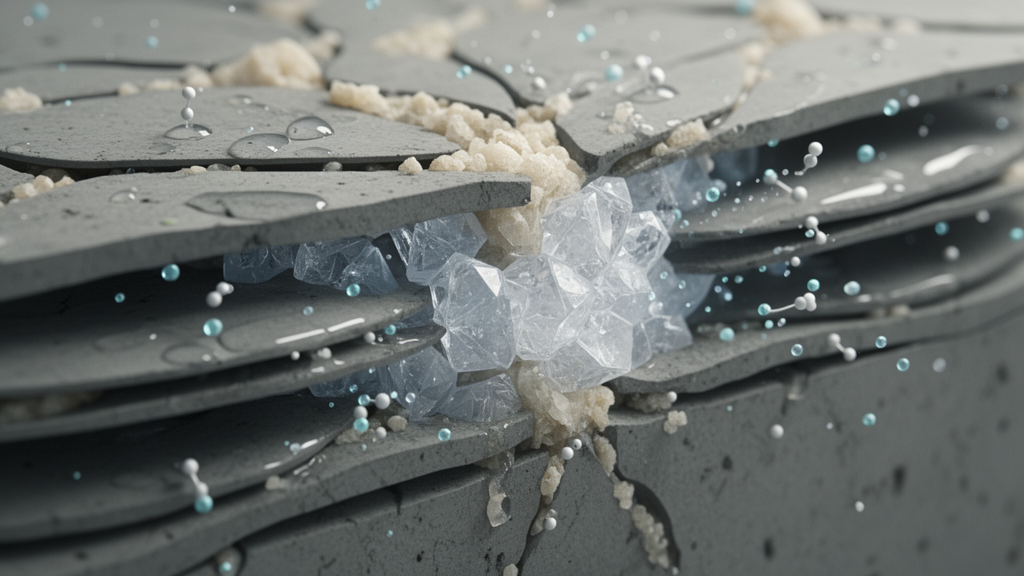
A magnesium oxide–metakaolin binder strengthened clay when it was allowed to develop a gel-based structure before exposure to carbon dioxide, according to laboratory tests on lean clay collected from a construction site in Jiaxing, China. The study found that three days of accelerated carbonation raised the unconfined compressive strength of specimens pre-cured for 28 days to 1.266 megapascals, up from 0.740 megapascals after normal curing alone. X-ray diffraction, thermogravimetric analysis and electron microscopy indicated that carbon dioxide converted brucite into nesquehonite, a magnesium carbonate crystal that filled pores, bridged cracks and interlocked with the pre-existing binding matrix. The researchers argue that this strengthening depended on the order of the reactions: carbonation worked most effectively after metakaolin had helped form a continuous magnesium aluminosilicate hydrate gel.
The clay was classified as lean clay and had a natural water content of 47.6%, a liquid limit of 36.4% and a plasticity index of 18.9. The investigators mixed it with reactive magnesium oxide, metakaolin and water, then cast cylindrical specimens 37.6 millimetres in diameter and 80 millimetres high. A preliminary series varied the magnesium oxide-to-metakaolin mass ratio, binder content and liquid-to-solid ratio, with three parallel specimens prepared for each condition. Mechanical results were based on the arithmetic mean of three valid measurements, and statistical comparisons used one-way analysis of variance followed by Tukey’s test. Carbonation was conducted at 20 degrees Celsius, 70% relative humidity and 20% carbon dioxide, an accelerated laboratory condition rather than an atmospheric exposure.
Mix design strongly affected the clay’s strength before carbonation. At 30% binder content and a liquid-to-solid ratio of 0.65, the mixture with equal masses of magnesium oxide and metakaolin produced the highest mean seven-day strength, 0.580 megapascals. This was not a simple case of adding more magnesium oxide being better: the magnesium-only mixture reached just 0.044 megapascals, while reducing magnesium oxide too far also lowered strength. The researchers selected a 6:4 magnesium oxide-to-metakaolin ratio because its seven-day strength was not significantly different from that of the 5:5 mixture, while X-ray observations indicated that it retained more brucite as a potential carbonation reserve. Increasing binder content raised seven-day strength from 0.278 megapascals at 20% to 0.580 and 0.803 megapascals at 30% and 40%, respectively.
The selected binder also remained less alkaline than an ordinary Portland cement reference. At 28 days, the magnesium oxide–metakaolin clay had a pH lower than the 11.89 measured for the Portland cement mixture, although the paper did not test effects on surrounding soils, groundwater or ecosystems. Water content also influenced performance: both strength and pH decreased approximately linearly as the liquid-to-solid ratio rose from 0.60 to 0.70. More initial water meant weaker particle contacts and could impede carbon dioxide transport through pore films. The 0.65 ratio was therefore retained for the principal carbonation experiments as a compromise between mechanical performance and carbonation conditions.
Most of the strength in the composite came from hydration rather than from brucite alone. Magnesium oxide releases magnesium ions and hydroxide during hydration, producing brucite and establishing an alkaline environment that helps dissolve metakaolin. The metakaolin supplies reactive silicon and aluminum that combine in low-crystallinity magnesium aluminosilicate hydrate, or M-(A)-S-H, gel. Clay stabilized with magnesium oxide alone remained below 0.05 megapascals after 28 days, while the selected magnesium oxide–metakaolin mixture reached 0.740 megapascals. The gel-rich matrix was therefore interpreted as the principal load-bearing skeleton, wrapping and bridging clay particles, while brucite contributed more limited pore filling and alkalinity buffering. Hydrotalcite-like layered double hydroxides were also detected and may have contributed to layered pore filling and ion regulation, although their contribution was not independently quantified.
Carbonation produced a secondary gain only when it followed enough hydration. For specimens pre-cured for seven days, carbonation initially increased strength, but five days of exposure returned the compressive strength to a level not significantly different from that of non-carbonated specimens. In contrast, all carbonated 14-day groups were stronger than their non-carbonated controls, and specimens pre-cured for 28 days gained strength after one day of carbonation and improved further after three days. Extending carbonation from three to five days did not produce a significant additional increase at the longer curing ages. This apparent optimum suggests that sufficient pre-cure is needed for carbonate crystals to become integrated with a continuous gel framework, rather than accumulating as discrete products in a still-open pore network.
The phase evidence supported that two-stage interpretation. Before carbonation, X-ray diffraction identified brucite, residual periclase and a broad feature consistent with poorly crystalline M-(A)-S-H gel, as well as a broad hydrotalcite-like reflection. After exposure to carbon dioxide, nesquehonite reflections intensified while brucite reflections weakened, indicating progressive conversion of brucite into hydrated magnesium carbonate. Thermogravimetric measurements showed that apparent carbon dioxide uptake was consistently greater near the specimen exterior than in the interior, confirming that transport through the material was incomplete. Yet the mature 28-day matrix remained comparatively stable: its gel-associated thermal mass loss did not decrease appreciably during carbonation, suggesting that the M-(A)-S-H skeleton was retained and combined with the new carbonate phase.
Microscopy showed how the products fit together. Brucite appeared as loosely stacked plates in early specimens, while longer curing produced denser material with continuous gel-like regions between clay particles. After carbonation, larger needle-like or hexagonal prismatic nesquehonite crystals appeared alongside the gel. Some crystals grew inside cracks and bridged opposing surfaces. Elemental maps showed broad overlap of magnesium, silicon, aluminum and oxygen in gel-rich regions, while magnesium, carbon and oxygen were concentrated in the prismatic crystals. A gel-like region had a magnesium-to-silicon atomic ratio of about 1.18, consistent with M-(A)-S-H-related material, and a crystal had a magnesium-to-carbon ratio of about 1.02, supporting its identification as nesquehonite when combined with the diffraction and thermal data. The specimens also underwent slight axial expansion during carbonation, consistent with crystal growth and pore filling.
Under the study’s assumptions, the magnesium oxide–metakaolin system also had a lower estimated carbon footprint than Portland cement. For treating one tonne of clay with 300 kilograms of binder, the authors estimated a net footprint of 231.12 kilograms of carbon-dioxide equivalent for magnesium oxide–metakaolin, compared with 285.28 kilograms for Portland cement, a reduction of 18.98%. Apparent carbon dioxide uptake deducted from this balance was 33.71 kilograms per tonne of clay. After 28 days of curing and five days of carbonation, the magnesium oxide–metakaolin specimens had a mean strength of 1.309 plus or minus 0.079 megapascals, versus 1.120 plus or minus 0.080 for the Portland cement reference. The balance depended on specified production, transport and processing assumptions, and the accelerated 20% carbon dioxide treatment did not establish performance under natural weathering or field-scale carbonation. The central laboratory result is instead a clear mechanistic pairing: hydration creates the load-bearing gel network, and subsequent carbonation adds interlocking crystals that reinforce an already developed matrix.
Subject of Research: Hydration-controlled carbonation strengthening of clay stabilized with a magnesium oxide–metakaolin binder
Article Title: Hydration regulation and carbonation-induced strengthening of MgO–metakaolin binders in clay-based composites
Article References: Xiao, Z., Zhu, C., Cao, K., An, K., & Hu, A. (2026). Hydration regulation and carbonation-induced strengthening of MgO–metakaolin binders in clay-based composites. Case Studies in Construction Materials, 25, Article e06624. https://doi.org/10.1016/j.cscm.2026.e06624
Image Credits: AI Generated
DOI: 10.1016/j.cscm.2026.e06624
Keywords: clay stabilization, magnesium oxide, metakaolin, carbonation, nesquehonite, cement replacement, M-(A)-S-H gel, CO2 mineralization, unconfined compressive strength, construction materials, Hydration, regulation
News Source: Denise Maddox. (October 20, 2026). Hydrated clay binder gains strength as carbonation builds interlocking crystals. Scienmag.