• HOME
  • NEWS
  • EXPLORE
    • CAREER
      • Companies
      • Jobs
    • EVENTS
    • iGEM
      • News
      • Team
    • PHOTOS
    • VIDEO
    • WIKI
  • BLOG
  • COMMUNITY
    • FACEBOOK
    • INSTAGRAM
    • TWITTER
Tuesday, October 20, 2026
BIOENGINEER.ORG
No Result
View All Result
  • Login
  • HOME
  • NEWS
  • EXPLORE
    • CAREER
      • Companies
      • Jobs
        • Lecturer
        • PhD Studentship
        • Postdoc
        • Research Assistant
    • EVENTS
    • iGEM
      • News
      • Team
    • PHOTOS
    • VIDEO
    • WIKI
  • BLOG
  • COMMUNITY
    • FACEBOOK
    • INSTAGRAM
    • TWITTER
No Result
View All Result
Bioengineer.org
No Result
View All Result
Home NEWS Science News Technology

Uncertainty-aware multimodal model evaluated for cervical-cell classification

by
October 20, 2026
in Technology
Reading Time: 2 mins read
0
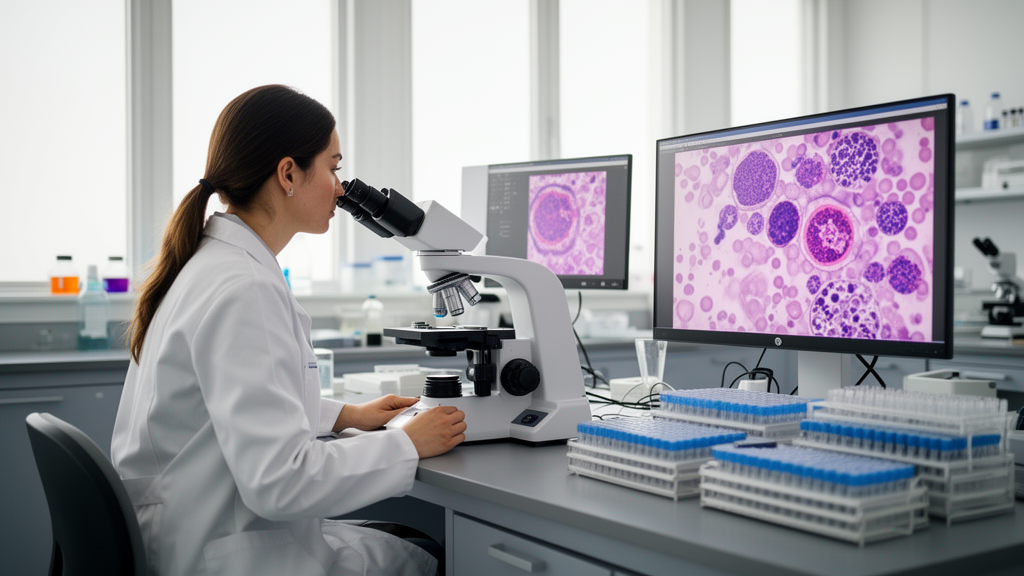
Uncertainty-aware multimodal model evaluated for cervical-cell classification

AI Learns When to Distrust Itself in Cervical Cancer Screening Breakthrough

Share on FacebookShare on TwitterShare on LinkedinShare on RedditShare on Telegram

A proof-of-concept deep-learning framework combined image, clinical and genomic information to classify cervical cells while estimating predictive uncertainty. The abstract reports that, on a combined SIPaKMeD and Herlev benchmark of 6,849 cervical-cell images, the framework achieved an AUC-ROC of 0.993 (95% CI 0.988–0.997), with 97.08% accuracy, 98.07% sensitivity and 96.08% specificity. These findings were summarized from the study abstract rather than independently assessed from the full article.

The proposed architecture used an ensemble image encoder comprising ResNet50, DenseNet121 and EfficientNet-B0, together with dedicated clinical and genomic encoders. An adaptive fusion mechanism combined modality-specific predictions through convex weights driven by predictive entropy estimated with Monte Carlo Dropout. In tests where auxiliary modalities were uninformative, the framework was reported to suppress their influence and maintain identical test-set predictions across all image-containing configurations. A static equal-weight baseline, by comparison, had an AUC of 0.982 rather than 0.993.

The framework also produced well-calibrated probabilities in the reported evaluation, with a Brier score of 0.025 and expected calibration error of 0.014. Confidence-based selective prediction was described as showing potential for human-in-the-loop triage. This is a measured evaluation result, but the abstract does not establish improved clinical outcomes or demonstrate benefit in prospective screening.

Important limitations constrain the scope of the work. The study was explicitly presented as a proof-of-concept, and paired patient-level multimodal data were unavailable. Clinical features were therefore derived from an independent risk-factor cohort, while genomic features were synthetically generated. Cross-dataset transfer experiments showed a generalization gap, indicating that further external validation is needed. The reported performance came from cervical-cell image benchmarks and should not be interpreted as evidence that the full multimodal framework has been validated for routine patient screening.

Subject of Research: Proof-of-concept evaluation of uncertainty-aware multimodal classification of cervical-cell images

Article Title: Uncertainty-aware adaptive fusion with graceful degradation for trustworthy cervical cytology

Article References: Chaabane, S. B., Bushnag, A., Oyouni, A. A. A., Massoudi, W., Abuzneid, S., & Aluneizi, S. (2026). Uncertainty-aware adaptive fusion with graceful degradation for trustworthy cervical cytology. Scientific Reports. https://doi.org/10.1038/s41598-026-73797-w

Image Credits: AI Generated

DOI: 10.1038/s41598-026-73797-w

Keywords: cervical cytology, deep learning, multimodal fusion, predictive uncertainty, image classification, model calibration, synthetic genomic data, external validation, Uncertainty-aware, adaptive, fusion, graceful

News Source: Denise Maddox. (October 20, 2026). Uncertainty-aware multimodal model evaluated for cervical-cell classification. Scienmag.

Tags: adaptivecervical cytologydeep learningexternal validationfusiongracefulimage classificationmodel calibrationmultimodal fusionpredictive uncertaintysynthetic genomic dataUncertainty-aware
Share12Tweet7Share2ShareShareShare1

Related Posts

Simulation and experiments link electrospinning parameters to cellulose acetate nanofiber morphology

Simulation and experiments link electrospinning parameters to cellulose acetate nanofiber morphology

October 20, 2026
George Mason researchers begin crash tests of National Park Service bridge railings

George Mason researchers begin crash tests of National Park Service bridge railings

October 20, 2026

Experimental Ce and ultrasonic treatment improves Al–Si–Cu–Ni melt purity and casting properties

October 20, 2026

Mouse Acinar Organoids Reveal Stage-Specific Control of Cell Plasticity

October 20, 2026

POPULAR NEWS

  • BMI change patterns linked to hospitalization risk in prospective cohort of 20,329 high-risk Chinese adults

    BMI change patterns linked to hospitalization risk in prospective cohort of 20,329 high-risk Chinese adults

    29 shares
    Share 12 Tweet 7
  • Sevoflurane reduced myocardial injury in rat and cell ischemia-reperfusion models through a circ_SMG6-related pathway

    29 shares
    Share 12 Tweet 7
  • Simulation and experiments link electrospinning parameters to cellulose acetate nanofiber morphology

    29 shares
    Share 12 Tweet 7
  • Uncertainty-aware multimodal model evaluated for cervical-cell classification

    29 shares
    Share 12 Tweet 7

About

We bring you the latest biotechnology news from best research centers and universities around the world. Check our website.

Follow us

Recent News

BMI change patterns linked to hospitalization risk in prospective cohort of 20,329 high-risk Chinese adults

Sevoflurane reduced myocardial injury in rat and cell ischemia-reperfusion models through a circ_SMG6-related pathway

Simulation and experiments link electrospinning parameters to cellulose acetate nanofiber morphology

Subscribe to Blog via Email

Enter your email address to subscribe to this blog and receive notifications of new posts by email.

Join 85 other subscribers
  • Contact Us

Bioengineer.org © Copyright 2023 All Rights Reserved.

Welcome Back!

Login to your account below

Forgotten Password?

Retrieve your password

Please enter your username or email address to reset your password.

Log In
No Result
View All Result
  • Homepages
    • Home Page 1
    • Home Page 2
  • News
  • National
  • Business
  • Health
  • Lifestyle
  • Science

Bioengineer.org © Copyright 2023 All Rights Reserved.