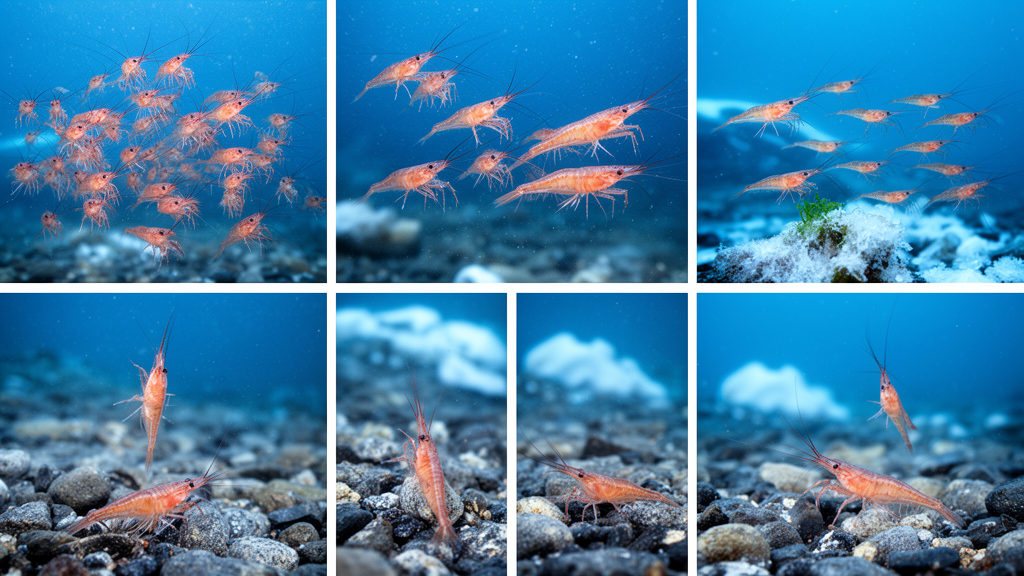
Continuous seabed video recorded a pronounced night-centered rhythm among euphausiids in Antarctic coastal waters, with animals generally more abundant in the camera’s field of view at night than during the day. A preliminary field study at 28 metres depth in Great Wall Bay, near China’s Great Wall Station on King George Island, identified six recurring behavioral phases over 72 hours. Visible euphausiid counts ranged from zero to 96 individuals per sampled frame, with the highest local densities occurring around midnight. Multivariate analysis identified dissolved oxygen as the environmental variable most closely associated with abundance during several phases of the cycle, although the observations do not by themselves establish oxygen as the cause of the behavior.
The observations were made with a Polar Seabed Observation System, or PSOS, deployed from 31 May to 3 June 2023 during the 39th Chinese National Antarctic Research Expedition. The seabed platform combined a continuously operating high-definition camera with sensors for temperature, salinity and dissolved oxygen. Its camera was anchored horizontally 0.5 metres above the sediment and recorded within an effective observation range of about 0.5 to 3 metres. The system used 12 watts of white LED illumination, producing a measured underwater irradiance of 0.08–0.12 lux at the two-metre midpoint of the range. The deployment was non-invasive: researchers did not capture, handle or experimentally manipulate euphausiids, fish or other marine organisms. An environmental assessment conducted under Antarctic Treaty protocols classified the activity as having less than a minor or transitory impact.
The camera generated 144 half-hour video files during the deployment. Investigators extracted one image every five minutes, producing 865 frames for abundance counting. Because the volume of seawater visible in a single frame could not be calculated, the results were reported as individuals per sampled shoot, reflecting temporal changes in local counts within the camera’s field of view rather than population-wide density. All recognizable euphausiids were treated as one group because image resolution and viewing distance did not permit reliable species identification. Fish could be distinguished from euphausiids by differences in body morphology and color, but they were also counted only as a broad group. The team defined daytime as 8:30 a.m. to 2:30 p.m. and nighttime as 2:30 p.m. to 8:30 a.m. the following day, reflecting the approximately six hours of daylight and 18 hours of darkness available at this sub-Antarctic site during winter.
The recorded cycle contained six distinct phases. From 9:00 a.m. to 2:30 p.m., euphausiids were largely quiescent, with only sporadic individuals visible. Between 2:30 p.m. and 1:00 a.m., visible numbers rose steadily in a period interpreted by the researchers as the majority of animals leaving benthic habitats to forage. Counts then declined sharply from 1:00 to 4:30 a.m. The decline may reflect horizontal dispersal, movement beyond the camera’s narrow field of view or a return to the seabed, rather than a migration route demonstrated by the footage. A second low point, described as a resting state, occurred from 4:30 to 5:00 a.m. Activity briefly increased from 5:00 to 6:00 a.m. before visible abundance declined again from 6:00 to 9:00 a.m. Together, the phases form a repeating daily pattern centered on the winter night.
Across the deployment, mean nighttime abundance reached 34.3 ± 28.6 individuals per sampled frame, compared with 1.3 ± 1.7 during daytime, a 27.5-fold difference. Nighttime counts were also 7.7 times higher than those in the evening day-to-night transition, whose mean was 4.5 ± 5.3 individuals per frame, and 3.4 times higher than those in the morning night-to-day transition, whose mean was 10.0 ± 15.5. Co-occurring fish showed a broadly synchronized rhythm, although their maximum observed count was 52 individuals per frame. Euphausiids remained the dominant recorded group for most of the observation period, accounting for more than half of the observed animals. These values describe changes in local camera counts, not estimates of abundance across the bay or total standing stock in the surrounding ecosystem.
Environmental measurements at the seabed also varied during the three-day record. Temperature rose consistently over the deployment, with midday readings systematically higher than those measured at 8:30 a.m. Salinity remained within a narrow range of 33.95–34.03 and followed a less regular pattern. It declined to a minimum of 33.94 by 6:00 a.m. on 2 June, then increased by approximately 0.11 units by 6:00 p.m. before declining again. Dissolved oxygen showed a pronounced oscillation with an amplitude of 2.02 milligrams per litre, reaching a low near midnight and a peak around dusk at approximately 3:00 p.m. The oxygen cycle was consistent with the study authors’ interpretation that local biological activity influenced benthic oxygen conditions, although the sensor record alone cannot separate all biological and physical contributions. Video observations also indicated stronger bottom currents beginning at 6:00 a.m. on 2 June and continuing to noon on 3 June, coinciding with the salinity inflection.
Relationships between euphausiid abundance and the measured environmental variables changed by behavioral phase. Temperature showed its strongest inverse association with abundance during the 4:30–5:00 a.m. resting phase, with a log–log slope of −12.1 and an R² of 0.55. Other phases had positive, negative or negligible temperature slopes, indicating that no single thermal relationship characterized the entire day. Salinity correlations were weak, with R² values no greater than 0.36, and the narrow, non-systematic salinity range made ecological interpretation difficult. Dissolved oxygen had significant negative associations with euphausiid abundance during the rapid escalation, abrupt decline and resting phases, with R² values of 0.11, 0.61 and 0.58, respectively, and p-values below 0.001. Rank-correlation analysis likewise found a statistically robust negative association between oxygen and euphausiid abundance.
Principal component analysis of standardized abundance and environmental data for the rapid escalation, decline and resting phases separated the environmental regimes along two components. Those components accounted for 84.22%, 92.13% and 95.83% of the observed variance in the three phases, respectively. A three-dimensional analysis of temperature, dissolved oxygen and euphausiid abundance also placed higher visible densities under lower thermal and oxygen conditions. On the basis of these results and the rank correlations, the researchers identified dissolved oxygen as the predominant abiotic factor associated with euphausiid population dynamics. Their conceptual model places oxygen alongside food availability and physical transport as interacting controls on winter behavior, but the short deployment and observational design prevent a firm separation of those influences or a direct test of causation.
The study had important spatial and taxonomic limitations. A single camera monitored a small area near the seabed at one 28-metre-deep site, so the results cannot be generalized across the Southern Ocean, other depths, ice-covered habitats or the full range of euphausiid species living in Antarctic waters. The camera could not resolve the animals reliably to species level, despite seven species having been recorded from the region, nor could it measure body size. Consequently, the team could not convert visible counts into carbon biomass or evaluate differences among species that may have different overwintering strategies and roles in carbon cycling. Currents may also have transported animals through the field of view, making changes in local counts difficult to distinguish from movement across a larger area. The study therefore provides a preliminary, site-specific baseline rather than a complete account of Antarctic euphausiid ecology.
The deployment demonstrates the potential of continuous optical observations to document near-bottom euphausiid behavior in shallow Antarctic coastal waters during winter. The authors propose combining future PSOS deployments with standard zooplankton net tows to establish taxonomic ground truth, echo sounders on upper-ocean buoys to widen detection coverage, and calibrated cameras fitted with reference scales for species identification and morphometric measurements. Integrating optical records with acoustic measurements is a proposed next step, not a method evaluated in the present study. Improved systems would also support more reliable conversion of biological observations into carbon biomass. The present findings identify a clear six-phase rhythm, a 27.5-fold difference between mean nighttime and daytime local counts, and dissolved oxygen as the strongest measured correlate. They offer a testable starting point for longer, broader and taxonomically resolved investigations of how euphausiids persist through polar winter.
Subject of Research: Winter diel rhythms and environmental correlates of euphausiids observed on the seabed of Great Wall Bay, Antarctic Peninsula
Article Title: Polar Seabed Observation Systems reveal winter diel rhythms and environmental drivers of euphausiids in Great Wall Bay, Antarctic Peninsula
Article References: Wang, C., Jiang, H., Fan, Y., Zhong, M., Du, W., Qi, L., Zhang, W., Wu, Z., Li, B., Du, H., Luo, G., & Liu, R. (2026). Polar Seabed Observation Systems reveal winter diel rhythms and environmental drivers of euphausiids in Great Wall Bay, Antarctic Peninsula. Scientific Reports, 16(1), Article 33010. https://doi.org/10.1038/s41598-026-62036-x
Image Credits: AI Generated
DOI: 10.1038/s41598-026-62036-x
Keywords: Antarctic euphausiids, winter behavior, diel rhythm, seabed video, dissolved oxygen, Great Wall Bay, Antarctic Peninsula, Southern Ocean, continuous observation, Polar Seabed Observation System, Polar, Seabed
News Source: Denise Maddox. (October 20, 2026). Antarctic euphausiids show six winter activity phases in seabed footage. Scienmag.