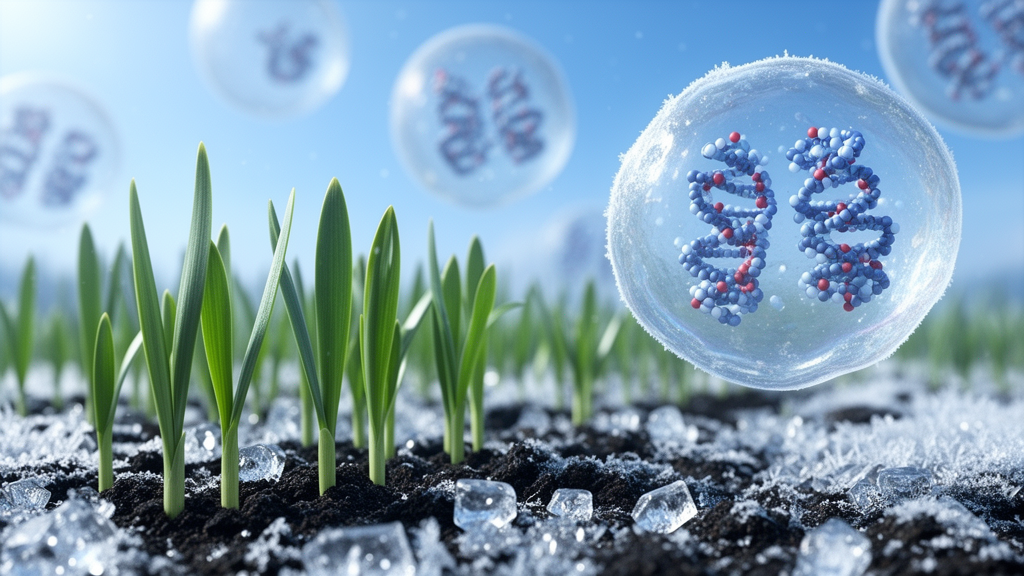
Wheat seedlings that experienced a mild, non-lethal cold treatment later tolerated a stronger chill better than plants exposed to the stronger cold for the first time, according to an experimental study published in The Crop Journal . During the second chilling, previously primed plants retained better photosystem II performance, accumulated less hydrogen peroxide, and maintained higher levels of key antioxidants. The researchers also found that recovery after the initial cold was an active period of biological change rather than a passive return to normal conditions.
Wheat reorganized its gene regulation during this interval, and selected genes acquired histone-modification signatures before the next cold event arrived. The results suggest that cold memory is associated with photosystem adaptation and a distinctive post-stress regulatory program. The experiment used wheat seedlings in a three-stage sequence.
Researchers from Nanjing Agricultural University first exposed the seedlings to a non-lethal cold treatment, allowed them to recover fully after temperatures returned to normal, and then subjected them to an even stronger chill. Other plants had no prior cold exposure when they encountered the stronger treatment. This sequence made it possible to compare the later response of primed plants with that of previously unexposed plants while also tracking what happened during recovery.
The study was an experimental investigation of a defined plant system, so the findings concern the tested wheat seedlings and conditions rather than a direct demonstration of improved field performance or crop yield. One of the clearest results was that the effect of the first cold exposure did not disappear when the cold treatment ended. Some differences between primed and unprimed plants persisted after recovery, showing that the later response was not simply the result of stress-response genes remaining continuously switched on.
Instead, many genes responded with a delay. Genes involved in jasmonic acid biosynthesis, heat-shock responses, protein folding, and other protective processes were only weakly activated immediately after the initial cold treatment but became much more active after temperatures had returned to normal. The delayed pattern indicated that recovery itself was associated with a distinct phase of regulation in which wheat reorganized its response after the original stress had disappeared.
Molecular analysis linked this delayed response to lasting changes in histone modifications at selected genes. The researchers found that some stress-responsive genes gained H3K4me3, a mark generally associated with active transcription, while others lost H3K27me3, a mark commonly linked to repression. In several cases, the modification changes appeared before large differences in gene expression became evident.
Their timing supports the interpretation that the initial cold exposure left a molecular record at selected genes, preserving information from the earlier stress without requiring the plant to maintain a broad, continuously elevated stress response. The study associates these chromatin changes with cold memory, but it does not establish the complete molecular pathway responsible for the phenomenon. The physiological measurements showed that the molecular changes coincided with measurable differences during the later chill.
Primed plants displayed better photosystem II performance, less hydrogen peroxide accumulation, and higher levels of key antioxidants than plants without the initial cold exposure. These results indicate that prior mild chilling was associated with greater tolerance under the subsequent, stronger treatment. They also provide a functional counterpart to the delayed gene responses and histone-modification signatures observed during recovery.
The researchers did not report field trials, agricultural outcomes, or the effect of priming on wheat yield in the supplied description of the study, so those broader applications cannot be inferred from the experimental result. Signs of the altered molecular state were already present before the second cold event. Many photosystem-related genes had acquired different histone-modification states while their transcript levels remained largely unchanged.
In other words, the change in regulatory condition preceded a major shift in gene expression. Instead, they entered the new stress with selected genes already marked by the earlier exposure. The timing is central to the study because it places preparation for renewed cold within the recovery period, when the first stress had ended but its molecular consequences remained detectable.
The photosynthetic response produced the study’s most unexpected feature. Strong activation of genes associated with photosystem components and chloroplast protein synthesis could have indicated that primed plants mounted a more intensive repair response during the second chill. Instead, plants without prior exposure strongly induced many of these genes, whereas primed plants showed weaker induction despite retaining photosystem II in better condition.
The researchers described this as primed plants appearing to need less repair. Their advantage was therefore not a larger repair-and-replacement response. It was the better preservation of photosynthetic function during renewed cold, accompanied by a smaller requirement for the extensive response seen in previously unexposed plants.
The observed gene-expression pattern was consistent with the idea that plants suffering less photosynthetic damage have less need to replace damaged components or increase chloroplast protein synthesis. The researchers did not claim that primed plants lacked repair capacity; the evidence instead concerns how strongly repair-related genes were induced under the tested conditions. Their findings support enhanced photosystem tolerance, rather than intensive repair capacity alone, as an important feature of cold memory.
Because the experiments involved seedlings and controlled cold treatments, the study also does not show that the same response is equally effective across other wheat varieties, growth environments, or field conditions. Taken together, the experiments place the post-stress recovery phase at the center of a broader model of cold memory in wheat. Mild priming altered physiological performance during later chilling, while the recovery interval was marked by delayed protective gene responses and selective histone-modification changes.
Many of those changes were visible before renewed cold arrived. At the same time, better photosystem II condition was accompanied by weaker induction of many repair- and replacement-related genes than occurred in previously unexposed plants. The study does not establish how long the memory persists, whether priming can be used to improve agricultural performance, or exactly how chloroplast-derived signals interact with chromatin-regulating mechanisms in the nucleus.
The authors identified that final question as an area for further work, while the present results show that recovery after cold is an active biological window in which wheat reorganizes its response to a subsequent chill.
Subject of Research: Experimental investigation of cold priming, gene regulation, histone modifications, and photosystem adaptation in wheat seedlings.
Article Title: Wheat remembers the cold: Molecular changes prepare plants for the next chill
Article References: Wheat remembers the cold: Molecular changes prepare plants for the next chill. Original publication (Bibliographic details unavailable.)
Image Credits: AI Generated
DOI: Not provided
Keywords: wheat, cold priming, stress memory, photosystem II, histone modifications, gene regulation, chromatin, photosynthesis, antioxidants, crop resilience, remembers, cold
News Source: Alan Morgan. (October 20, 2026). Wheat remembers the cold: Molecular changes prepare plants for the next chill. Scienmag.