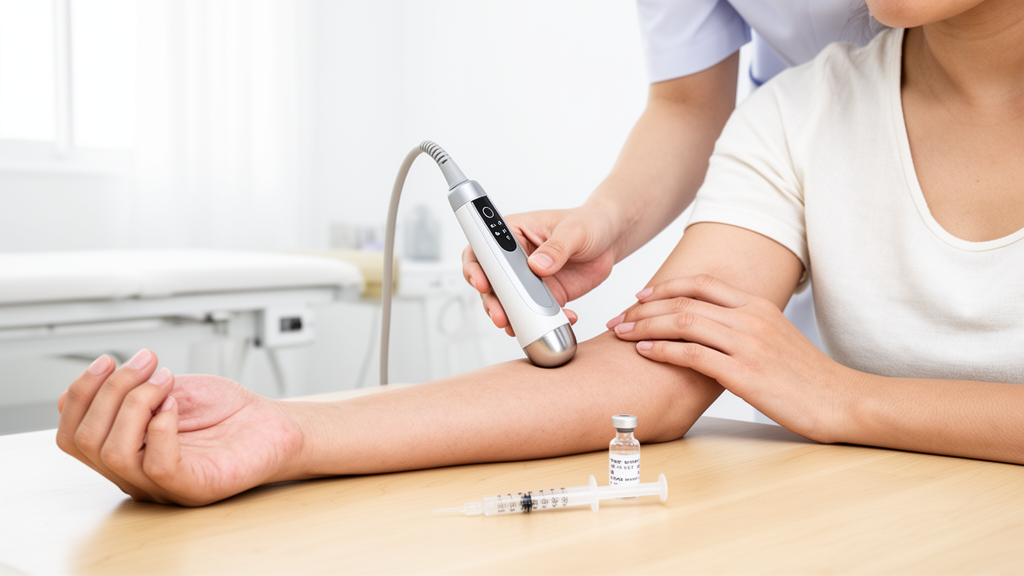
A systematic review of seven randomized controlled trials found that adding extracorporeal shock wave therapy to botulinum toxin type A injections was associated with greater short-term reductions in post-stroke muscle spasticity and improved motor impairment. The combined treatment did not, however, show a reliable increase in activities of daily living, and the researchers said the evidence is not yet sufficient to support routine clinical use. The analysis included 377 adults, with six trials and 242 participants contributing to the primary quantitative estimates of the treatment’s added effect.
Post-stroke spasticity is an involuntary increase in muscle tone that can make movement, rehabilitation and everyday activities more difficult. Intramuscular botulinum toxin type A, commonly known by the brand name Botox, is a standard focal treatment because it reduces overactivity in selected muscles. Its effects are time-limited, however, and may begin to wane within eight to 12 weeks. Shock wave therapy has been investigated as a non-invasive addition to injection-based care, with proposed effects on neuromuscular structures, soft tissue and mechanotransduction, although none of those biological pathways has been confirmed as the mediator of clinical benefit after stroke.
The review specifically asked whether shock wave therapy adds benefit beyond botulinum toxin rather than whether the two treatments work when compared with sham therapy or rehabilitation alone. This distinction is important because a broad comparison could make the treatment look effective by capturing the known effects of botulinum toxin. The primary analysis therefore included only randomized comparisons in which both groups received a botulinum toxin-based intervention, such as toxin alone or toxin plus sham shock wave therapy. The investigators searched eight medical databases from their inception through March 2026 and included studies reported in English or Chinese.
p>For spasticity measured with the Modified Ashworth Scale, the pooled analysis produced a standardized effect of Hedges’ g = 0.87, with a 95% confidence interval from 0.41 to 1.34 and p < 0.001. Six trials and 242 participants contributed 21 effect estimates to this result, which indicated a greater reduction in muscle tone with the combined intervention. Certainty in this evidence was rated as moderate, downgraded because the independent trial base was small and the magnitude of the standardized benefit remained uncertain. A sensitivity analysis using a bias-reduced cluster-robust variance estimator also favored the combination, with an interval of 0.25 to 1.49 and p = 0.016.
p>Motor impairment, assessed with the Fugl-Meyer Assessment, showed a similar pattern. Five trials and 202 participants contributed 14 post-treatment effect estimates, yielding g = 1.11, a 95% confidence interval of 0.45 to 1.76 and p < 0.001. The point estimate favored botulinum toxin plus shock wave therapy, but certainty was rated as low because of substantial differences between studies and imprecision in the estimated magnitude. A cluster-robust sensitivity analysis remained above the null, although its interval was wider, from 0.16 to 2.05. Leave-one-out analyses preserved positive MAS and Fugl-Meyer estimates, supporting the direction of the findings while not resolving the limitations of the small evidence base.
p>Functional independence was the least certain domain. Activities of daily living, measured with global instruments including the Modified Barthel Index and Functional Independence Measure, produced a pooled estimate of g = 1.15 in favor of the combined treatment. Its 95% confidence interval extended from −0.03 to 2.32, however, and the result narrowly missed conventional statistical significance at p = 0.056. The corresponding cluster-robust interval was also inconclusive, spanning −0.39 to 2.68. Certainty for activities of daily living was rated as very low after considering risk of bias, inconsistency and imprecision. Change-score sensitivity models produced intervals crossing the null under all three assumed pre-post correlations of 0.2, 0.5 and 0.8.
p>The apparent difference between impairment and functional outcomes was not uniform across all analyses. In an exploratory subgroup analysis, the radial shock wave trials showed a smaller positive activities-of-daily-living estimate of g = 0.62, with a 95% confidence interval of 0.11 to 1.13, after the influential focused-shock-wave trial was removed. An apparent association between shock wave modality and functional results was driven mainly by that single focused-shock-wave trial, which had marked baseline imbalance. Stroke stage also showed exploratory associations in meta-regression, but the number of independent study clusters was too small to treat such findings as confirmatory. The investigators emphasized that these analyses cannot establish that focused treatment is superior to radial treatment, or that either protocol is optimal.
Treatment protocols differed markedly among the trials. Five of the six studies in the primary analysis used radial extracorporeal shock wave therapy, while one used focused therapy. Radial protocols generally delivered approximately 1,000 to 2,000 impulses at pressures of 1.8 to 3.0 bar, whereas the focused protocol used an energy flux density of 0.030 mJ/mm² with 1,000 shocks per session. Participants received between four and 24 sessions, and the first treatment began from immediately after injection to seven days later. Treated areas included elbow, wrist and finger flexors in the upper limb and the gastrocnemius, soleus, triceps surae and ankle plantar flexors in the lower limb. Botulinum toxin doses, injection techniques and rehabilitation co-interventions also varied, preventing reliable dose-response analysis.
To address the repeated follow-up measurements, multiple treated muscles and related outcomes reported within the same trials, the researchers used a three-level random-effects meta-analysis. This model separated sampling error, variation among outcomes within a study and genuine differences between studies. Most MAS variation occurred within studies, whereas 64.3% of the Fugl-Meyer variation and 90.7% of the activities-of-daily-living variation occurred between studies. That pattern helps explain why impairment outcomes were more consistent than functional results: the latter were strongly shaped by differences in participant characteristics, treatment protocols, outcome instruments and follow-up schedules. Although the statistical model handled dependent estimates appropriately, it could not add independent trials or remove uncertainty caused by their small size and heterogeneous designs.
Safety evidence was also incomplete. Two of 20 participants in one trial developed transient erythema after shock wave therapy; the symptoms resolved after approximately 20 minutes, and no other side effects were reported in that trial. Other studies reported no obvious adverse reactions or no serious complications, but three of the seven trials did not provide usable trial-level safety data. Because adverse-event definitions and ascertainment differed, the review could not calculate a comparative safety estimate. The authors also could not formally assess publication bias because fewer than 10 independent studies contributed to each outcome; most trials were modest-sized, single-center studies, leaving selective publication and selective reporting difficult to exclude.
Overall, the findings support a cautious distinction between improvements in body impairment and gains in daily functioning. Better muscle-tone control and limb-level motor scores may create more favorable conditions for rehabilitation, but they do not automatically translate into greater independence in dressing, transfers, walking or self-care. The authors concluded that the current evidence does not support routine implementation of adjunctive shock wave therapy after botulinum toxin, nor can it establish a preferred modality, target, dose, treatment schedule or timing relative to injection. Larger, adequately blinded trials with standardized toxin dosing, clearly specified muscles, harmonized shock wave parameters and prespecified functional outcomes are needed before firm clinical recommendations or dose-response conclusions can be made.
Subject of Research: Systematic review of adjunctive extracorporeal shock wave therapy for post-stroke spasticity after botulinum toxin injection
Article Title: Adjunctive extracorporeal shock wave therapy after botulinum toxin type A injection for post-stroke spasticity: a systematic review and three-level meta-analysis
Article References: Ke, W., Wang, L., Shen, W., Chen, M., & Wang, Z. (2026). Adjunctive extracorporeal shock wave therapy after botulinum toxin type A injection for post-stroke spasticity: a systematic review and three-level meta-analysis. Frontiers in Neurology, 17, Article 1890975. https://doi.org/10.3389/fneur.2026.1890975
Image Credits: AI Generated
DOI: 10.3389/fneur.2026.1890975
Keywords: post-stroke spasticity, botulinum toxin, extracorporeal shock wave therapy, systematic review, meta-analysis, motor impairment, activities of daily living, stroke rehabilitation, treatment safety, evidence certainty, Adjunctive, extracorporeal
News Source: Cassandra Pierce. (October 20, 2026). Shock-wave therapy may ease post-stroke spasticity after Botox injections. Scienmag.