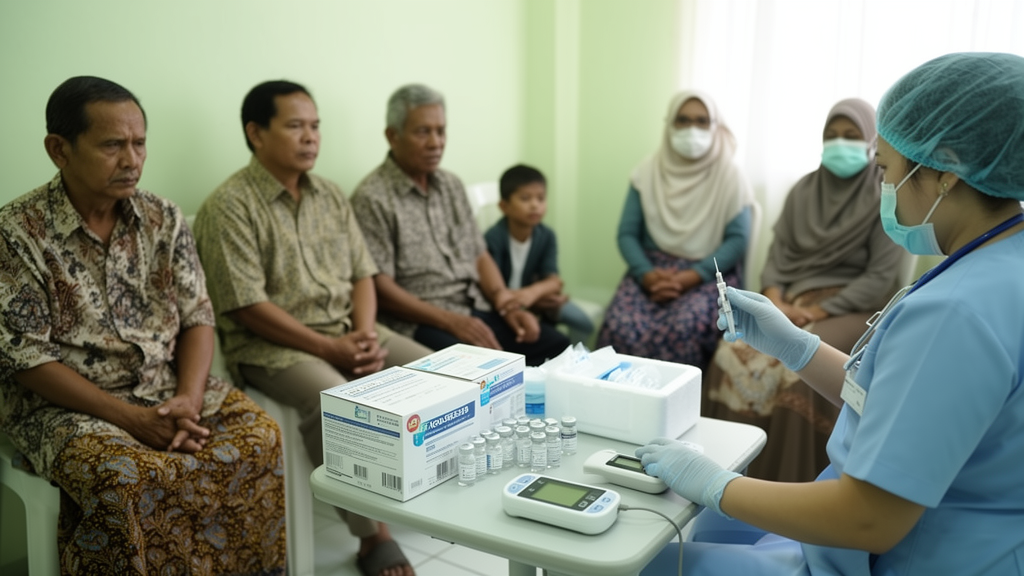
People with diabetes who had received a COVID-19 vaccine before their infection had a lower rate of daily health complaints than those who had never been vaccinated, according to a cross-sectional study conducted in primary care in Indonesia’s DI Yogyakarta Province from March through August 2024. The analysis included 420 people aged 15 years or older with diagnosed diabetes mellitus and a self-reported history of COVID-19 infection. In the multivariable analysis, never-vaccinated participants had a 45% higher rate of total daily health complaints than those vaccinated before infection, with an adjusted incidence rate ratio of 1.45 and a 95% confidence interval of 1.10–1.91. This was an association in a retrospective, single-time-point assessment, not proof that vaccination caused the difference; the investigators said future prospective studies with uninfected control groups are needed to confirm causality.
Trained enumerators interviewed participants face to face for approximately 20–30 minutes and administered a structured checklist covering 25 possible daily health complaints. The total score ranged from zero to 25 and was divided into three domains: sensory function or pain, body-system function, and activity participation. Participants were eligible if they were at least 15 years old, had diagnosed diabetes and reported a previous COVID-19 infection. Vaccination status was verified using electronic records from Indonesia’s SatuSehat platform and physical vaccination cards. Missing data were addressed through K-nearest-neighbours imputation with k = 5, producing an analytic sample of 420 participants. The count outcomes were modelled with negative binomial regression adjusted for sociodemographic and clinical variables.
The participants had a median age of 60 years, and 70.2% were female. A total of 36.2% had received a COVID-19 vaccine before their infection. Joint or muscle pain was the most prevalent complaint, reported by 46.0% of participants, followed by visual impairment at 43.1% and fatigue at 24.3%. The multivariable results also identified associations between demographic or clinical characteristics and particular complaint domains. Female participants had a higher rate of total daily complaints than male participants, with an incidence rate ratio of 1.25 and a 95% confidence interval of 1.02–1.53. Participants with secondary education had a lower rate of body-system dysfunction, with an incidence rate ratio of 0.66, while the absence of other comorbidities was associated with a lower rate of sensory or pain complaints, with an incidence rate ratio of 0.84. The supplied abstract did not provide confidence intervals for these two domain-specific estimates.
Vaccination after the index COVID-19 infection was not significantly associated with a lower rate of complaints related to that infection. The estimated incidence rate ratio was 1.06, with a 95% confidence interval of 0.90–1.26, which includes no difference. This estimate does not show that vaccination after infection reduced complaints, but it also does not establish that vaccination before infection was superior to vaccination after infection. The significant pre-infection estimate and the non-significant post-infection estimate came from separate comparisons, and the reported confidence interval for the post-infection association includes both lower and higher values than one. The clearest finding was therefore the observed association between pre-infection vaccination status and the overall rate of daily complaints, rather than a demonstrated advantage of one vaccination timing over the other.
The study offers a primary-care view of health burdens reported by people with diabetes after COVID-19, a population for which evidence from low- and middle-income settings was described as limited. The authors proposed that vaccination promotion could be integrated into routine chronic-disease management in these settings, while calling for prospective confirmation of the association. Several features constrain that conclusion. The cross-sectional design assessed vaccination and infection histories retrospectively and collected the other data at a single time point, allowing the analysis to estimate rates but not establish temporal or causal relationships. The sample was drawn from one Indonesian province and included only people with self-reported prior infection, with no uninfected control group. Unmeasured differences between vaccinated and never-vaccinated participants could therefore contribute to the observed pattern, and the findings may not generalize to other populations or primary-care systems. Within these limitations, the study linked pre-infection vaccination with a lower overall burden of daily complaints among 420 Indonesian primary-care patients with diabetes after COVID-19.
Subject of Research: Association of pre-infection COVID-19 vaccination with daily health complaints among Indonesian primary-care patients with diabetes.
Article Title: Beyond the pandemic declaration: daily health complaints in diabetic COVID-19 survivors and the association with prior vaccination in Indonesian primary care
Article References: Machmud, P. B., Khatimah, H., Mahkota, R., Veronica, J., & Wijayanto, A. W. (2026). Beyond the pandemic declaration: daily health complaints in diabetic COVID-19 survivors and the association with prior vaccination in Indonesian primary care. BMC Public Health. https://doi.org/10.1186/s12889-026-30043-2
Image Credits: AI Generated
DOI: 10.1186/s12889-026-30043-2
Keywords: COVID-19 vaccination, diabetes mellitus, daily health complaints, post-COVID symptoms, cross-sectional study, primary care, Indonesia, long COVID, negative binomial regression, Beyond, pandemic, declaration
News Source: Kristina Jarvis. (October 20, 2026). Pre-infection COVID-19 vaccination linked to fewer complaints in Indonesian patients with diabetes. Scienmag.