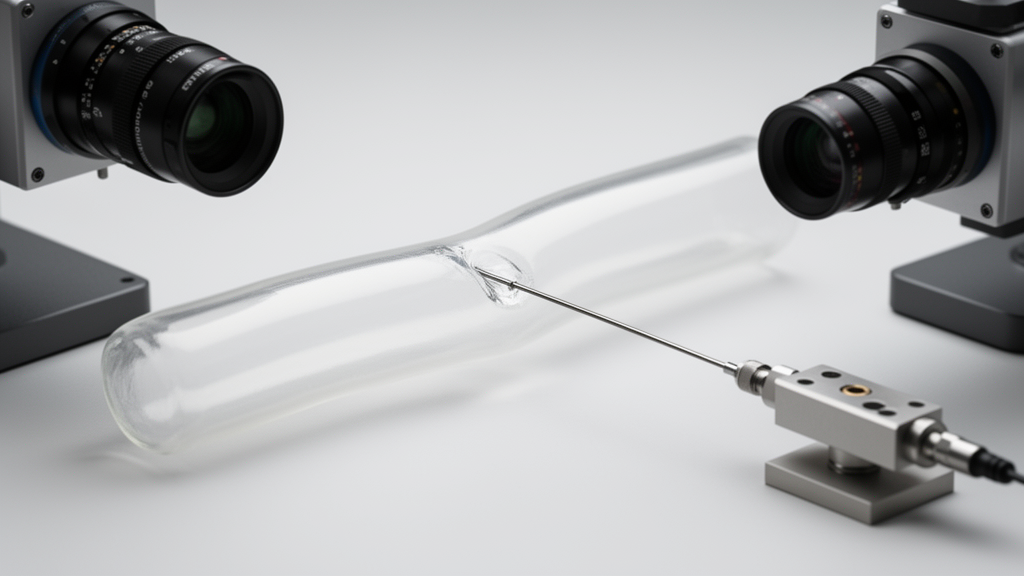
A vision-based computational method estimated guidewire contact forces from conventional planar images without adding sensing hardware. Tested on 343 samples acquired on a three-dimensional printed vessel phantom, the model achieved a mean absolute error (MAE) of 0.861 g and a root mean square error (RMSE) of 1.036 g. An ablation experiment found that adding the region-mask component reduced MAE by 79% relative to the identical architecture without it.
The study addresses contact force between a guidewire and a vessel wall during percutaneous coronary intervention, where force is a key mechanical factor in vessel injury but cannot be measured directly with conventional imaging. Sensor-based methods can measure contact force directly, but they also increase instrumentation complexity and cost. The proposed alternative instead learns an end-to-end mapping from planar images to force values associated with four predefined contact regions, using visual information alone.
Technically, the approach combines multi-scale feature extraction with region-mask mean pooling. The former is incorporated into the model alongside the region-mask operation, while mean pooling summarizes features according to the four designated regions. The system then maps the resulting visual representation to the contact force in each region.
The authors report that the method requires neither additional sensing hardware nor complex physical modeling, distinguishing it from a sensor-based measurement approach. Evaluation was confined to 343 samples acquired on a three-dimensional printed vessel phantom, so the reported performance does not establish accuracy in patients or during live percutaneous coronary intervention. In the ablation comparison, researchers tested the identical architecture without the region mask.
Inclusion of the mask was associated with a 79% reduction in MAE, indicating a substantial contribution from that component within the experimental dataset. The findings support the technical feasibility of vision-based, sensorless contact-force estimation under the tested conditions and suggest a possible route toward force feedback in interventional procedures, but that broader application was not demonstrated.
Subject of Research: Vision-based estimation of regional guidewire contact forces from planar images
Article Title: Visual estimation of guidewire contact forces by integrating multi-scale features and region mask
Article References: Guo, J., Yang, D., Xiao, N., Li, J., Zheng, Q., & Wei, W. (2026). Visual estimation of guidewire contact forces by integrating multi-scale features and region mask. Medical & Biological Engineering & Computing. https://doi.org/10.1007/s11517-026-03690-1
Image Credits: AI Generated
DOI: 10.1007/s11517-026-03690-1
Keywords: guidewire contact force, computer vision, medical imaging, percutaneous coronary intervention, region masking, sensorless estimation, image analysis, vessel phantom, multi-scale features, force feedback, Visual, estimation
News Source: Blake Davidson. (October 20, 2026). Vision model estimates guidewire contact forces in vessel-phantom images. Scienmag.