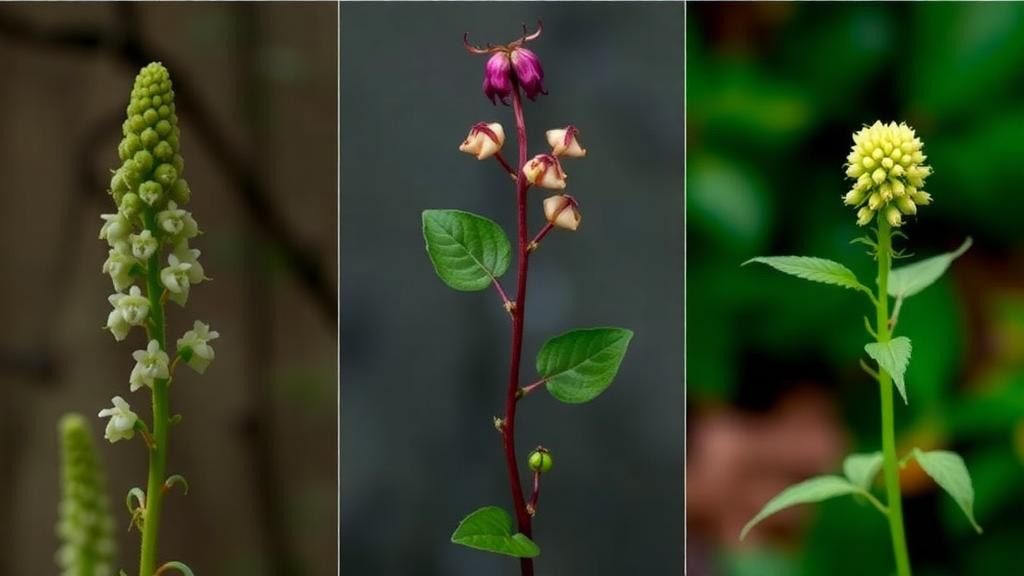
Global and regional Red List assessments of three plant taxa conclude that Raven’s garlic and Seguenza’s knapweed are Critically Endangered worldwide, while white saksaul is Critically Endangered within Iraq. The assessments, published together in Italian Botanist, examine a plant surviving at one site in Uzbekistan, a Sicilian endemic restricted to coastal cliffs and a desert tree whose Iraqi population now contains only juveniles. The evidence ranges from an estimated six mature individuals of Allium ravenii to more than 250 mature Centaurea seguenzae and 1,222 juvenile Haloxylon persicum in Iraq.
Allium ravenii, commonly called Raven’s garlic, is a perennial geophyte in the amaryllis family known only from saline plains beside the Eastern Chink of the Ustyurt Plateau in Karakalpakstan, Uzbekistan. Its only known population occupies gypsum or calcareous soils at approximately 150 metres above sea level in an extremely arid zone influenced by the drying of the Aral Sea. The locality is also the species’ type locality. Regional climate analyses cited in the assessment indicate increasing aridity and moisture deficits, particularly during spring, while long-term records show that temperature variation has increased in both the cold and warm halves of the year.
Field research in 2009 and 2010 recorded about 20 A. ravenii individuals in full bloom, but a monitoring expedition in 2015 found only six plants, identified in the assessment as mature individuals. Targeted searches during the growing seasons of 2020 and 2021 found no plants, a result following very dry years, including less than 75 millimetres of precipitation in 2020, and a sharp reduction in spring rainfall. The assessors did not classify the species as extinct because underground portions of several mature individuals were found in 2015, indicating that plants could persist below ground when no shoots were visible. Both the extent of occurrence and the area of occupancy were calculated as 4 square kilometres, and the mature population was estimated at about six individuals.
Several pressures converge on that single population. The Ustyurt Plateau and Eastern Chink serve as nomadic pastures for sheep, goats and camels, while saiga antelope and goitered gazelle also graze there. The plateau contains large natural-gas reserves, and several drilling stations operate near the garlic population. The site lies beside the only road crossing the plateau toward the Aral Sea, where irregular traffic includes tourists and equipment used by geologists; satellite images showed more than ten new roads around the population. A single location, continuing decline, habitat deterioration, population fluctuations and the extreme smallness of the population supported classification under Red List criteria B, C and D. The locality is not included in a reserve or other protected area, although Uzbekistan’s national Red Book lists the species under category 1, meaning it is on the brink of extinction.
Centaurea seguenzae, or Seguenza’s knapweed, presents a different pattern of extreme restriction. The perennial species is endemic to the Peloritani Mountains in northeastern Sicily, where its entire known distribution comprises one population and one stand on the rocky slopes of Capo Tindari near Patti. It grows on wind-exposed coastal cliffs at elevations of up to 300 metres, in lithosols formed from Mesozoic marble and calcium-silicate feldspar. Its habitat supports a community of chasmophytic plants. A rough count found more than 250 mature individuals, although inaccessible cliffs mean that the total may have been underestimated. Direct observations showed no significant decline in population size or the number of mature individuals in recent years.
Despite that absence of a measured abundance decline, the habitat of C. seguenzae is deteriorating. The cliffs are susceptible to natural erosion, detachment of individual blocks and landslides, including a small-to-massive landslide near the Verde lagoon in spring 2009. The invasive cactus Opuntia ficus-indica occupies much of the rocky habitat and restricts the space available to the native knapweed, contributing to an ongoing loss of suitable habitat. Potential fires are an additional threat because the surrounding territory is periodically affected by arson. The species has an extent of occurrence and area of occupancy of 4 square kilometres. Its occurrence at a single location, together with continuing decline in habitat quality, led to a Critically Endangered classification under criterion B. This differs from its previous global assessment of Near Threatened.
Some conservation measures are already in place for C. seguenzae. Its population lies within the Laguna di Oliveri–Tindari Special Area of Conservation, part of the European Natura 2000 network. The species was one of the targets of the SiMaSeed project, funded under the Interreg Italy–Malta 2014–2020 programme. Living plants and seeds were preserved at the seed bank of Catania University, which had stored more than 8,000 seeds under accession number SiMaSeed/CT/19/370. The assessors nevertheless called for further research into reproductive biology and population trends, monitoring of human activities in nearby tourist areas and urgent management of invasive alien plants.
Haloxylon persicum, known as white saksaul or ghada, is a small tree distributed broadly from Egypt to China. Its global Red List category is Least Concern, but the regional assessment for Iraq identifies a much more severe situation. Only two small, fragmented Iraqi populations remain in the southern desert of Al-Muthanna Governorate. The larger extends for about 45 kilometres at Busayyah, roughly 100 kilometres south of Al-Nasiriya, while the second lies near Qusair, approximately 20 kilometres south of Hammar Marsh. Both occupy sparsely vegetated sandy dunes without temporary watercourses, where the main water supply is annual rainfall averaging about 93 millimetres. The tree can live for 15 to 25 years, reproduce vegetatively and tolerate high temperatures and drought.
Iraq’s remaining saksaul population has declined dramatically during the past decade. The latest monitoring counted 1,222 juvenile plants, including 356 near Hammar Marsh and 866 at the other site, but no mature individuals. The assessment links the sharp reduction chiefly to indiscriminate removal. Historically, Bedouin communities harvested branches and stems for fuel, which helped safeguard the trees; more recently, collectors have cut the roots of large adults for hookah smoking. Loggers reportedly severed stems close to the ground and pulled root systems with vehicles, compromising vegetative reproduction. Local residents described mature saksaul as reaching five metres and providing shade for as many as four camels, whereas the surviving juveniles were about 0.4–0.7 metres to approximately 1.6 metres tall.
Grazing by camels, sheep and goats, dust generated by traffic on unpaved roads, recreational camping, off-road vehicle use and three consecutive years of severe drought added further pressure to the Iraqi populations. The area has also experienced severe continental temperature extremes, including 53.8 °C at Basrah Airport from 1949 through March 2022 and −13.8 °C at Samawa in January 2020. With no mature individuals, 1,222 juveniles divided among two subpopulations and a continuing decline, the Iraqi population was classified as Critically Endangered under criteria C and D. No dedicated protection measures for H. persicum are currently in place in Iraq. The assessors recommended monitoring, in situ and ex situ conservation, possible translocation and public awareness work, particularly among young people. They emphasized that conservation is also a social, legal and cultural issue connected to changing tribal customs.
Subject of Research: Global and regional Red List assessments of three threatened plant taxa
Article Title: Global and Regional IUCN Red List Assessments: 14
Article References: Fenu, G., Al-Rammahi, H. M., Cambria, S., Cristaudo, A. E., Khabibullaev, B. S., Mohammad, M. K., Shomurodov, K. F., Tavilla, G., & Orsenigo, S. (2022). Global and Regional IUCN Red List Assessments: 14. Italian Botanist, 14, 81-94. https://doi.org/10.3897/italianbotanist.14.97176
Image Credits: AI Generated
DOI: 10.3897/italianbotanist.14.97176
Keywords: IUCN Red List, Critically Endangered, plant conservation, Raven’s garlic, Seguenza’s knapweed, white saksaul, Uzbekistan, Sicily, Iraq, arid ecosystems, Global, Regional
News Source: Drew Townsend. (October 19, 2026). Three Plants Classified Critically Endangered in Global or Regional Red Lists. Scienmag.