A first dated molecular phylogeny of Ethiopia’s high-altitude trechine ground beetles shows that the country’s highland fauna belongs to at least three isolated evolutionary lineages, while revising the relationships of recently described groups and documenting a new genus and subgenus. The study, based on 55 specimens representing 49 species, places the initial diversification of the two oldest and most species-rich Ethiopian groups in the Oligocene or Early Miocene, a period associated with major volcanic uplift north and south of the Rift Valley. It finds no support for the alternative hypothesis that the highland fauna was assembled mainly through Pleistocene cooling.
The researchers combined morphological examination with sequence fragments from two mitochondrial and two nuclear ribosomal genes. Their analyses included Ethiopian species from all currently recognized genera and subgenera, alongside representatives of trechine lineages from Africa, Asia, Europe, Australia, the Americas and New Zealand. Maximum-likelihood analysis established the overall relationships, while Bayesian evolutionary dating estimated divergence times.
Two dating approaches were used: one based on fossil and geological age constraints, and another combining those constraints with previously estimated rates for the selected gene fragments. All sampled Ethiopian high-altitude trechines were recovered within the subtribe Trechina, contrary to a recent proposal that some afroalpine groups might be related to Trechodina. The apparent anatomical similarities between the two subtribes—including bidentate mandibles in some Ethiopian groups—are therefore interpreted as independently evolved characters.
Ethiopian members of Trechodina, including Pachydesus, Perileptus and Trechodes, were found along brooks and rivers at lower and medium elevations. By contrast, the analyzed highland Trechina lineages occupy afromontane and afroalpine environments, although the molecular data do not by themselves explain the ecological causes of that separation. Most Ethiopian high-altitude species were placed within the broadly defined genus Trechus, but the phylogeny revealed distinct northern and southern clades without support for a sister relationship between them.
The northern material came principally from the Abune Yosef Massif, Guassa Plateau and Mount Choke, while southern species represented the Bale and Arsi Mountains and Gughe Highlands. Neither Ethiopian clade was closely related to the Holarctic Trechus lineages in the recovered tree. This result leaves open whether the two clades descended from one ancestral immigration or arose through separate movements into Ethiopian highlands.
The study established the new genus Baehria and described its type species, Baehria separata, from Mount Choke in northern Ethiopia. In the analysis, Baehria formed a well-supported clade with the New Zealand genus Duvaliomimus, with Paratrechus from South and Central America as a related lineage. The authors interpret Baehria as potentially preserving an old lineage, but they describe that conclusion as preliminary because the global diversity and phylogenetic relationships of Trechina remain incompletely sampled.
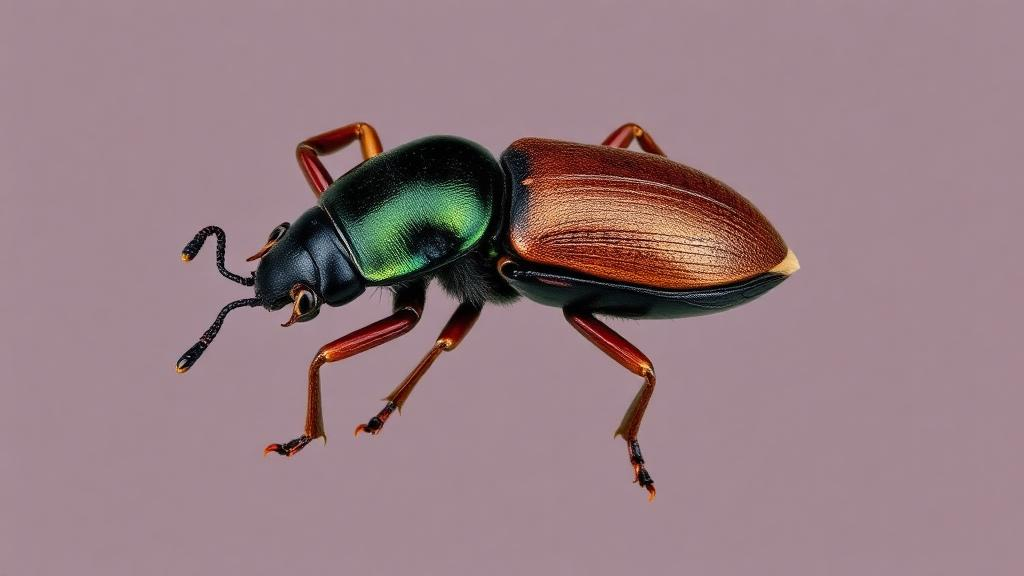
The systematic position of the eyeless Ethiopian genus Nunbergites could not be tested because no molecular material was available. Baehria separata measures 6.9–7.5 millimetres in length and is dark brown to blackish. Diagnostic features include a robust head, large mandibles, small but protruding eyes, a cordiform pronotum, slender elytra and reduced hindwings.
The head and wing covers bear unusual arrangements of sensory setae, including three or four setae on each side of the clypeus and an anterior elytral discal seta in the fourth interval. Its male genitalia have an elongated, narrow, tube-like median lobe with a small internal copulatory piece. The genus honours entomologist Martin Baehr, while the epithet separata refers to the taxon’s presently isolated distribution from its closest known relatives.
These observations indicate an association with flowing-water habitats, but the authors state that further morphological and molecular work is required to determine whether populations differing in genital shape, antennal coloration, elytral microsculpture and sampled DNA represent separate species or subspecies. The genus is currently known only from Mount Choke, and the researchers note that other populations or species may remain undiscovered, potentially along afroalpine streams in the Simien Mountains. Within Trechus, the authors erected the new subgenus Abunetrechus, with T. bipartitus as its type species.
It contains T. bipartitus and T. lalibelae from the Abune Yosef Mountains and T. habeshaicus from the Guassa Plateau. Molecular data place Abunetrechus in a clade with Anchotrechus from Tenerife, Arabotrechus from Yemen and Meruitrechus from Mount Meru in Tanzania. These present-day distributions are widely separated, but the tree supports shared ancestry.
The study does not establish how that distribution arose, and further analysis—including material from Mount Elgon and other East African trechines—is needed to resolve the clade’s deeper relationships. The phylogeny also led to a substantial taxonomic reorganization. Six groups proposed in 2021—Abayopsis, Abyssiniopsis, Aethiopsis, Afrotrechus, Deuveopsis and Nilotrechus—were placed within the northern Trechus clade and synonymized under Abyssinotus, the earliest available name for that group.
In the south, the type species of Archeotrechus clustered with Minitrechus, so Archeotrechus was synonymized as a separate subgenus. Re-examination of the type material of Trechus patrizii also showed that pores normally associated with pronotal setae were present despite the setae being absent, indicating a preservation artefact. Trechus oromiensis was consequently synonymized with the older T. patrizii.
Anchotrechus and Speotrechus, treated elsewhere as separate genera, were recovered within Trechus in the broad sense. Dating indicated that the stem and crown ages of the endemic groups varied by method. Abyssinotus showed a similar difference between methods.
For the younger northern groups, Baehria had a stem age of 15.19 million years, with an interval of 9.86–21.13 million years, when calibrated with age constraints alone, or 22.87 million years, with an interval of 15.9–30.08 million years, when rates were added. Abunetrechus had corresponding stem estimates of 10.67 million years, with an interval of 6.83–14.62 million years, and 17.74 million years, with an interval of 12.93–22.96 million years. These stem estimates cannot precisely date the arrival of each lineage in Ethiopia because ancestral evolution may have occurred elsewhere.
The study identifies 79 described Trechina species from the Ethiopian Highlands and reports that field workers are aware of several additional undescribed species, while noting that large areas remain understudied. All but one described highland species is known to be endemic to an individual volcanic mountain or valley system, and mountains at or above 4,000 metres are particularly species-rich. Up to eight Abyssinotus species have been observed together on slopes such as Mount Choke, but the authors frame interspecific concurrence and the possible role of limited competition from other high-altitude ground beetles as hypotheses requiring further ecological study.
The central conclusion is that Ethiopian trechine diversity reflects immigration and diversification associated with the Oligocene–Early Miocene development of the highlands, rather than a history driven primarily by late Cenozoic cooling, while several basal branches and the affinities of the Simien Mountains fauna remain unresolved.
Subject of Research: Molecular phylogeny, taxonomy and historical biogeography of Ethiopian high-altitude trechine ground beetles
Article Title: Explosive radiation versus old relicts: The complex history of Ethiopian Trechina , with description of a new genus and a new subgenus ( Coleoptera , Carabidae , Trechini )
Article References: Faille, A., Hofmann, S., Merene, Y., Hauth, D., Opgenoorth, L., Woldehawariat, Y., & Schmidt, J. (2023). Explosive radiation versus old relicts: The complex history of Ethiopian Trechina, with description of a new genus and a new subgenus (Coleoptera, Carabidae, Trechini). Deutsche Entomologische Zeitschrift, 70(2), 311-335. https://doi.org/10.3897/dez.70.107425
Image Credits: AI Generated
Keywords: Ethiopian Highlands, trechine beetles, molecular phylogeny, historical biogeography, volcanic uplift, habitat islands, taxonomic revision, ground beetles, Baehria separata, Trechus, Explosive, radiation
News Source: Gavin Prescott. (October 20, 2026). Dated phylogeny reshapes Ethiopian trechine beetle evolution. Scienmag.