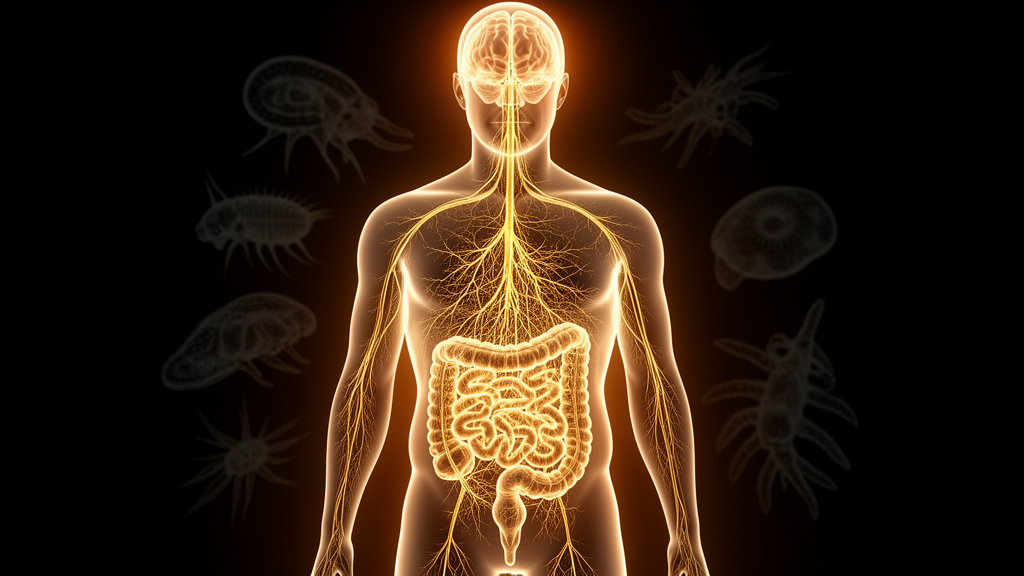
A provocative new theory from Australian researchers is turning one of biology’s most familiar assumptions on its head. Rather than viewing the brain as the body’s central command center from which all other systems descend, scientists at Flinders University argue that the nervous system may have first emerged in the gut, with the brain evolving later as an extension built to serve the digestive tract’s demands. The idea, laid out in an opinion piece published in The Journal of Physiology, draws on physiology and evolutionary biology to reframe a question that has puzzled scientists for generations: why did brains evolve in the first place?
The paper, titled ‘The first brain at the centre: An enteric reframing of the nervous system,’ was authored by Dr Tim Hibberd, Hayley Rhodes and Professor Nick Spencer of Flinders University. It was published as a commentary, meaning it presents an interpretive argument synthesized from existing evidence rather than the results of a single new experiment. Even so, its implications reach into the heart of evolutionary neuroscience, because it suggests that the energy-hungry business of digestion, not cognition, may have been the original driving force behind the emergence of nervous tissue in early animals.
At the center of the argument is the enteric nervous system, the vast web of neurons embedded in the walls of the gastrointestinal tract. Often described as the body’s ‘second brain,’ this network contains hundreds of millions of neurons in humans, a number that rivals or exceeds the neuronal population of the spinal cord. Crucially, the enteric nervous system can operate without direct input from the brain or spinal cord. It senses the chemical and mechanical conditions of the gut lining, processes that information locally, and coordinates complex patterns of muscle contraction, secretion and blood flow that make digestion possible. Isolated segments of intestine continue to generate coordinated peristaltic activity in laboratory conditions, a striking demonstration of just how autonomous this system is.
Dr Hibberd, from Flinders’ College of Medicine and Public Health, argues that this autonomy is precisely why the enteric nervous system deserves to be reconsidered as the body’s original neural architecture. ‘We are proposing a different way of looking at the nervous system,’ he says. ‘The enteric nervous system in the gut can sense its environment, process information and coordinate complex responses. In many ways, it functions like a brain in its own right.’ By that logic, he and his colleagues contend, it may be more accurate to think of the gut’s neural network not as a second brain but as the first one.
The evolutionary reasoning behind this claim rests on a simple biological imperative. For any organism, the overriding priority is securing energy: capturing nutrients, breaking them down and distributing them to tissues. Early multicellular animals faced this challenge without the benefit of centralized nervous systems. A diffuse network of neurons arranged around the digestive apparatus would have provided an immediate survival advantage, allowing a primitive gut to detect food, respond to it and coordinate the movements needed to move it through the body. Only later, as animals grew larger, more mobile and more behaviorally complex, would centralized brains have become useful, and even then, the Flinders researchers argue, the brain’s fundamental role remained to support the gut’s mission of energy acquisition.
This perspective aligns with features of modern nervous system diversity. Many animals with simple body plans, including certain cnidarians and other basal lineages, possess nerve nets with little or no centralization, organized largely around the oral and digestive regions. In more complex animals, the gut tube retains its own complete nervous system regardless of how elaborate the brain has become. The persistence of this independent enteric circuitry across such a wide range of species, the researchers suggest, hints at its ancient origins. Rather than being a derived or secondary feature, the gut’s nervous system may preserve the architecture of the earliest nervous systems that ever evolved.
Senior author Professor Nick Spencer, from Flinders Health and Medical Research Institute, says the theory helps explain a puzzle that has long interested physiologists: why the gut remains so influential in directing functions throughout the body, long after brains capable of vision, memory and movement appeared. ‘The gut is constantly gathering information and communicating with other organs,’ says Professor Spencer. ‘It plays a major role in regulating digestion, metabolism and other functions essential for survival. These fundamental processes may have helped drive the evolution of the nervous system.’ The gut, in this framing, is not a passive organ awaiting instructions but an active sensing and signaling hub whose outputs ripple through hormones, immune signaling and neural pathways to shape appetite, metabolism and even mood.
The reframing also speaks to a growing body of research on the gut-brain axis, the bidirectional communication network linking the gastrointestinal tract with the central nervous system. The vagus nerve provides a direct neural highway between gut and brain, while gut-derived hormones modulate hunger, satiety and glucose regulation. Clinical observations have reinforced the significance of this axis: alterations in gut function are increasingly documented in conditions as varied as Parkinson’s disease, obesity and diabetes. In Parkinson’s disease, for example, aggregates of the protein alpha-synuclein have been detected in the enteric nervous system, prompting ongoing debate about whether pathological processes may begin in the gut before reaching the brain. A theoretical framework that treats the gut’s nervous system as primary, rather than peripheral, could reshape how such connections are investigated.
The Flinders team is candid that their proposal is unlikely to change medical practice overnight. As an opinion piece, it functions as a challenge to the field, an invitation to reinterpret existing evidence through a different lens rather than a definitive proof of gut-first neural evolution. But the authors argue that the conceptual stakes are high, because the assumptions scientists bring to anatomy shape the questions they ask about disease. ‘The way we think about the body shapes the way we investigate disease,’ says Dr Hibberd. ‘If we begin to view the gut as a central player in nervous system function, it may open up new avenues for research.’ Those avenues could include exploring the enteric nervous system as a therapeutic target for metabolic and neurodegenerative disorders, or re-examining the evolutionary record of early animals with fresh attention to the neural tissue surrounding the digestive tract.
Whatever the ultimate verdict of the scientific community, the paper injects new energy into one of evolution’s oldest questions. If the Flinders researchers are right, the human brain, with all its capacity for language, art and abstraction, is best understood not as the founding organ of the nervous system but as a brilliant late addition, recruited in service of an older, quieter intelligence coiled within the gut. The idea invites scientists and the public alike to reconsider where the story of the nervous system truly began: not in the skull, but in the ancient, energy-driven demands of the gut that every animal, from the simplest worm to the human being, still carries at its core.
Subject of Research: Evolutionary origins of the enteric nervous system and the gut-first hypothesis of brain evolution
Article Title: What evolved first – our brain or gut?
Article References: What evolved first – our brain or gut?. Original publication (Bibliographic details unavailable.)
Image Credits: AI Generated
DOI: Not provided
Keywords: enteric nervous system, evolution, gut-brain axis, neuroscience, digestion, Flinders University, Journal of Physiology, brain evolution, Parkinson's disease, metabolism, second brain, physiology
News Source: Cassandra Pierce. (October 19, 2026). Gut May Have Been the Body’s First Brain, Evolutionary Study Argues. Scienmag.