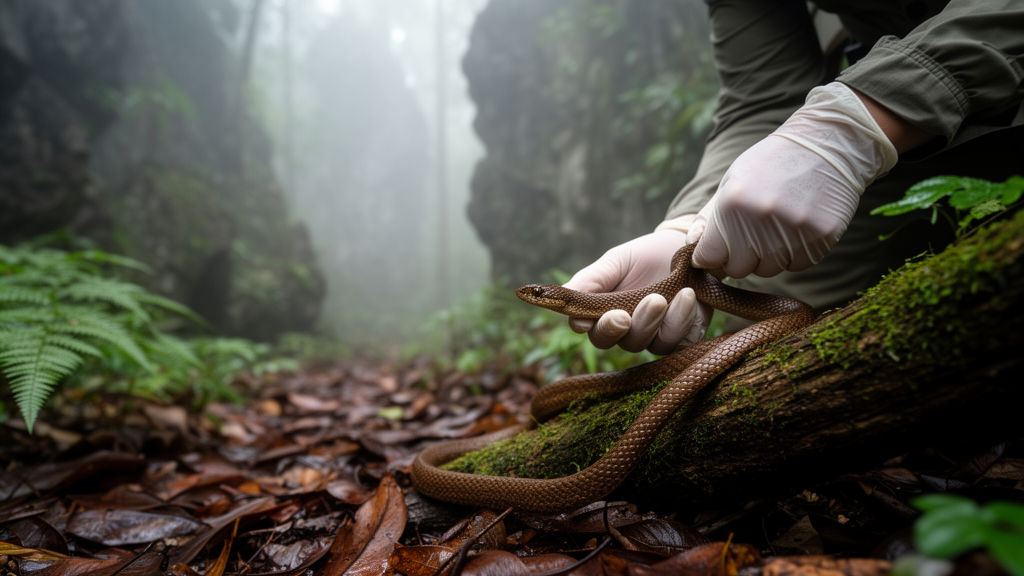
Scientists have described the first known female of Achalinus vanhoensis, one of Vietnam’s most recently discovered and least documented snakes, from Cuc Phuong National Park in Ninh Binh Province. The finding, published in the journal Herpetozoa, represents only the second specimen of the species ever recorded and extends its known range approximately 112 kilometers southeastward from its type locality in Son La Province, northwestern Vietnam.
Achalinus vanhoensis belongs to the odd-scaled snake genus Achalinus, a group of small, secretive, semifossorial snakes distributed across East and Southeast Asia. Members of this genus are infrequently encountered due to their cryptic habits and preference for limestone karst forests, and several species remain known from only one or a few specimens. Vietnam currently harbors nine recognized species of Achalinus, four of which are endemic to the country, indicating that the diversity and distribution of these snakes remain incompletely documented.
The species was originally described in 2022 based on a single adult male collected in limestone forest at Hua Tat Village, Van Ho District, Son La Province. No additional specimen or locality had subsequently been documented until researchers T.V. Nguyen and D.T. Le encountered an adult female in Cuc Phuong National Park in June 2019. The snake was found at approximately 19:00 hours following light rain, shortly after being struck by a vehicle while attempting to cross a concrete road bordered by limestone cliffs and secondary forest. The specimen was still alive but moribund when found and died approximately ten minutes later.
After its death, a muscle tissue sample was preserved in 96% ethanol, and the specimen was deposited in the zoological collection of Duy Tan University in Da Nang, Vietnam. Morphological examination revealed that the female shares with the male holotype the principal diagnostic characters of the species, including an internasal suture distinctly longer than the prefrontal suture, a loreal scale fused with the prefrontal, seven supralabials, six infralabials, two pairs of chin shields, and keeled dorsal scales arranged in 25–23–23 rows. These characters are particularly informative because Cuc Phuong National Park lies close to the known range of A. tranganensis, which differs from A. vanhoensis in having a distinct loreal separated from the prefrontal.
Molecular phylogenetic analyses based on the mitochondrial cytochrome c oxidase subunit I (COI) gene were conducted using a dataset comprising 32 samples, including 30 ingroup samples representing Achalinus, with Stoliczkia vanhnuailianai and Xenodermus javanicus included as outgroups. Maximum-likelihood analysis was performed in IQ-TREE v. 1.6.12 using the optimal substitution model TIM+F+R3, and Bayesian inference was conducted in MrBayes v. 3.2.7a using GTR+F+I+G4. The phylogenetic trees recovered the female specimen from Ninh Binh Province in a moderately supported clade with the holotype of A. vanhoensis (ultrafast bootstrap support 94; Bayesian posterior probability 0.89). The two specimens exhibited an uncorrected COI p-distance of 3.8%, further supporting the identification of the newly collected specimen as A. vanhoensis.
Despite the agreement in diagnostic characters, the two known specimens differ markedly in meristic counts and body proportions. The female has more ventral scales (202 versus 176), fewer subcaudal scales (74 versus 84), and a proportionally shorter tail (tail length to total length ratio 0.192 versus 0.264). These differences may indicate sexual dimorphism, as comparable sex-associated differences are common in Achalinus and have been reported in most species of the genus. However, because only one specimen of each sex is currently known for A. vanhoensis and the two specimens originate from different localities separated by extensive limestone landscapes, sexual, individual, and geographical variation cannot yet be distinguished from one another.
The new record from Cuc Phuong National Park also lowers the documented elevational limit of the species from 1,121 to 440 meters above sea level. Established in 1962 as Vietnam’s first national park, Cuc Phuong is among the country’s longest-studied protected areas, yet its herpetofaunal diversity remains incompletely documented, particularly for secretive, semifossorial, and karst-associated species. The park lies near the biogeographical transition between the Northwest Uplands and Northeast Lowlands of northern Indochina and encompasses an extensive limestone karst landscape interspersed with primary and secondary forests. Its herpetological importance is demonstrated by the discovery of several new species from the park and surrounding limestone landscapes, including Cyrtodactylus cucphuongensis, Micryletta nigromaculata, Hebius vogeli, and Lycodon duytan.
The circumstances surrounding the discovery of the female specimen illustrate the value of opportunistic road searches, particularly at night following rain, for detecting secretive and semifossorial snakes. Road-killed specimens have provided important distributional, morphological, and natural-history data for several poorly known Vietnamese snakes. However, the frequent occurrence of road-killed amphibians and reptiles along the surveyed road, where vehicular traffic is relatively heavy, also indicates that traffic mortality may represent a local conservation threat within Cuc Phuong National Park.
Achalinus vanhoensis has not previously been evaluated for inclusion in the IUCN Red List. The species is currently known from only two specimens and two confirmed localities, and information on its population size and trends, area of occupancy, habitat requirements, and exposure to threats remains unavailable. Although the new locality lies within Cuc Phuong National Park, its occurrence within a protected area alone is insufficient to support an assessment of Least Concern. Given the extremely limited information currently available, the researchers provisionally recommend that A. vanhoensis be assessed as Data Deficient under the IUCN Red List Categories and Criteria.
The limitations associated with diagnoses based on single specimens are not restricted to A. vanhoensis. Several Vietnamese congeners remain known from extremely limited material, most notably A. timi, which is documented in the taxonomic literature only from its male holotype, and A. tranganensis, which is documented only from its female holotype. Consequently, their currently reported ventral and subcaudal counts, body proportions, and head-scale configurations represent individual states, and their intraspecific, sexual, and geographical variation remains unknown. The newly documented variation in A. vanhoensis demonstrates that some characters initially considered diagnostic may vary when additional specimens become available. Further sampling across the intervening limestone landscapes between Van Ho and Cuc Phuong, particularly in Phu Tho and Thanh Hoa provinces, together with multilocus molecular data and specimens of both sexes, is needed to better characterize morphological and genetic variation within the species and clarify its relationships with geographically adjacent congeners.
Subject of Research: First description of the female of Achalinus vanhoensis with a new distribution record from northern Vietnam
Article Title: First description of the female of Achalinus vanhoensis Ha et al., 2022 ( Squamata , Xenodermidae ), with a new distribution record from northern Vietnam
Article References: Nguyen, T. V., Xu, Y., Semenova, A. A., Tran, P. N., Le, D. T., Suwannapoom, C., & Poyarkov, N. A. (2026). First description of the female of Achalinus vanhoensis Ha et al., 2022 (Squamata, Xenodermidae), with a new distribution record from northern Vietnam. Herpetozoa, 39, 419-427. https://doi.org/10.3897/herpetozoa.39.e213275
Image Credits: AI Generated
DOI: 10.3897/herpetozoa.39.e213275
Keywords: Achalinus vanhoensis, odd-scaled snakes, Xenodermidae, Vietnam, Cuc Phuong National Park, sexual dimorphism, COI barcoding, limestone karst, Data Deficient, herpetology, First, description
News Source: Drew Townsend. (October 19, 2026). First female of Vietnam’s odd-scaled snake found 112 km from its only known male. Scienmag.