The Nile pufferfish Tetraodon lineatus, the only freshwater pufferfish known from the Nile Basin, has finally yielded its first chromosome data. A preliminary cytogenetic study published in the journal Comparative Cytogenetics reports the karyotype of a single male collected from the White Nile Basin in southwestern Ethiopia, providing the first karyotypic information for Tetraodon, the type genus of the pufferfish family Tetraodontidae. The finding fills a conspicuous gap in a family whose chromosome diversity has long puzzled researchers.
Pufferfishes are among the most biologically distinctive fishes on Earth. The family Tetraodontidae comprises 27 genera and 193 valid species of marine, brackish and freshwater teleosts distributed across tropical and subtropical regions worldwide. These fishes can inflate their bodies as a defense mechanism, possess specialized dentition, and produce tetrodotoxin, one of the most potent neurotoxins known. Equally remarkable is their genetic makeup: pufferfish genomes are the most compact among vertebrates, a reduction attributed primarily to the contraction of non-coding regions such as introns and intergenic sequences. Despite this compaction, tetraodontid genomes retain structural and regulatory complexity and harbor diverse retrotransposable elements that may contribute to genome organization and evolutionary dynamics.
Against this backdrop, chromosome studies of pufferfishes have revealed striking variability. Cytogenetic information is currently available for 31 of the 193 species, belonging to nine of the 27 genera, and diploid chromosome numbers in the family range from 28 to 46. Such wide variation suggests notable karyotype differentiation within Tetraodontidae, consistent with genomic data showing variability in structural rearrangements, repeat content and recombination rates among tetraodontids. Yet much of the existing cytogenetic literature was produced under obsolete systematic arrangements, because the family has undergone extensive taxonomic revisions in recent years.
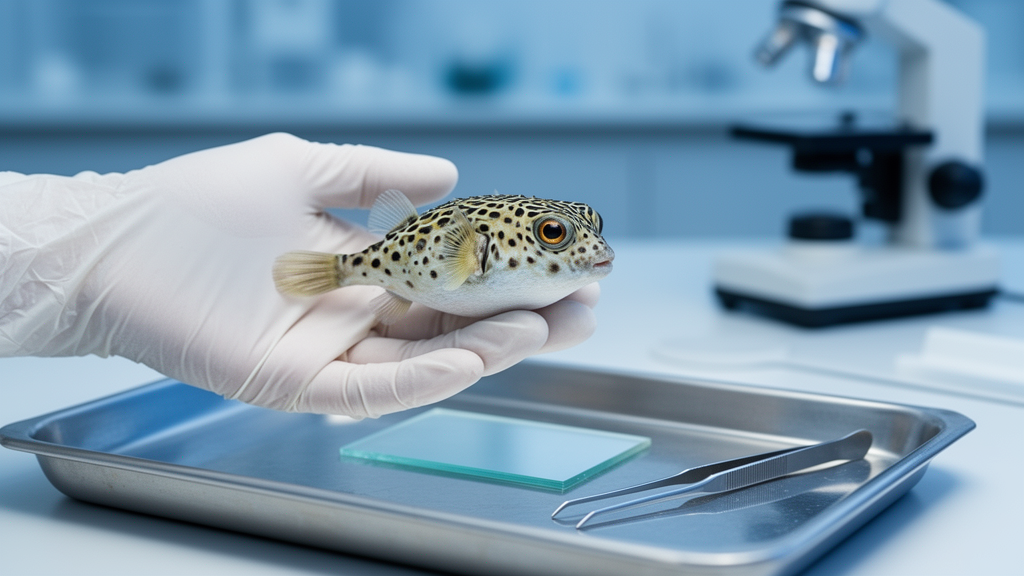
The new study focused on Tetraodon lineatus, the type species of the genus Tetraodon, which is itself the type genus of the family. Two male specimens, with standard lengths of 183 and 214 millimeters, were obtained from the Alvero River downstream of the Abobo Dam in southwestern Ethiopia. The Alvero River belongs to the Sobat River drainage, which discharges into the White Nile in South Sudan. Species identification was carried out on the basis of morphological characters, and voucher specimens were deposited at the Severtsov Institute of Ecology and Evolution in Moscow.
The laboratory work followed established field cytogenetic protocols. Fish were treated intraperitoneally with 0.1% colchicine for three to five hours to arrest cells in mitosis, then euthanized with an overdose of tricaine methanesulfonate. Chromosome preparations were obtained from kidney and testis tissue, and spreads were stained conventionally with 4% Giemsa solution in a phosphate buffer at pH 6.8. Analysis was performed using a Carl Zeiss Axioplan 2 Imaging microscope equipped with a CV-M4+CL camera and Ikaros software. Karyotypes were arranged according to centromere position following the nomenclature of Levan and colleagues, modified into metacentric/submetacentric and subtelocentric/acrocentric categories, with chromosome pairs ordered by size within each category. In total, 13 complete mitotic metaphases were studied for the successfully karyotyped male, ten from kidney and three from testes.
The results were unambiguous. The examined male T. lineatus from the White Nile Basin has a diploid chromosome number of 2n = 40 in all complete metaphases. The karyotype comprises 12 metacentric/submetacentric and 28 subtelocentric/acrocentric chromosomes, giving a fundamental number of FN = 52, calculated by counting biarmed and monoarmed chromosomes respectively. All chromosomes in the karyotype are very small and difficult to analyze, a characteristic shared with other karyotyped members of the family. This observation is consistent with the fact that tetraodontids possess the smallest genomes among vertebrates. Attempts at AgNOR- and C-banding, as well as fluorescent in situ hybridization with a (TTAGGG)4 telomeric probe, were unsuccessful due to the poor quality of the chromosome material collected under field conditions, underscoring the challenges of cytogenetic work on remote field collections.
Placing the new data in evolutionary context, the study follows the backbone of a multi-gene phylogeny that divides Tetraodontidae into two major clades. Of the genera with karyotyped representatives, Clade 1 comprises only the genus Takifugu, whose seven karyotyped species have conserved karyotypes with 2n = 44. The basal group of Clade 2 comprises the genera Lagocephalus and Sphoeroides, whose members have karyotypes with 2n = 44 to 46. The genus Canthigaster belongs to the second group within Clade 2 and shows extensive variability in diploid number, from 28 to 36, the widest range recorded in the family.
The remaining genera with karyotyped members belong to the third group within Clade 2. Here the new data align remarkably well with phylogenetic expectations. The karyotyped specimen of T. lineatus and the studied species of the genus Chelonodon share 2n = 40, a uniformity that agrees with the sister-group relationship between Tetraodon and Chelonodon recovered in all phylogenetic reconstructions to date. The genus Arothron, the sister group of Tetraodon plus Chelonodon, has karyotypes with 2n = 38 to 42. The genera Pao, Leiodon and Dichotomyctere, which are sisters to the group comprising Arothron and Tetraodon plus Chelonodon, have karyotyped members with 2n = 40 to 42.
The taxonomic history of the genus Tetraodon adds further significance to the finding. Until recently, Tetraodon included not only African freshwater pufferfishes but also Asian brackish and freshwater representatives, whose karyotyped members are now assigned to the genera Pao, Leiodon and Dichotomyctere. The preliminary cytogenetic data on Tetraodon are in good agreement with the current taxonomy: T. lineatus, like representatives of the closely related genus Chelonodon, has 2n = 40, whereas all karyotyped members of Pao, Leiodon and Dichotomyctere, with one exception, have 2n = 42. Chromosome number thus emerges as a useful cytotaxonomic marker that mirrors the revised classification of the family.
Given the wide variability in diploid chromosome number, even conventional karyotyping can provide useful cytotaxonomic markers for tetraodontids. The study provides a preliminary karyotype of T. lineatus from Ethiopia and a baseline for chromosomal studies of African tetraodontids, a group for which no cytogenetic data previously existed. The authors emphasize that further cytogenetic studies of Tetraodontidae, integrated with taxonomic, phylogenetic and genomic research, are needed. With only about 16% of species in the family karyotyped to date, understanding of chromosome diversity within this remarkable group remains incomplete, and the Nile pufferfish now stands as the reference point for future work on African members of the family.
Subject of Research: Cytogenetics of the Nile pufferfish Tetraodon lineatus
Article Title: Preliminary karyotypic data on the Nile pufferfish Tetraodon lineatus ( Tetraodontidae )
Article References: Skuratovskaya, A. Y., Jukova, J. S., Tefera, F., Simanovsky, S. A., & Golubtsov, A. S. (2026). Preliminary karyotypic data on the Nile pufferfish Tetraodon lineatus (Tetraodontidae). Comparative Cytogenetics, 20, 235-243. https://doi.org/10.3897/compcytogen.20.212458
Image Credits: AI Generated
DOI: 10.3897/compcytogen.20.212458
Keywords: Tetraodon lineatus, Tetraodontidae, pufferfish, karyotype, cytogenetics, diploid chromosome number, White Nile Basin, Ethiopia, genome compaction, chromosome evolution, Comparative Cytogenetics, fish genetics
News Source: Juliet Wilcox. (October 19, 2026). Nile pufferfish karyotype reveals first chromosome data for Tetraodon genus. Scienmag.