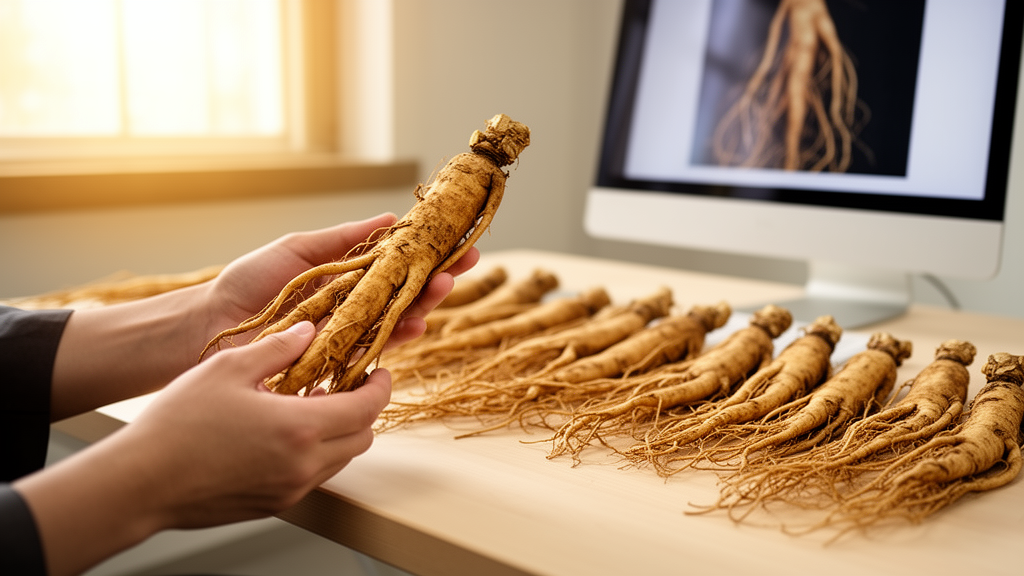
In the mountainous heart of Jilin Province, China, the value of a single ginseng root can swing wildly depending on subtle features that only the most seasoned experts can judge: the segmented rings of the rhizome head, the graceful curve of the main root, the delicate spread of fibrous roots, the sheen of the epidermis, and the presence of tiny defects. Grading these roots has long been a craft passed down through years of apprenticeship, governed by provincial standards and settled by the trained eye. Now, a team of researchers has taught a computer vision system to do the same, and in doing so they have tackled one of the most stubborn problems in agricultural artificial intelligence: how to make a machine learn fine-grained distinctions when there are barely enough examples to learn from.
The study, published in BMC Plant Biology by Haotian Cai and colleagues at Jilin Agricultural Science and Technology College and Jilin Agricultural University, introduces a method called MP-CBA-YOLO, a morphology-preserving, class-balanced object detection framework designed specifically for small-sample, imbalanced ginseng grade detection. The work addresses a challenge that extends far beyond ginseng: whenever the most valuable category of a product is also the rarest, machine learning systems struggle to learn what makes it special.
The core difficulty is a familiar one in deep learning. Convolutional neural networks, the engines behind modern object detection, typically require thousands of labeled examples per category to reach reliable performance. But in ginseng grading, premium-grade roots are inherently scarce. Collectors simply do not encounter many of them, and each one commands a price that makes routine handling impractical. Meanwhile, the visual boundaries between adjacent grades are continuous rather than sharply defined, meaning the difference between a first-grade and a second-grade root may hinge on subtle shifts in root proportion or surface quality. Add to this the natural variation in photographic backgrounds and lighting, and the problem becomes a perfect storm of small sample size, class imbalance, weak fine-grained differences, and background interference.
To build a rigorous foundation, the researchers assembled a standardized dataset of 679 high-resolution images covering four ginseng grades: premium, first, second, and ordinary. Every sample was photographed in a controlled environment to minimize background variation, and crucially, every grade label was confirmed by at least two experienced experts working according to the T/thrs-Jilin Province Authentic Medicinal Material Ginseng Grading Standard. This expert-verified labeling matters enormously, because in fine-grained recognition tasks the quality of the ground truth sets a hard ceiling on what any algorithm can achieve. The dataset was formatted in the standard YOLO annotation style, making it immediately usable by the broader computer vision community.
The heart of the contribution is the MP-CBA augmentation strategy, a data-level technique constrained by domain knowledge. Rather than applying aggressive synthetic transformations indiscriminately across all classes, the method performs conservative augmentation only for the minority premium and first-grade classes during training. The transformations were chosen with anatomical sensitivity in mind: small-angle rotations, slight scaling, low-amplitude translations, horizontal flipping, and brightness-contrast perturbations. Each of these operations expands the effective coverage of rare samples without distorting the morphological features that define a root’s grade. A violent warp or aggressive color shift might create a visually plausible image, but it could also destroy the very luster or proportion cues that distinguish a premium root from an ordinary one. Importantly, the validation and test sets remained completely untouched by augmentation, preserving the integrity of the evaluation.
With the data pipeline established, the team turned to model selection, and here the study offers a lesson in disciplined machine learning practice. After comparing candidate architectures using validation-set evidence, the researchers settled on YOLO11s, the small variant of the YOLO11 detector, with an input image size of 640 pixels as the final configuration. YOLO, which stands for You Only Look Once, is a family of single-stage object detectors prized for their speed and accuracy, making them well suited to practical deployment in sorting facilities where roots must be graded in real time.
The results on the held-out test set were striking. The selected YOLO11s-640 model achieved a precision of 0.782, a recall of 0.913, a mean average precision at an intersection-over-union threshold of 0.50 of 0.907, and a mean average precision averaged over thresholds from 0.50 to 0.95 of 0.836. In plain terms, the model caught the overwhelming majority of graded roots, rarely missed a root that was present, and localized the bounding boxes around each root with high fidelity. The gap between precision and recall is telling: the model errs on the side of detection, flagging nearly every root even if that means occasionally raising a false alarm, a sensible bias for a screening tool where a missed premium root represents real economic loss.
Perhaps the most scientifically interesting findings came from the comparisons that did not work out. The researchers tested whether adding a P2 high-resolution detection head, an architectural modification designed to improve detection of small objects, would improve performance. It did not. They also examined whether more aggressive class-balanced augmentation would help, and found that excessive augmentation likewise failed to improve localization quality. These negative results carry real weight, because they demonstrate that bigger or more data-hungry configurations are not automatically better when the underlying task is morphology-sensitive. The fine-grained features that define ginseng grades are not simply small objects; they are subtle relationships of shape, texture, and proportion that aggressive processing can erase.
The study’s methodological stance is equally noteworthy. The authors explicitly argue that model selection should be based on validation-set evidence rather than repeated test-set comparison, a principle that sounds obvious but is routinely violated in applied machine learning, where researchers quietly tune their models against the very test data meant to measure generalization. By holding the test set completely apart and making decisions only on validation data, the team produced performance estimates that are more likely to hold up when the system encounters genuinely new roots in a commercial setting.
The implications reach well beyond the ginseng trade. Medicinal herbs, specialty crops, timber, seafood, and countless other agricultural products are graded by expert judgment against continuous quality scales, and in nearly every case the highest grades are the scarcest. The MP-CBA approach offers a template: respect the domain, augment conservatively and only where needed, verify labels with real experts, and let validation evidence, not test-set leakage, guide architectural choices. As demand for transparent, standardized quality assessment grows across global supply chains, systems like this one suggest a future in which the centuries-old eye of the master appraiser is preserved, encoded, and made available at the speed of a camera shutter.
Subject of Research: Deep learning-based ginseng grade detection using morphology-preserving class-balanced augmentation
Article Title: MP-CBA-YOLO: a morphology-preserving class-balanced object detection method for small-sample imbalanced ginseng grade detection
Article References: Cai, H., Yang, M., Dai, Y., Wang, S., Zhao, L., Chuai, X., & Yu, Y. (2026). MP-CBA-YOLO: a morphology-preserving class-balanced object detection method for small-sample imbalanced ginseng grade detection. BMC Plant Biology. https://doi.org/10.1186/s12870-026-09946-0
Image Credits: AI Generated
DOI: 10.1186/s12870-026-09946-0
Keywords: ginseng grading, object detection, YOLO11, class imbalance, data augmentation, small-sample learning, computer vision, fine-grained recognition, agricultural AI, morphology-preserving augmentation, BMC Plant Biology, precision agriculture
News Source: Alan Morgan. (October 19, 2026). AI Learns to Grade Ginseng Roots Like a Master Appraiser. Scienmag.