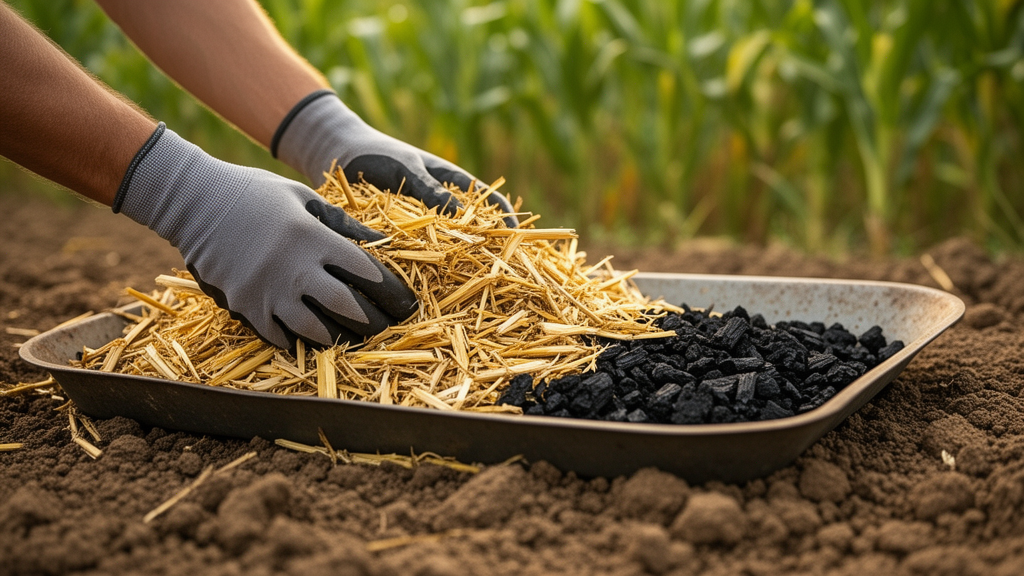
Cadmium and zinc contamination is one of the quiet crises of modern agriculture. These metals, released during mining, smelting and the mechanical processing of ores, persist in farmland soils for decades, accumulate in crops, and ultimately enter the human food chain. Cadmium is especially notorious: it is highly toxic, potentially carcinogenic, and inhibits plant growth by interfering with photosynthetic pigments and enzymes. Zinc, although an essential trace nutrient, becomes harmful in excess. A new laboratory study published in the journal SOIL suggests that an elegantly simple recipe, one part corn straw to three parts biochar, may simultaneously trap these metals, feed soil microbes, and lock carbon into the ground more stably than either material used alone.
The research, led by Xirui Kang and colleagues at Shandong Agricultural University in Tai’an, China, set out to solve a genuine dilemma in soil remediation. Biochar, the charcoal-like material produced by heating biomass in the absence of oxygen, is widely praised for its ability to immobilize heavy metals through adsorption, precipitation, chelation and complexation. But biochar’s carbon is locked in stable aromatic ring structures that soil microorganisms struggle to digest. Paradoxically, remediating a polluted field with biochar can leave the soil’s microbial communities starving for carbon, undermining the very ecological functions that keep farmland fertile. The Shandong team asked whether mixing biochar with crop straw, a labile carbon source that microbes can decompose readily, could deliver the best of both worlds.
The experiment was conducted on loamy tidal soil collected from the top 20 centimeters of farmland in Liaocheng City, Shandong Province. The soil was naturally alkaline, with a pH of 8.05, and contained total cadmium at 0.83 milligrams per kilogram and total zinc at 407 milligrams per kilogram. Corn straw from a local farm was crushed, and a portion was pyrolyzed at 500 degrees Celsius for two hours under a flowing nitrogen atmosphere to produce biochar. The researchers then set up six treatments in 500-milliliter culture flasks, each holding 200 grams of soil: an untreated control, pure straw, pure biochar, and three mixtures with straw-to-biochar ratios of 3:1, 2:2 and 1:3. Each treatment was incubated in the dark at 25 degrees Celsius for 90 days at 70 percent of field capacity, with destructive sampling on days 30, 60 and 90.
The results on metal immobilization were striking. Using diethylenetriaminepentaacetic acid extraction, a standard proxy for the bioavailable and biotoxic fraction of heavy metals, the team found that the 1:3 straw-biochar mixture reduced available cadmium by 30.22 to 32.81 percent and available zinc by 21.31 to 23.06 percent compared with the untreated control. Pure biochar performed best overall, thanks to its high porosity, abundant oxygen-containing functional groups and strong adsorption capacity, but the difference between pure biochar and the 1:3 mixture was statistically insignificant at every sampling time. In other words, adding a quarter of the straw costs nothing in remediation performance while contributing a valuable carbon subsidy to the soil.
Straw alone told a more complicated story. Its decomposition releases humic substances, fulvic acid, humic acid and humin, which bind cadmium and lower its availability, and indeed straw-only treatments significantly reduced available cadmium by day 60. But the effect faded by day 90, and zinc availability actually crept upward in the straw-only flasks, likely because mineralization released zinc contained in the plant tissue. Carbon dioxide measurements revealed another downside: by day 90, cumulative carbon dioxide emissions from the pure straw treatment were 4.85 times those of the control, as microbes rapidly burned through the labile carbon. The 1:3 mixture released only 1.85 times the control’s emissions, demonstrating that biochar’s recalcitrant aromatic structure dampens the respiratory burst that raw straw triggers.
Carbon chemistry in the amended soils shifted in encouraging ways. All treatments raised soil organic carbon by roughly 18 to 26 percent across the incubation, but the composition of that carbon mattered as much as its quantity. Dissolved organic carbon and particulate organic carbon rose dramatically in all amended flasks, yet the mineral-associated organic carbon fraction, the form most resistant to degradation and longest-lived in soil, was 21.21 percent higher with pure biochar than with pure straw. Fluorescence spectroscopy of the dissolved fraction showed that straw and biochar mainly boosted humic acid content rather than changing the overall composition of dissolved organic matter. Together these results indicate that blending straw with biochar enhances the stability of soil organic carbon, turning a waste product into a durable carbon sink rather than a temporary carbon subsidy.
Perhaps the most revealing measurements concerned the soil’s invisible workforce. Microbial biomass carbon, nitrogen and phosphorus all increased under every amendment, but the 1:3 mixture produced the highest values of all treatments, reaching 283.44, 44.02 and 16.51 milligrams per kilogram respectively. Enzyme assays told a parallel story: activities of beta-glucosidase, urease and alkaline phosphatase, the microbial enzymes that acquire carbon, nitrogen and phosphorus, rose by 44.51 to 251.67 percent depending on treatment and enzyme. Using enzymatic stoichiometry vector analysis, the researchers quantified microbial nutrient limitation. The untreated contaminated soil showed the longest vectors, a signature of severe carbon limitation, and pure biochar failed to relieve it, confirming that its aromatic carbon is effectively invisible to microbes. Every treatment containing straw shortened the vectors, easing the microbial carbon famine, while vector angles below 45 degrees showed that nitrogen, not phosphorus, remained the relatively scarcer nutrient throughout.
Correlation and principal component analyses wove the individual threads into a coherent picture. Available cadmium correlated positively with available zinc and negatively with alkali hydrolysable nitrogen, available potassium, mineral-associated organic carbon, microbial biomass nitrogen and microbial biomass phosphorus, evidence that bioavailable heavy metals suppress nutrient supply, carbon stabilization and microbial reproduction all at once. Straw quantity tracked with carbon dioxide emissions, easily oxidizable carbon and the nitrogen- and phosphorus-scavenging enzymes, while biochar quantity tracked with available nutrients, mineral-associated carbon and microbial biomass nitrogen, and correlated negatively with extractable cadmium and zinc. The two amendments thus occupy complementary roles: straw feeds and stimulates the microbial community, while biochar detoxifies, retains nutrients and stabilizes carbon.
When the researchers standardized seventeen soil indicators and computed a comprehensive evaluation score using principal component analysis and fuzzy membership functions, the 1:3 straw-to-biochar mixture ranked first with a score of 1.7513, ahead of pure biochar, pure straw and every other blend. The cumulative variance of the first two components reached 90.9 percent, giving the ranking strong statistical footing. The authors attribute the result to synergy: biochar compensates for straw’s carbon volatility and zinc release, while straw compensates for biochar’s carbon recalcitrance, and together they balance heavy metal remediation, carbon sequestration, nutrient availability and microbial activity in a way no single amendment can.
The practical implications extend well beyond one laboratory in Shandong. China produces more than 600 million tons of crop straw annually, much of which is returned to fields, and biochar production is expanding as a carbon removal strategy. A validated mixing ratio that couples pollution remediation with climate-relevant carbon stabilization and measurable gains in soil fertility offers farmers and land managers a low-tech, scalable tool for contaminated farmland. The study’s authors describe the 1:3 ratio as a novel integrated approach and a practical foundation for sustainable management of heavy-metal-polluted soils. Field trials across different soils, climates and contamination profiles will be the necessary next step, but the core message is already compelling: sometimes the smartest environmental fix is not a new synthetic material but a better recipe for the ones we already grow and burn.
Subject of Research: Straw and biochar co-application for remediation of cadmium- and zinc-contaminated soil
Article Title: Straw and biochar co-application: a strategy to reduce Cd–Zn bioavailability, alleviate microbial nutrient limitations and enhance soil C stability
Article References: Kang, X., Geng, N., Li, Y., Wang, H., Pan, H., Yang, Q., Yang, Z., Lou, Y., & Zhuge, Y. (2026). Straw and biochar co-application: a strategy to reduce Cd–Zn bioavailability, alleviate microbial nutrient limitations and enhance soil C stability. SOIL, 12(2), 1021-1033. https://doi.org/10.5194/soil-12-1021-2026
Image Credits: AI Generated
DOI: 10.5194/soil-12-1021-2026
Keywords: biochar, cadmium, zinc, soil remediation, heavy metal immobilization, straw return, soil organic carbon, microbial biomass, enzymatic stoichiometry, carbon sequestration, soil fertility, Straw
News Source: Alan Morgan. (October 19, 2026). Corn Straw and Biochar in a 1:3 Blend Lock Away Toxic Cadmium in Soil. Scienmag.