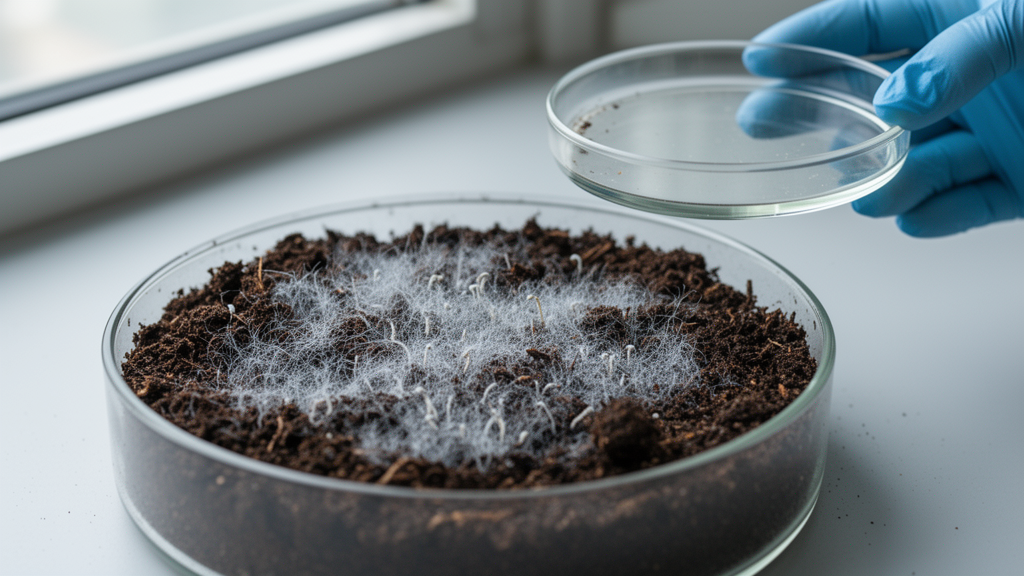
Deep in the soils of China, from the subtropical forests of Guangxi to the cold black earth of Heilongjiang, scientists have uncovered six previously unknown species of fungi, five in the genus Absidia and one in Gongronella. The discovery, published in the journal MycoKeys as the sixteenth installment of a long-running survey of early-diverging fungi in China, pushes the global species count of Absidia to 71 and Gongronella to 34, making the family Cunninghamellaceae one of the most species-rich lineages among the early-diverging fungal phylum Mucoromycota.
The new species were not found in remote wilderness alone but in ordinary soil samples collected during 2024 from six provinces and regions: Anhui, Fujian, Guangdong, Guangxi Zhuang Autonomous Region, Heilongjiang, and Hubei. Researchers followed established protocols, sealing each soil sample in plastic bags with precise records of collector, date, altitude, latitude, and longitude. Back in the laboratory, the samples were stored at 4 degrees Celsius until fungal isolation began using spread and streak plate methods on Rose Bengal Chloramphenicol Agar, a medium that suppresses bacterial growth while allowing fungal colonies to emerge.
Single spores were picked under a stereomicroscope and transferred onto Potato Dextrose Agar to establish pure cultures. Each strain was then subjected to a dual identification strategy combining classical morphology with molecular phylogenetics. Colonies were photographed, and microscopic structures such as sporangiophores, sporangia, columellae, apophyses, and spores were measured with Digimizer software. For DNA analysis, researchers extracted genomic DNA and amplified five genomic loci: the small subunit (SSU), internal transcribed spacer (ITS), large subunit (LSU) of ribosomal DNA, translation elongation factor 1-alpha (TEF1α), and actin (act). These markers were sequenced by Sanger method and aligned with MAFFT, trimmed with TrimAl, and concatenated in MEGA for phylogenetic reconstruction.
For the genus Absidia, the phylogenetic dataset comprised 152 strains, including 148 Absidia in-group taxa and four Cunninghamella out-group species, C. blakesleeana and C. elegans. The concatenated ITS-LSU-TEF1α-act-SSU alignment totaled 4,963 characters, of which 3,157 were constant, 1,518 parsimony-informative, and 288 parsimony-uninformative. Maximum Likelihood analysis on the CIPRES Science Gateway using RAxML-HPC with 1,000 bootstrap replicates under the GTR model, and Bayesian Inference with the GTR+I+G model sampling every 1,000 generations across twelve cold Markov chains for 50 million generations, produced trees with strong statistical support for the new species placements.
The results revealed distinct evolutionary relationships among the new Absidia species. Absidia guangxiensis, named for Guangxi, and A. heilongjiangensis, from Heilongjiang, formed a sister clade with maximum likelihood bootstrap support of 99 percent and Bayesian posterior probability of 1.0. Their pairwise identity values ranged from 91.5 percent for ITS to 100 percent for LSU, confirming they are closely related yet genetically distinct. Morphologically, A. guangxiensis grows faster at 14.3 to 15.0 millimeters per day, has wider hyphae and stolons, broader apophyses, and larger sporangiospores than its sister species.
Absidia heilongjiangensis, in contrast, grows more slowly at 11.8 to 12.5 millimeters per day and produces narrower sporangiophores and smaller spores. Absidia hubeiensis, from Hubei Province, is closely related to A. cylindrospora with 89 percent bootstrap support and 0.99 posterior probability, but differs in having a slower growth rate, shorter sporangiophores, larger sporangia, smaller columellae, and larger sporangiospores. Absidia longisporangiophora, whose name refers to its exceptionally long sporangiophores reaching up to 372.7 micrometers, and A. myceliosa, distinguished by luxuriant mycelia, are sister species with full phylogenetic support of 100 percent bootstrap and 1.0 posterior probability, yet differ dramatically in growth rate, hyphal width, and reproductive structure dimensions.
For Gongronella, the phylogenetic analysis used a dataset of 49 strains, with 48 Gongronella in-group taxa and Cunninghamella echinulata as the out-group. The concatenated ITS-LSU-act-TEF1α alignment totaled 3,052 characters. The new species Gongronella globospora, named for its globose sporangia, is closely related to G. chlamydospora with full support, but is morphologically distinguished by its spherical rather than pyriform sporangia, smaller columellae, and larger chlamydospores measuring 7.2 to 18.8 micrometers in diameter.
The six new species bring notable additions to a family with significant industrial and ecological value. Species of Absidia produce fatty acids, chitin, α-galactosidase, and other metabolites used in industry and medicine, and participate in wine fermentation and the biotransformation of natural products. Gongronella species secrete chitosanases for the chitosan industry, solubilize phosphate, degrade the fungicide metalaxyl, induce laccase production, and promote plant growth by providing phosphorus. Gongronella butleri w5, for example, regulates carbon allocation through a sucrose transporter protein that enhances nitrogen-fixing bacteria activity and releases volatile organic compounds that stimulate plant root development.
The soils from which these fungi emerged reflect extraordinary ecological diversity. Anhui has a transitional climate between warm temperate and subtropical zones with yellow-cinnamon and red soils; Fujian features subtropical maritime monsoon conditions with red and yellowish soils; Guangdong has strongly acidic red and lateritic soils; Guangxi contains acidic red soils enriched in iron and aluminum; Heilongjiang is characterized by fertile black and dark brown soils; and Hubei has diverse yellow-brown and yellow-cinnamon soil types. These varied climates and substrates support rich microbial communities that remain largely unexplored.
The discovery underscores how much fungal biodiversity remains hidden in plain sight, even in well-studied regions. The researchers suggest that future work should integrate morphological and molecular phylogenetic analyses to further reveal species richness, clarify taxonomic placement, and resolve evolutionary relationships among zygomycotan fungi. Genomic exploration could also enhance the application value of Cunninghamellaceae in industry, medicine, and agriculture, paving the way for biotechnological innovations from these newly described soil dwellers.
Subject of Research: biology
Article Title: Unveiling species diversity within early-diverging fungi from China XVI: Five new Absidia and a new Gongronella species ( Cunninghamellaceae , Mucoromycota )
Article References: Li, F., Zhang, R.-P., Fang, J.-N., Wang, X.-J., Zou, H.-Y., Geng, S.-T., Wang, S., Fang, Z.-M., & Liu, X.-Y. (2026). Unveiling species diversity within early-diverging fungi from China XVI: Five new Absidia and a new Gongronella species (Cunninghamellaceae, Mucoromycota). MycoKeys, 136, 193-216. https://doi.org/10.3897/mycokeys.136.201393
Image Credits: AI Generated
DOI: 10.3897/mycokeys.136.201393
Keywords: mycology, fungi, taxonomy, China, phylogenetics, biodiversity, Unveiling, species, diversity, within, early-diverging, Five
News Source: Roger Howard. (October 19, 2026). Six New Soil Fungi from China Expand the Cunninghamellaceae Family. Scienmag.