For millions of people who suffer from benign paroxysmal positional vertigo, or BPPV, the sudden, room-spinning bouts of dizziness triggered by simple head movements are only the beginning of the story. The condition, caused by tiny calcium carbonate crystals drifting into the fluid-filled semicircular canals of the inner ear, is usually treated successfully with canalith repositioning procedures, a series of precisely choreographed head maneuvers that guide the dislodged particles back to where they belong. Yet even after these maneuvers succeed, a frustrating shadow often remains. Roughly 43 percent of patients continue to experience what clinicians call residual dizziness, a persistent sense of unsteadiness, floating, or nonspecific vertigo that can erode quality of life, raise the risk of falls, and in some cases evolve into a chronic condition known as persistent postural-perceptual dizziness.
A new systematic review and meta-analysis published in Frontiers in Medicine suggests that a classical Chinese herbal strategy may offer these patients meaningful relief. Researchers from Dongzhimen Hospital at Beijing University of Chinese Medicine combed eight Chinese and English-language databases for randomized controlled trials testing what traditional Chinese medicine calls spleen-strengthening and phlegm-resolving therapy, or SSPR, against the stubborn dizziness that lingers after repositioning. Their search, covering records from database inception to May 5, 2026, initially retrieved 2,437 articles. After rigorous screening, 37 randomized controlled trials involving 2,794 participants made the final cut, all published in Chinese between 2016 and 2026. The team assessed methodological quality with the Cochrane Risk of Bias tool and pooled the data using random-effects models in RevMan 5.4 and Stata 18.0.
The results were strikingly consistent. When SSPR herbal therapy was compared directly with standard-of-care treatments such as betahistine, ginkgo biloba extracts, or vestibular rehabilitation, the herbal approach significantly reduced scores on the Dizziness Handicap Inventory, a validated 0-to-100 quality-of-life measure, with a mean difference of minus 9.24 points. It also lowered visual analogue scale ratings of dizziness intensity by 1.32 points on average and reduced traditional Chinese medicine syndrome scores with a standardized mean difference of minus 1.84. Beyond the symptom scales, patients receiving herbal therapy achieved higher rates of complete dizziness resolution and better overall clinical effectiveness than those on conventional care alone.
Perhaps even more intriguing were the findings for combination therapy. When SSPR formulas were added to standard treatment, the combined approach outperformed standard care alone on every outcome the researchers evaluated. The Dizziness Handicap Inventory fell by an additional 9.33 points, visual analogue scores dropped by a further 1.39 points, and dizziness resolution rates rose by a factor of 1.66 compared with conventional treatment alone. Most notably, at the six-month follow-up, the recurrence rate in the combination group was just 4.24 percent, versus 14.97 percent among patients receiving only standard care, a relative risk of 0.35 that suggests the herbal strategy may help keep the disabling symptom from coming back.
The numbers carry real clinical weight. Previous research has established that a reduction of at least 18 points on the Dizziness Handicap Inventory represents the minimum clinically important difference, while a more recent analysis suggested that patients begin to perceive meaningful change at around an 11-point reduction. The meta-analysis found that SSPR therapy consistently cut DHI scores by approximately 9 to 11 points, whether used alone or in combination with conventional medicine, approaching that patient-perceived threshold. In subgroup analyses, when the herbal therapy replaced regimens containing central psychotropic drugs, the reduction reached 11.35 points, and when combined with vestibular rehabilitation plus Western medicine, the advantage over standard treatment climbed to more than 20 points.
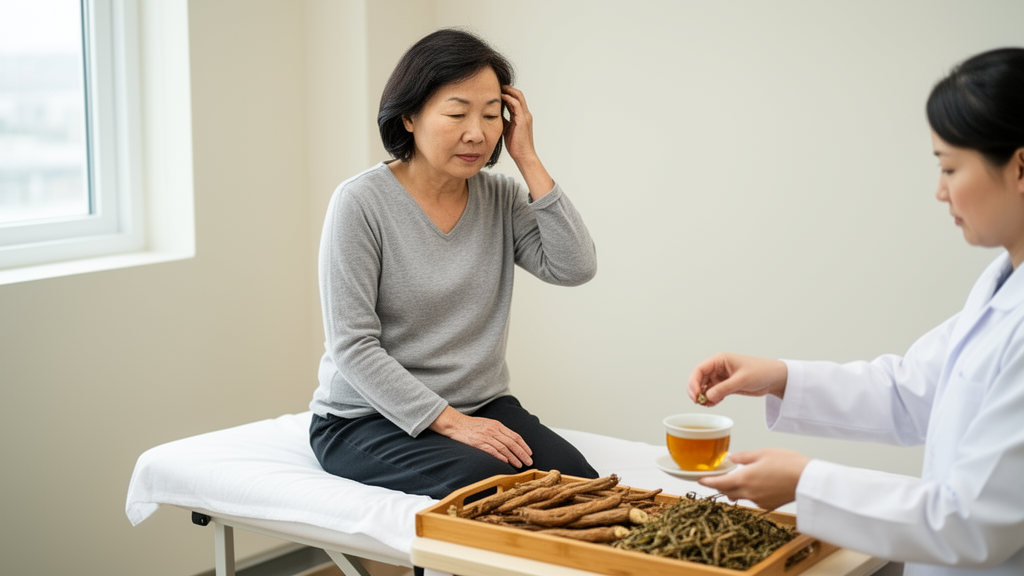
The therapy itself is rooted in a centuries-old theoretical framework. In traditional Chinese medicine, residual dizziness falls under the category of vertigo, and classical physicians held that neither deficiency nor phlegm should be overlooked. The influential Ming dynasty physician Zhang Jingyue declared that no dizziness arises without deficiency, while his contemporary Zhu Danxi countered that no dizziness arises without phlegm. According to this model, a weakened spleen fails to transform fluids, allowing dampness to condense into a pathological substance called phlegm-turbidity, which is heavy and viscous and blocks the clear yang from ascending to nourish the sensory orifices, producing dizziness and unsteady gait. The SSPR strategy aims to fortify the spleen to cut off the source of phlegm production while simultaneously resolving the phlegm that has already accumulated.
The prescription patterns identified across the 37 trials reveal a remarkably coherent herbal core. Among the 69 distinct herbs used, the five most frequently appearing were Pinelliae Rhizoma, known as Banxia, which appeared 34 times; liquorice root, or Gancao, and Atractylodis Macrocephalae Rhizoma, known as Baizhu, each appearing 31 times; Poria, or Fuling, appearing 30 times; and Gastrodiae Rhizoma, or Tianma, appearing 28 times. Those five herbs are precisely the constituents of Banxia Baizhu Tianma Decoction, a foundational formula for resolving phlegm, extinguishing internal wind, and strengthening the spleen. Warm-natured herbs dominated the prescriptions, appearing 182 times, in keeping with the classical instruction that phlegm-fluid disorders should be harmonized using warm herbs to activate yang qi and assist the spleen’s transformative work.
Modern pharmacology offers tentative mechanistic explanations for why these botanicals might help a vestibular disorder. Network pharmacology studies indicate that the Fuling-Baizhu herb pair may act through calcium and estrogen signaling pathways to modulate inner ear microcirculation and reduce the risk of otolith dislocation. Alkaloids from Banxia appear to damp neuronal hyperexcitability through gamma-aminobutyric acid, or GABA, signaling, and also show anxiolytic effects, while extracts of the herb reduce oxidative stress and may help restore the vestibular microenvironment. Tianma’s active components likewise elevate GABA levels and have demonstrated anti-vertigo, antidepressant, and circulatory effects, enhancing recovery in animal models of vestibular dysfunction. Traditional theory also maps phlegm-turbidity onto abnormal blood rheology, and studies of Banxia Baizhu Tianma Decoction show it can regulate blood lipids and the vasoactive factors endothelin-1 and calcitonin gene-related peptide, potentially improving inner ear blood flow.
Safety data, however, remain the soft underbelly of the evidence. Twenty-four of the included trials mentioned adverse events, fourteen of which reported none in either group. Among the ten trials that documented adverse events, the effects were predominantly mild gastrointestinal complaints such as nausea, abdominal distension, and diarrhea, and no severe adverse events were recorded anywhere in the dataset. Statistically, SSPR therapy showed no significant difference in adverse event rates compared with no intervention, placebo, or standard care, and combining it with conventional treatment raised the incidence only negligibly. Yet the review’s authors are candid that this apparent safety rests on incomplete and possibly underreported data, with low event counts and inconsistent adverse event documentation across the included studies, leaving the true safety profile uncertain.
That caveat is emblematic of the broader limitations the researchers themselves acknowledge. All 37 trials were conducted in China, raising questions about generalizability to other populations. Only 25 trials described their randomization methods, just 7 employed allocation concealment, and none of the studies reporting dropouts used intention-to-treat analysis, contributing to elevated risk-of-bias assessments in a substantial portion of the evidence base. Under the GRADE framework, most outcomes were downgraded one or two levels, yielding evidence of low or very low certainty for many comparisons, with only a handful of outcomes, such as DHI in the combination analysis and visual analogue scores, reaching moderate quality. Publication bias signals also emerged for some secondary outcomes like traditional Chinese medicine syndrome scores and clinical effective rates, likely reflecting heterogeneous rating scales and subjective evaluation criteria. The authors conclude that SSPR therapy shows genuine potential both as an alternative for patients who respond poorly to conventional regimens and as an adjunct that may reduce recurrence, but they call for high-quality, large-sample, adequately blinded randomized trials with objective vestibular outcome measures before the therapy can be firmly recommended. For now, an ancient prescription for phlegm and a weakened spleen has earned a place on the modern research agenda, even if the final verdict on this herbal remedy for stubborn dizziness is still awaiting its most rigorous test.
Subject of Research: Efficacy and safety of spleen-strengthening and phlegm-resolving herbal therapy for residual dizziness after canalith repositioning in benign paroxysmal positional vertigo
Article Title: Efficacy and safety of spleen-strengthening and phlegm-resolving herbal therapy for residual dizziness after repositioning of benign paroxysmal positional vertigo: a systematic review and meta-analysis of randomized controlled trials
Article References: Zhang, Y., Sun, Y., Li, Q., Li, Q., Du, Y., Zhang, B., & Wu, S. (2026). Efficacy and safety of spleen-strengthening and phlegm-resolving herbal therapy for residual dizziness after repositioning of benign paroxysmal positional vertigo: a systematic review and meta-analysis of randomized controlled trials. Frontiers in Medicine, 13, Article 1949948. https://doi.org/10.3389/fmed.2026.1949948
Image Credits: AI Generated
DOI: 10.3389/fmed.2026.1949948
Keywords: benign paroxysmal positional vertigo, residual dizziness, traditional Chinese medicine, spleen-strengthening and phlegm-resolving therapy, meta-analysis, randomized controlled trials, canalith repositioning, Dizziness Handicap Inventory, vestibular rehabilitation, herbal medicine, recurrence rate, GRADE evidence certainty
News Source: Ophelia Keating. (October 19, 2026). Chinese Herbal Therapy Shows Promise for Lingering Dizziness After Vertigo Treatment, Meta-Analysis Finds. Scienmag.