A routine respiratory infection caused by Rhinovirus/Enterovirus, the group of viruses best known for producing the common cold, set off a life-threatening cascade in a previously healthy 14-year-old boy, according to a case report published in Frontiers in Pediatrics. The infection precipitated atypical hemolytic uremic syndrome, a rare complement-driven disorder in which the immune system’s attack machinery turns against the body’s own blood vessels. What makes the case extraordinary is not the kidney failure, which is the disease’s hallmark, but the extent of the skin damage: hemorrhagic blisters and dying tissue across the boy’s neck, armpit, and back that refused to heal despite aggressive drug therapy, ultimately forcing surgeons to cut away the necrotic tissue and close the wounds.
Atypical hemolytic uremic syndrome, abbreviated aHUS, belongs to a family of conditions called thrombotic microangiopathies. In these disorders, tiny blood clots form throughout the microvasculature, shearing red blood cells apart as they squeeze through partially blocked vessels and consuming platelets along the way. The classic diagnostic triad consists of Coombs-negative microangiopathic hemolytic anemia, thrombocytopenia, and acute kidney injury, often accompanied by blood and protein in the urine. While the kidneys bear the brunt of the injury, the disease can also strike the central nervous system, gastrointestinal tract, and heart. Skin involvement is documented but distinctly uncommon, and progression to hemorrhagic bullae and full-thickness necrosis is rarer still, particularly in children.
The boy arrived at the hospital in May 2024 with three days of vomiting, diarrhea, limb numbness, and weakness. Three weeks earlier he had developed a paroxysmal dry cough, followed about a week later by a low-grade fever between 37.5 and 38.3 degrees Celsius. Outpatient treatment with cefaclor, dextromethorphan, and ambroxol had brought no clear improvement. On admission he was febrile and hypertensive, with a hemoglobin of 79 grams per liter, a platelet count of 94 × 10⁹ per liter, and a serum creatinine of 175 micromoles per liter, a level indicating substantial kidney injury. Markers of inflammation were sharply elevated, with C-reactive protein at 122.2 milligrams per liter and procalcitonin at 11.27 nanograms per milliliter. Nucleic acid testing identified Rhinovirus/Enterovirus in respiratory samples, and chest computed tomography revealed an infiltrative lesion in the left upper lung lobe.
Distinguishing aHUS from its mimics is a diagnostic exercise in exclusion, and the clinical team worked through the differential systematically. A peripheral blood smear showed schistocytes, the fragmented red cells that signal microangiopathic hemolysis. Stool testing for Shiga toxin-producing Escherichia coli, the cause of typical post-diarrheal hemolytic uremic syndrome, came back negative, as did blood next-generation sequencing and autoimmune serologies. ADAMTS13 activity, which collapses toward zero in thrombotic thrombocytopenic purpura, was preserved. The complement workup told a different story: C3 and factor I were markedly depleted, and soluble C5b-9, the soluble form of the membrane attack complex, was significantly elevated. Together these findings pointed to runaway activation of the alternative complement pathway. Whole-exome sequencing, however, identified no pathogenic variant associated with aHUS, underscoring that current genetic panels miss a portion of clinically relevant complement abnormalities.
The underlying biology follows what researchers describe as a multi-hit model. The alternative complement pathway is constitutively active at a low level and depends on strict regulation by proteins such as factor H, factor I, and membrane cofactor protein CD46 to prevent it from damaging the body’s own endothelium. Roughly 60 percent of aHUS patients carry complement gene mutations or anti-factor H antibodies, yet about 5 percent of healthy people carry associated complement mutations as well. Penetrance within families is low, estimated near 10 percent among carriers of the same pathogenic mutation. In other words, the mutation confers susceptibility rather than certainty, and a second inflammatory hit, most often an infection in childhood, is needed to tip the balance into overt disease. Respiratory pathogens including influenza and SARS-CoV-2 have been implicated as triggers, but Rhinovirus/Enterovirus has rarely been reported in this role. A 2023 report by Jason Diep and colleagues described recurrent aHUS triggered by Rhinovirus/Enterovirus in a patient carrying a CFHR1/CFHR3 gene deletion, making the present case one of only a handful linking this ubiquitous viral group to the syndrome.
Treatment began with high-dose methylprednisolone pulse therapy, eculizumab, therapeutic plasma exchange, and continuous renal replacement therapy, supplemented by antihypertensive drugs, intravenous immunoglobulin, and plasma infusion. Eculizumab, a monoclonal antibody that blocks cleavage of complement component C5, has transformed aHUS outcomes by preventing formation of the terminal complement complex, and early administration is associated with better renal recovery. The boy ultimately received four plasma exchange sessions and four eculizumab doses. His kidney function recovered, but the hematologic abnormalities lagged behind: weeks into the illness his platelet count remained at 44 × 10⁹ per liter and hemoglobin at 72 grams per liter, with C3 still depressed.
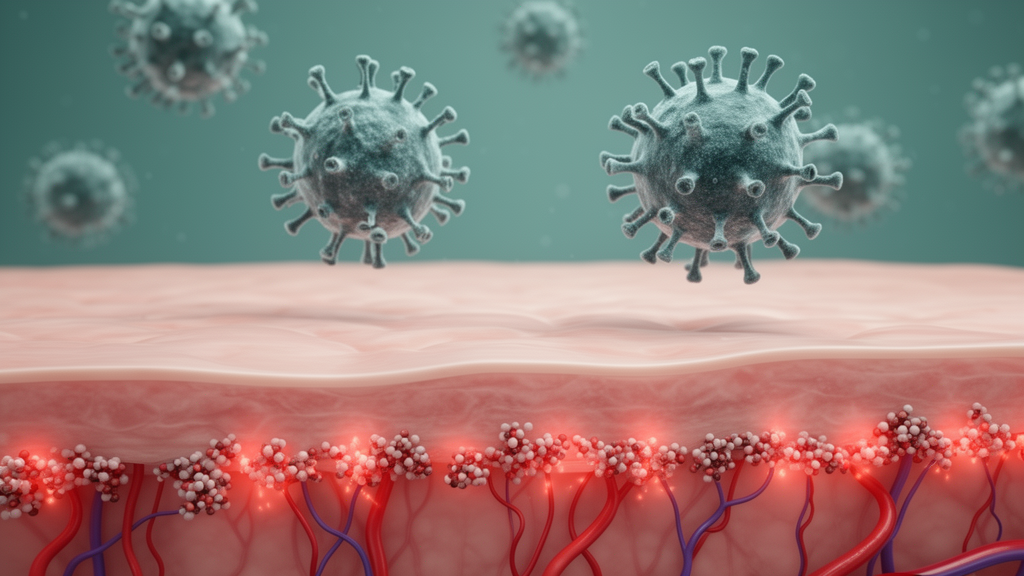
Then the skin lesions appeared. Roughly two weeks after disease onset, ecchymoses spread across his trunk, and within another week hemorrhagic bullae erupted in the left axilla, posterior neck, and back before evolving into necrotic wounds. Coagulation testing showed markedly prolonged prothrombin and activated partial thromboplastin times with substantial elevation of fibrin degradation products and D-dimer, and low-molecular-weight heparin was added alongside local wound dressings. The mechanism behind such dramatic cutaneous injury is well mapped in principle: uncontrolled C3b generation drives formation of C3 and C5 convertases, culminating in membrane attack complex deposition on endothelial surfaces. Endothelial swelling, loss of antithrombotic integrity, and platelet activation follow, producing microvascular thrombosis. The anaphylatoxin C5a additionally induces tissue factor expression on neutrophils and endothelial cells, directly linking complement activation to the coagulation cascade and amplifying thrombus formation throughout the skin’s microvasculature.
With the necrotic areas failing to heal, platelet consumption continuing, and infection risk climbing, the team concluded that devitalized tissue had become an active driver of morbidity rather than a passive consequence of systemic disease. At approximately ten weeks after admission, once the platelet count had climbed from 44 to 81 × 10⁹ per liter, surgeons debrided and sutured all three wounds. Intraoperative blood loss was about 60 milliliters, and the patient received one unit each of packed red cells and platelets. Because corticosteroid therapy had caused skin fragility and dermal atrophy, the team used full-thickness horizontal mattress sutures to reduce wound-edge tension and prevent tissue tearing. Low-molecular-weight heparin was withheld 12 hours before surgery in line with American Society of Regional Anesthesia and Pain Medicine recommendations, and published evidence suggests such anticoagulation has not been clearly associated with increased bleeding complications in dermatologic surgery. Histopathologic examination of the excised tissue confirmed skin necrosis with microvascular thrombosis, establishing the diagnosis of cutaneous thrombotic microangiopathy.
The postoperative course was strikingly favorable. Two weeks after surgery the platelet count had risen to 205 × 10⁹ per liter, hemoglobin reached 90 grams per liter, and serum C3 normalized. No bleeding, wound infection, or dehiscence occurred, sutures were removed at three weeks, and the wounds healed without complication. At the most recent follow-up the boy had returned to regular school and age-appropriate physical activity, with soft, flat, well-matured scars, no sensory deficit, and normal results on ambulatory blood pressure monitoring, blood counts, urinalysis, chemistry, coagulation studies, and cardiac and abdominal ultrasound.
The authors are careful about the limits of a single case. Causality between the viral infection and aHUS rests on temporal association and the exclusion of other etiologies, the negative whole-exome sequencing leaves the genetic substrate unidentified, and the parallel administration of multiple therapies makes it impossible to attribute recovery to any single intervention. They also caution that the apparent improvement in platelet count and complement levels after debridement, while suggestive that removing necrotic tissue interrupted local consumption and inflammatory activation, cannot be proven causal in one patient. Even so, the report carries a practical message for clinicians managing complement-mediated disease: when necrotic cutaneous thrombotic microangiopathy persists despite eculizumab, plasma exchange, and anticoagulation, timely surgical debridement, planned around platelet thresholds and perioperative anticoagulation guidelines, can be an effective adjunct rather than a last resort.
Subject of Research: Rhinovirus/Enterovirus-triggered atypical hemolytic uremic syndrome with cutaneous thrombotic microangiopathy requiring surgical management in an adolescent
Article Title: Case Report: Atypical hemolytic uremic syndrome triggered by Rhinovirus/Enterovirus infection with cutaneous thrombotic microangiopathy requiring surgical management
Article References: Shen, J., Cai, K., Kang, W., He, Q., Zhang, J., & Yin, L. (2026). Case Report: Atypical hemolytic uremic syndrome triggered by Rhinovirus/Enterovirus infection with cutaneous thrombotic microangiopathy requiring surgical management. Frontiers in Pediatrics, 14, Article 1973640. https://doi.org/10.3389/fped.2026.1973640
Image Credits: AI Generated
DOI: 10.3389/fped.2026.1973640
Keywords: atypical hemolytic uremic syndrome, complement dysregulation, thrombotic microangiopathy, Rhinovirus/Enterovirus, eculizumab, cutaneous necrosis, surgical debridement, pediatric nephrology, C5b-9, therapeutic plasma exchange, Case, Report
News Source: Ophelia Keating. (October 19, 2026). Common Cold Virus Triggers Rare Complement Disease Requiring Skin Surgery in Teenager. Scienmag.