Deep in the temperate and oak-dominated forests of Bajaur District in Khyber Pakhtunkhwa, northern Pakistan, mycologists have identified two mushrooms that turn out to be entirely new to science. The species, named Rhodophana pakistanica and Rhodophana bajaurica, belong to the family Entolomataceae and were formally described in the journal MycoKeys after an investigation that combined field collection, high-resolution microscopy, and a four-gene DNA analysis. The discovery raises the number of Rhodophana species known from Pakistan from two to four and adds weight to the idea that the country’s northwestern forests remain one of the least explored fungal frontiers in South Asia.
Rhodophana is a small but globally distributed genus of agaric fungi first introduced by Robert Kühner and characterized by clitocyboid fruiting bodies with gills that attach to the stipe in an adnexed to adnate fashion. Its most diagnostic features, however, lie beyond the reach of the naked eye: the basidiospores are conspicuously undulate to pustulate, often showing minute angular outlines when viewed in polar orientation, and clamp connections are abundant throughout the hyphal system. These traits separate Rhodophana from its close relative Rhodocybe, which shares similar fruiting-body shapes and spore architecture but lacks the profusion of clamps. Multigene phylogenetics has repeatedly confirmed that Rhodophana forms a distinct, well-supported lineage within the Clitopilus and Rhodocybe clade of the Entolomataceae, and roughly twenty species are currently recorded in Index Fungorum across Africa, the Americas, Europe, Asia, and Oceania.
The fieldwork behind the new species began during the monsoon season of August 2024, when specimens were collected at sites including Mana Barang, Loy Mamond, Gabar Chena, and Batwar in District Bajaur, at elevations between roughly 1,167 and 1,540 meters. Field photographs were taken on site and colors were scored against the Munsell Soil Color Chart before the specimens were dried at 45 degrees Celsius and deposited in the Islamia Herbarium in Peshawar. Bajaur District had previously yielded only two recorded mushroom species of any kind, making the recognition of two novel Rhodophana taxa in a single study a striking indicator of how much undocumented diversity may persist in the region’s forest soils.
In the laboratory, the team rehydrated tissue samples in distilled water and 5 percent potassium hydroxide, stained them with 1 percent Congo Red, and measured twenty-five basidiospores, basidia, and cheilocystidia per collection using calibrated Piximètre software coupled to a compound microscope. Scanning electron microscopy, performed at the University of Peshawar, revealed the fine sculpturing of the spore walls, the single most important microscopic character for separating entolomatoid genera. The spores of both new species are broadly ellipsoid to sub-globose, clearly echinulate to verrucose with irregular blunt ornamentations, and carry a central oil droplet.
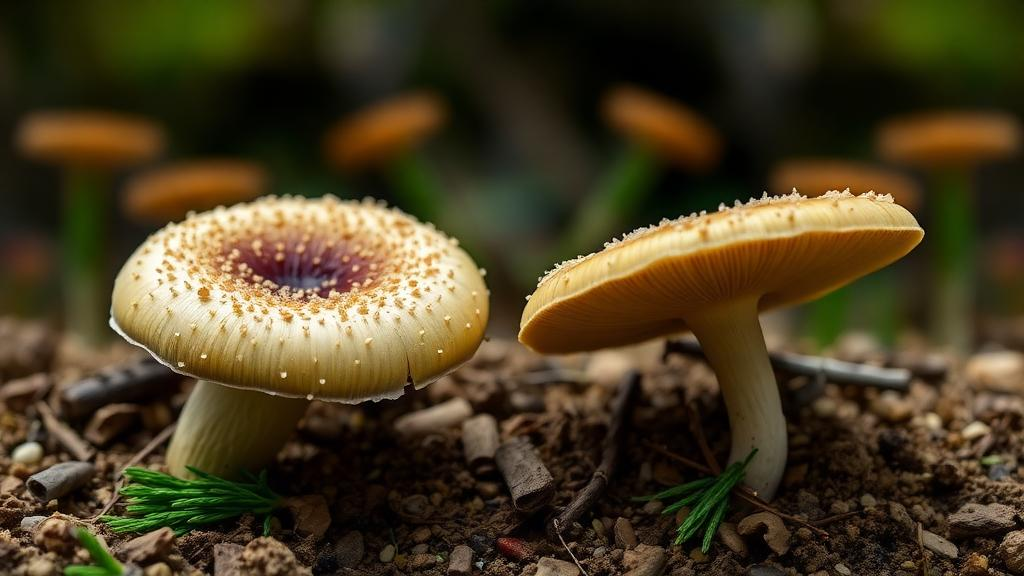
Rhodophana bajaurica is a small mushroom, producing caps only 7 to 18 millimeters across that are deep reddish-brown to dark cinnamon, paler toward the margin, with a velvety to densely tomentose surface that lacks the differentiated scales seen in some relatives. Its gills are adnate to slightly adnexed and crowded, pale orange to light salmon when young and deepening to orange-brown with maturity, while the slender stipe measures 24 to 26 by 2 to 4 millimeters. Microscopically, the species is defined by comparatively large, thin-walled basidiospores averaging 9.7 by 6.05 micrometers and by abundant cheilocystidia, the sterile cells lining the gill edges, which are clavate, lageniform to narrowly utriform, with rounded to slightly swollen apices. Pleurocystidia are absent, and clamp connections thread through every tissue.
Rhodophana pakistanica, collected specifically in oak-dominated forest, is similar in stature but differs in telling details. Its caps, 10 to 20 millimeters wide, bear a dark reddish-brown disc with a smooth to faintly fibrillose surface, and the crowded gills are adnate to slightly decurrent, maturing from pale brown to dark brown. Its basidiospores average 8.5 by 5.5 micrometers and are thick-walled, pale greenish to hyaline in potassium hydroxide, and its cheilocystidia are smaller than those of its sister species. The pileipellis is a cutis to subcutis of loosely interwoven, cylindrical hyphae with elongated terminal cells, again with clamps present throughout. These morphological contrasts, though subtle, align perfectly with genetic distances measured across the genome regions sampled.
That genetic evidence is the backbone of the study. The researchers generated sixteen new sequences and combined them with 137 retrieved from GenBank, aligning the internal transcribed spacer and 28S large subunit of nuclear ribosomal DNA together with the protein-coding RPB2 and TEF1-α genes. The GTR+I+G substitution model was selected with jModelTest, and the team ran maximum likelihood analyses in RAxML with 1,000 rapid bootstrap replicates alongside Bayesian inference in MrBayes using two independent runs of four Monte Carlo chains for ten million generations. The result was unambiguous: the Pakistani specimens resolved into two distinct clades with maximal statistical support of 100 percent bootstrap and 1.00 posterior probability, and the two new species emerged as sister lineages to each other, together related to the Indian species R. squamulosa and to unpublished Rhodophana sequences.
The new descriptions also shed light on a long-running headache in Rhodophana taxonomy. The genus’s type concept, R. nitellina, remains unstable because of marked phenotypic plasticity, poorly circumscribed diagnostic characters, and the absence of molecular data from a confirmed type specimen. Numerous GenBank accessions labeled as R. nitellina are phylogenetically scattered across multiple clades within the genus, a signature of widespread misidentification and annotation errors in public databases. The authors argue that typification-based molecular reassessment, supported by integrative multilocus and ultimately genomic approaches, is urgently needed to stabilize species boundaries across the genus, and they position their new species descriptions as a step toward that cleaner framework.
Ecologically, both species were observed as solitary to gregarious fruitings in the forest ecosystems of Bajaur, with R. pakistanica showing a specific association with oak-dominated stands. Their terrestrial habit on organic-rich forest soil suggests a role in litter decomposition and nutrient cycling, the unseen work that saprotrophic agarics perform in keeping temperate forests functioning. The researchers note that these habitat associations provide ecological corroboration of the two taxa’s separation and enrich understanding of Rhodophana diversity in northwestern Pakistan, a region where formal mycological documentation has barely begun.
For a genus with roughly twenty named species worldwide, seven of them already endemic to Asia, the addition of two well-supported Pakistani taxa is more than a technical footnote. It strengthens the case that the Hindu Kush and Himalayan foothills harbor a distinct regional radiation of Rhodophana, and it underscores how quickly baseline knowledge can advance when molecular tools are brought to previously unexplored terrain. With broader sampling, DNA barcoding of type specimens, and continued exploration of districts like Bajaur, mycologists expect many more species from these forests to cross the line from unnamed field collections to formally recognized members of the fungal tree of life.
Subject of Research: Taxonomic description and multigene phylogenetic analysis of two new Rhodophana mushroom species from northern Pakistan
Article Title: Two novel species of Rhodophana ( Entolomataceae ) from Pakistan
Article References: Ullah, M., Wang, M., Saba, M., Zheng, D., Rehman, U., Shah, S. M. T. A., Ullah, S., Ahmad, I., Asif, M., Dai, D.-Q., Hakki, E. E., Tarafder, E., Tibpromma, S., & Karunarathna, S. C. (2026). Two novel species of Rhodophana (Entolomataceae) from Pakistan. MycoKeys, 137, 1-20. https://doi.org/10.3897/mycokeys.137.199549
Image Credits: AI Generated
DOI: 10.3897/mycokeys.137.199549
Keywords: Rhodophana, Entolomataceae, new species, Pakistan, mycology, molecular phylogenetics, Bajaur District, ITS, basidiospores, fungal taxonomy, Khyber Pakhtunkhwa, forest fungi
News Source: Roger Howard. (October 19, 2026). Two New Mushroom Species Unearthed in Pakistan’s Unexplored Bajaur Forests. Scienmag.